

Check the Available SRAN-Radio-Network-Performance-Optimization Exam Dumps with 32 QA's UPDATED 2026
Download SRAN-Radio-Network-Performance-Optimization Exam Dumps Questions to get 100% Success in Nokia
NEW QUESTION # 14
Choose the correct statement from the options below.
- A. Beamforming and MIMO cannot be used together.
- B. MIMO focuses on directing the signal, while beamforming focuses on utilizing multiple paths for data transmission.
- C. Beamforming and MIMO are the same.
- D. Beamforming focuses on directing the signal, while MIMO focuses on utilizing multiple paths for data transmission.
Answer: D
Explanation:
The correct answer is B .
Beamforming is mainly about shaping and directing radio energy toward a UE or a target area. It improves coverage, SINR, and cell-edge performance by focusing the transmitted or received signal in a specific direction.
MIMO , or Multiple Input Multiple Output , uses multiple antenna paths to improve throughput, reliability, and spectral efficiency. MIMO can be used for spatial multiplexing, diversity, or beamforming depending on the antenna system and radio configuration.
Option A is incorrect because beamforming and MIMO are related but not the same.
Option C reverses the definitions.
Option D is incorrect because beamforming and MIMO are commonly used together, especially in Massive MIMO systems.
So the correct statement is:
Beamforming focuses on directing the signal, while MIMO focuses on utilizing multiple paths for data transmission.
NEW QUESTION # 15
In a 5G cell , the following parameter has been modified: lowLatencyReservation = 15 .
Which percentage of UEs will be reallocated to a higher SR periodicity group whenever the threshold for moving to a higher SR periodicity group is reached?
- A. 1.00
- B. 0.85
- C. 0.15
- D. 0.50
Answer: B
Explanation:
The correct answer is C .
In 5G uplink scheduling, SR , or Scheduling Request , is used by the UE to request uplink resources when it has data to send. SR periodicity affects uplink latency and PUCCH capacity: shorter SR periodicity gives lower latency but consumes more control-channel resources, while longer SR periodicity saves resources but increases delay.
The parameter lowLatencyReservation = 15 means 15% of the UE/resource share is reserved for the low- latency SR periodicity group. When the load threshold is reached, the remaining portion can be moved to a higher SR periodicity group.
Calculation:
100% # 15% = 85%
So the percentage of UEs that can be reallocated to a higher SR periodicity group is:
0.85 , or 85% .
NEW QUESTION # 16
Which statement is not true about MantaRay SON ?
- A. Energy savings management is not covered.
- B. It supports multi-vendor and multi-technology RAN.
- C. It has an open framework for module development.
- D. It was previously known as EdenNet SON.
Answer: A
Explanation:
The correct answer is B .
The statement "Energy savings management is not covered" is not true . Nokia describes MantaRay SON as supporting radio network performance, quality, and energy efficiency optimization. Nokia also references AI-powered energy savings management and RAN energy efficiency use cases under its SON/MantaRay automation portfolio.
The other statements are aligned with Nokia SON/MantaRay positioning. Nokia describes MantaRay SON as an automation layer within the MantaRay SMO framework, with support for multi-supplier/non-real-time RIC functionality and an application ecosystem. Nokia also has historical EdenNet SON material, including EdenNet SON Energy Saving Management.
Therefore, the statement that is not true is:
Energy savings management is not covered.
NEW QUESTION # 17
Which of the following statements does not apply to mmWave radio propagation ?
- A. Foliage and vegetation attenuation is high.
- B. Diffraction loss increases with frequency.
- C. Building penetration losses at mmWave frequencies can prevent practical outdoor-to-indoor coverage solutions.
- D. Water absorption is low at high frequencies.
Answer: D
Explanation:
The correct answer is C .
At mmWave / FR2 frequencies , radio propagation is more challenging than in low-band or mid-band spectrum. Diffraction becomes weaker, blockage is more severe, foliage attenuation is high, and building penetration loss is significant. This is why mmWave networks usually require dense site grids, line-of-sight or near-line-of-sight paths, and strong beamforming. Industry mmWave references consistently describe high path loss, high penetration loss, and the need for directional antenna systems to compensate for these losses.
Option C does not apply because water absorption and atmospheric absorption generally become more relevant at higher frequencies, not lower. Rain, humidity, and oxygen/water-vapor absorption are important considerations for mmWave link budgets.
So the statement that does not apply to mmWave propagation is:
Low water absorption at high frequencies.
NEW QUESTION # 18
Which port must be opened in NetAct for the connection from TraceSynthesis to NetAct?
- A. 0
- B. 1
- C. 2
- D. 3
Answer: D
Explanation:
The correct answer is B .
The connection from TraceSynthesis to NetAct is typically based on secure web/API communication, which uses HTTPS . The standard HTTPS port is 443 . Therefore, port 443 must be opened in NetAct/firewall rules to allow TraceSynthesis to communicate with NetAct.
The other options are not the best answer:
8443 is often used as an alternative HTTPS/application-server port, but it is not the standard answer here.
22 is used for SSH, mainly for secure shell access or file transfer.
8080 is commonly used for unsecured HTTP or proxy/application access, not the secure NetAct connection expected here.
So the required port is:
443.
NEW QUESTION # 19
In a high-mobility network, the maximum cell size must be restricted to 33 km . Which PRACH format and restricted-set type should be used?
- A. Format 0 / Type B
- B. Format 1 / Type A
- C. Format 1 / Type B
- D. Format 2 / Unrestricted Type
Answer: C
NEW QUESTION # 20
The CB009425 feature provides several enhancements to improve the transmission link budget for VoNR, offering a better customer experience. Which statements are correct regarding this feature?
- A. B and C
- B. A, B, and C
- C. A, B, C, and D
- D. Packet Loss Rate, or PLR, for VoNR is minimized, improving voice call quality.
- E. MCS downgrade control is used for VoNR DRBs.
- F. Specific initial BLER targets are used for VoNR DRBs.
- G. A only
- H. Configurable uplink minimum TBS is used for VoNR DRBs.
Answer: E
Explanation:
The correct answer is D.
The feature is focused on improving VoNR link robustness and user experience, especially near the cell edge or in difficult RF conditions. VoNR is sensitive to packet loss, delay, and uplink coverage limitations.
Therefore, link-budget improvement features commonly target BLER behavior, transport block sizing, and MCS robustness.
Statement A is correct because minimizing Packet Loss Rate, or PLR, directly improves VoNR speech quality and reduces mute, clipping, or robotic voice effects.
Statement B is correct because VoNR bearers can use specific initial BLER targets. A more suitable BLER target helps the scheduler choose a more robust MCS for voice traffic.
Statement C is correct because a configurable uplink minimum TBS, or Transport Block Size, helps ensure that small VoNR packets are transmitted efficiently and reliably.
Statement D is correct because MCS downgrade control can improve robustness by selecting a more conservative modulation and coding scheme for VoNR DRBs when radio conditions require it.
Therefore, all listed enhancements are part of the VoNR link-budget improvement concept:
A, B, C, and D.
NEW QUESTION # 21
Evaluate the impact of using MantaRay SON's centralized PCI optimization module compared to distributed SON implementations.
- A. Centralized PCI optimization can identify and resolve PCI issues across multi-vendor networks.
- B. Distributed SON implementations are more effective in handling multi-vendor networks.
- C. Centralized PCI optimization offers less visibility into network configuration.
- D. Distributed SON implementations provide better optimization benefits.
Answer: A
Explanation:
The correct answer is C .
A centralized SON approach has broader network-level visibility than a purely distributed implementation.
For PCI optimization , this is important because PCI conflicts, PCI confusion, and neighbor-related PCI issues are not always local to one cell. They may involve several neighboring cells, multiple layers, and sometimes multiple vendors.
Nokia positions MantaRay SON as a centralized, AI-powered network optimization and automation platform for improving RAN quality, efficiency, and customer experience. Nokia also describes MantaRay SON as supporting multi-supplier/non-real-time RIC functionality in the MantaRay SMO framework.
So compared with distributed SON, centralized PCI optimization can better analyze wider-area PCI relationships and resolve PCI problems across multi-vendor or multi-layer networks.
Therefore, the correct statement is:
Centralized PCI optimization can identify and resolve PCI issues across multi-vendor networks.
NEW QUESTION # 22
At which mark are all conditions fulfilled for energy saving , so the cell will be switched off? Refer to the image below.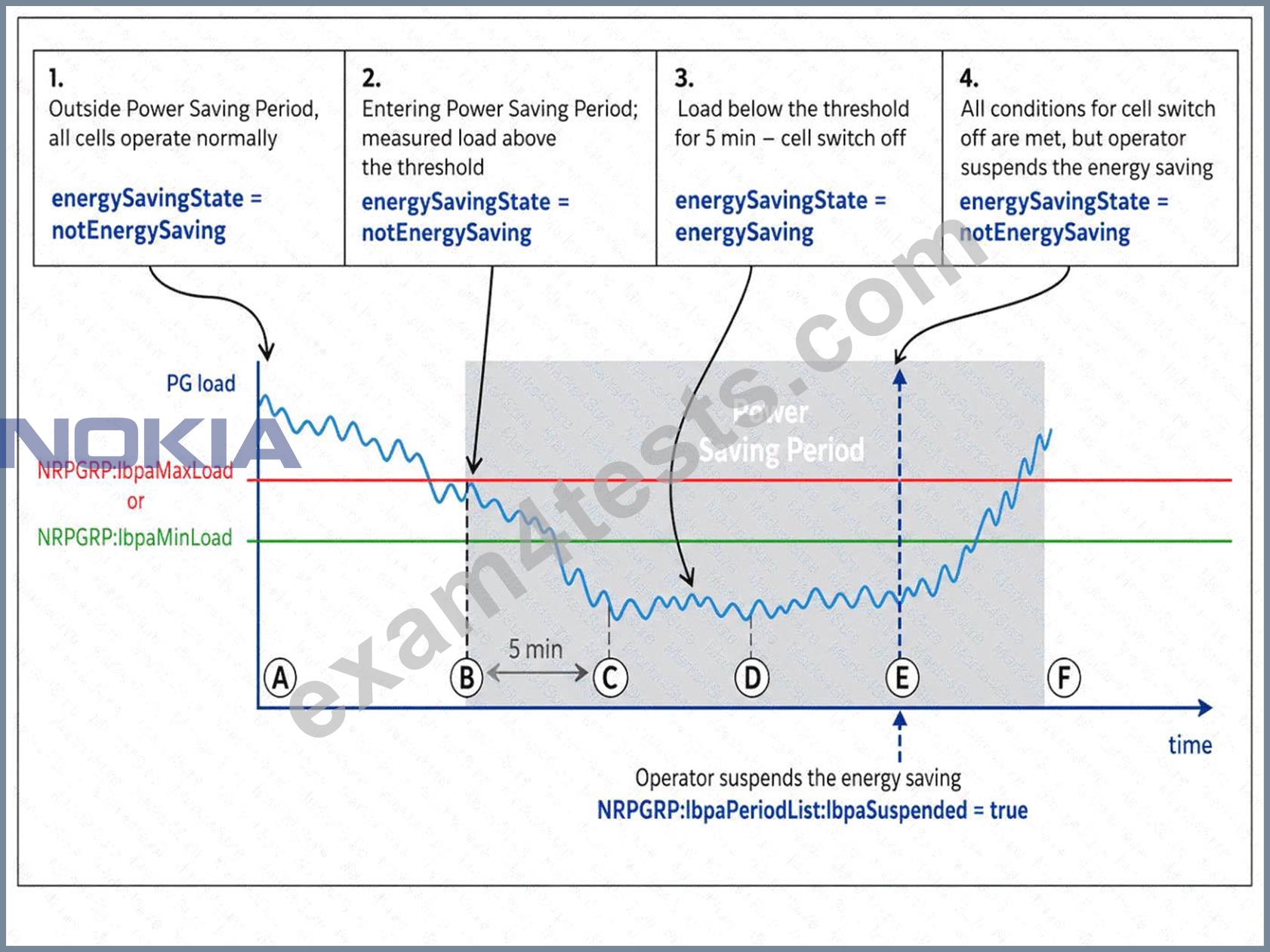
- A. B
- B. D
- C. E
- D. C
Answer: D
Explanation:
The correct answer is B , which corresponds to mark C in the diagram.
In the diagram, the energy-saving process follows these stages:
Before mark B , the cell is entering the power-saving period, but the required load condition has not yet been satisfied for the required duration.
At mark B , the measured load has gone below the configured threshold, but the cell is not switched off immediately. The system must confirm that the load remains below the required threshold for the configured time.
At mark C , the load has stayed below the required threshold for the required duration, shown as 5 minutes in the diagram. At this point, all conditions are fulfilled, and the cell can be switched off. The diagram also shows the state becoming:
energySavingState = energySaving
Marks D and E are already inside or near the later part of the power-saving period. Mark E is associated with operator suspension/exit behavior, not the initial moment when all switch-off conditions are first fulfilled.
NEW QUESTION # 23
A slice supporting sensors and smart meters would be categorized as:
- A. mMTC, massive Machine Type Communications
- B. eMBB, enhanced Mobile Broadband
- C. DNN, Data Network Name
- D. URLLC, Ultra-Reliable Low-Latency Communication
Answer: A
Explanation:
The correct answer is A .
Sensors and smart meters are typical massive IoT use cases. They usually involve a very large number of devices sending small amounts of data, often with low mobility and low power requirements.
This type of traffic fits mMTC , or massive Machine Type Communications .
Why the other options are not correct:
URLLC is used for very low-latency and highly reliable services, such as industrial automation, remote control, or mission-critical applications.
eMBB is used for high-throughput broadband services, such as video, fixed wireless access, or enhanced mobile internet.
DNN is not a slice category. It means Data Network Name and identifies the data network the UE connects to, similar to APN in LTE.
Therefore, a slice supporting sensors and smart meters is categorized as:
mMTC.
NEW QUESTION # 24
In a high-mobility network, the maximum cell size must be restricted to 33 km . Which PRACH format and restricted-set type should be used?
- A. Format 0 / Type B
- B. Format 1 / Type A
- C. Format 1 / Type B
- D. Format 2 / Unrestricted Type
Answer: C
Explanation:
The correct answer is Format 1 / Type B .
For PRACH planning, the selected preamble format must support the required cell radius. Format 0 is too short for a 33 km cell because it is typically suitable only up to around 14.5 km . Format 2 is also not suitable because its practical maximum cell radius is around 29.5 km , which is below the required 33 km . Therefore, a longer PRACH format is needed.
Because the scenario mentions high mobility , an unrestricted PRACH set is not preferred. High-mobility environments require a restricted set to handle Doppler effects and reduce ambiguity in PRACH preamble detection. Between the restricted-set options, Type B is the correct choice for this 33 km high-mobility case.
A matching Nokia-style question source also lists this exact scenario with Format 1 / Type B as option A.
NEW QUESTION # 25
Which of the following statements about CBRA , or contention-based random access , is correct?
- A. If there is already an existing connection, the gNB can instruct the UE to use a specific, dedicated preamble. Therefore, there is no risk of preamble collision, and contention resolution is not needed.
- B. If there is no existing connection between the UE and the RAN, the UE autonomously selects a preamble from the provided range and starts the access procedure.
- C. If the RACH procedure fails for an NSA UE, it reports the failure to the eNB via the 4G RRC connection, and the eNB informs the gNB via the X2 connection.
- D. If the RACH preamble is not particularly robustly coded, there is a risk that random noise combines into something that the BTS receiver interprets as a valid preamble.
Answer: B
Explanation:
The correct answer is B .
In contention-based random access , the UE chooses a random access preamble by itself from a configured pool of available contention-based preambles. This is typically used when the UE does not yet have a dedicated connection or when the network has not assigned a dedicated preamble.
Because multiple UEs may choose the same preamble at the same time, preamble collision is possible . That is why CBRA requires a contention resolution step.
Option C describes contention-free random access , not CBRA. In contention-free random access, the network assigns a dedicated preamble to the UE, so collision risk is avoided and contention resolution is not required.
Option A is not the correct CBRA principle being tested. RACH false detection can be a receiver/design issue, but it does not define the CBRA procedure.
Option D describes a possible NSA signaling behavior around access failure handling, but it is not the core correct definition of CBRA.
Therefore, the correct CBRA statement is:
The UE autonomously selects a preamble from the configured range and starts the random access procedure.
NEW QUESTION # 26
Which parameter defines the PRACH format ?
- A. prachRootSequenceIndex
- B. prachConfigurationIndex
- C. msg1-FrequencyStart
- D. totalNumberOfRAPreambles
Answer: B
Explanation:
The correct answer is B .
The prachConfigurationIndex defines the PRACH configuration, including the PRACH time-domain occasions and the associated PRACH format according to the PRACH configuration tables. In 5G NR, PRACH configuration is based on 3GPP-defined PRACH tables, where the configuration index maps to the PRACH format and PRACH occasion structure.
The other options have different meanings:
A). msg1-FrequencyStart defines the frequency-domain starting position of PRACH occasion resources.
C). prachRootSequenceIndex defines the root sequence used for PRACH preamble generation.
D). totalNumberOfRAPreambles defines how many random access preambles are available.
Therefore, the parameter that defines the PRACH format is:
prachConfigurationIndex.
NEW QUESTION # 27
......
Best Value Available! 2026 Realistic Verified Free SRAN-Radio-Network-Performance-Optimization Exam Questions: https://www.exam4tests.com/SRAN-Radio-Network-Performance-Optimization-valid-braindumps.html
100% Accurate Answers! SRAN-Radio-Network-Performance-Optimization Actual Real Exam Questions: https://drive.google.com/open?id=1jhq41qrq4G6LYrDqWDroMi0pq57bi63N