

CPRE-FL_Syll_3.0 Exam Dumps Pass with Updated 2025 Certified Exam Questions
CPRE-FL_Syll_3.0 Exam Questions - Real & Updated Questions PDF
Obtaining the CPRE-FL_Syll_3.0 certification can be a valuable asset for professionals working in the field of software development. It can help individuals to demonstrate their expertise and experience in requirements engineering and increase their chances of career advancement. In addition, companies and organizations can benefit from having employees who hold this certification, as it can ensure that they have the necessary skills to effectively manage and analyze requirements throughout the software development lifecycle.
NEW QUESTION # 21
In requirements engineering, a differentiation is made between system scope and context scope. In both cases it is possible that so-called grey zones may appear. For each statement, indicate if it is true or false. (2 Points)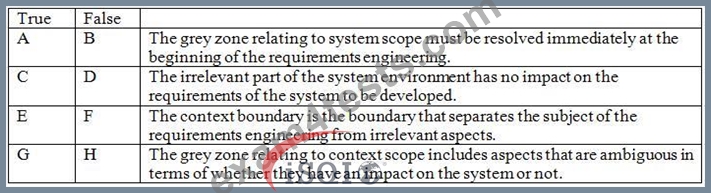
Answer:
Explanation:
B, C, E, G
NEW QUESTION # 22
Using natural language to write RE work products has the following advantages, EXCEPT:
- A. Natural language is flexible.
- B. Natural language is unambiguous.
- C. Natural language doesn't require training to be understood.
- D. Natural language is expressive.
Answer: B
NEW QUESTION # 23
Select the two typically highest abstraction levels among the following options.
- A. Stakeholder
- B. Subsystem
- C. System
- D. Component
- E. Business
Answer: A,E
Explanation:
Comprehensive and Detailed Explanation From Exact Extract:
The abstraction hierarchy described in CPRE starts with business requirements, then stakeholder requirements, and proceeds to system, subsystem and component levels. Business requirements capture organizational goals and strategic intentions. Stakeholder requirements express what different stakeholder groups want in order to fulfill those goals. These are higher-level and less detailed than system/subsystem
/component requirements, which are closer to implementation. Therefore Business and Stakeholder represent the highest abstraction levels among the options, while System, Subsystem and Component are progressively more detailed.
NEW QUESTION # 24
Listed below you will find four reasons why different views of individual components of the requirements are used instead of a single view displaying all the requirements and attributes. Which of the following reasons are true and which are false? (2 Points)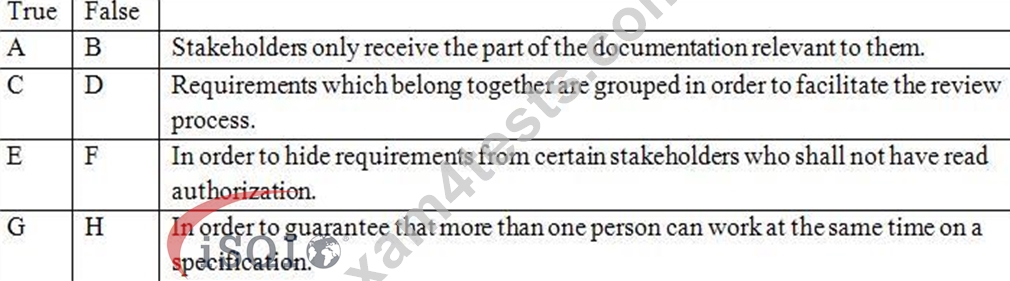
Answer:
Explanation:
A, C, E, H
NEW QUESTION # 25
Validating requirements is one of the main activities of requirements engineering. Which four of the following techniques are suitable for requirements validation? (2 Points)
- A. Perspective-based reading
- B. Walk through
- C. Visualization
- D. Inspection
- E. Monitoring
- F. Decomposition
- G. Ranking
- H. Generalization
- I. Validation by using an interface prototype
- J. Apprenticing
- K. Stakeholder analysis
Answer: A,B,D,I
Explanation:
Reference: http://www.certified-re.de/fileadmin/IREB/Lehrplaene/IREB_cpre_syllabus_FL_en_v21.pdf (page
26, first 6 bulleted points on the page)
NEW QUESTION # 26
The implementation of traceability offers many benefits for RE. Which of the following benefits would be the LEAST applicable?
- A. It helps to produce unambiguous requirements.
- B. It helps to produce verifiable requirements.
- C. It helps to analyze the impacts of change in requirements.
- D. It helps when trying to find where a requirement came from.
Answer: A,B
NEW QUESTION # 27
Which attribute is used to indicate that a requirement cannot be implemented without another requirement also being satisfied?
- A. Dependency
- B. Source
- C. Rationale
- D. Traceability
Answer: A
Explanation:
Comprehensive and Detailed Explanation From Exact Extract:
Requirements attributes capture structured information about each requirement. Rationale records why it exists. Source identifies where it came from (stakeholder, document, meeting). Traceability is a broader property, not a single attribute, enabling links to origins and realizations. The dependency attribute explicitly documents relationships between requirements, such as "Req A depends on Req B". It shows where a requirement's implementation requires others (enabler requirements) to be implemented first. Thus, dependency is the attribute used to represent such implementation dependencies.
NEW QUESTION # 28
Requirements engineers should...
- A. Ignore what is beyond the context boundary.
- B. Do exactly what stakeholders tell them to do.
- C. Keep requirements fixed, opposing any change.
- D. Strive to establish requirements that depend on the foreseen solution.
Answer: A
Explanation:
Comprehensive and Detailed Explanation From Exact Extract:
The principles emphasize that Requirements Engineers must actively analyze, challenge and improve stakeholder statements rather than acting as mere scribes, so A is wrong. They should deliberately distinguish problem requirements from solution decisions to avoid premature design bias, so B is incorrect. Change is considered normal, and RE must accommodate it rather than oppose it rigidly, making C false. The context boundary separates what is relevant for the system's requirements from what is not; anything beyond it is outside the defined scope and should normally be ignored in RE. Thus, D reflects the correct behaviour.
NEW QUESTION # 29
Which of the following options are considered evidences of a good application of RE in a project?
- A. There is no such thing as the assumption that requirements are self-evident.
- B. Stakeholders have a shared understanding of requirements.
- C. Early system implementation.
- D. People writing requirements are well educated in RE.
Answer: A,B,D
NEW QUESTION # 30
It is correct to say that domain requirements...
- A. ...are a subset of the stakeholder domain, such as the user requirements.
- B. ...establish the domain properties for a socio-technical or cyber-physical system.
- C. ...focus on the organization's business goals, objectives, and needs domains of a system.
- D. ...are something else than what is described in the other options.
Answer: B
NEW QUESTION # 31
In requirements engineering, the use of model-based documentation is very helpful. Behaviour, functions and the structures of the entity being considered can be represented with diagrams. Which two of the following diagrams help to represent the structural perspective of the requirements model? (1 Point)
- A. Entity-relationship diagram
- B. Data diagram
- C. Deployment diagram
- D. State diagram
- E. Class diagram
Answer: A,E
NEW QUESTION # 32
The following factors favour the adoption of a linear RE process, EXCEPT:
- A. The stakeholders are available, know their requirements, and can specify them up front.
- B. The development process for the system is plan-driven.
- C. A comprehensive requirements specification is required as a contractual basis for outsourcing or tendering the design and implementation of the system.
- D. The ability to change requirements easily is important for the project.
Answer: D
NEW QUESTION # 33
Consider the Kano model figure with three curves labeled A, B and C.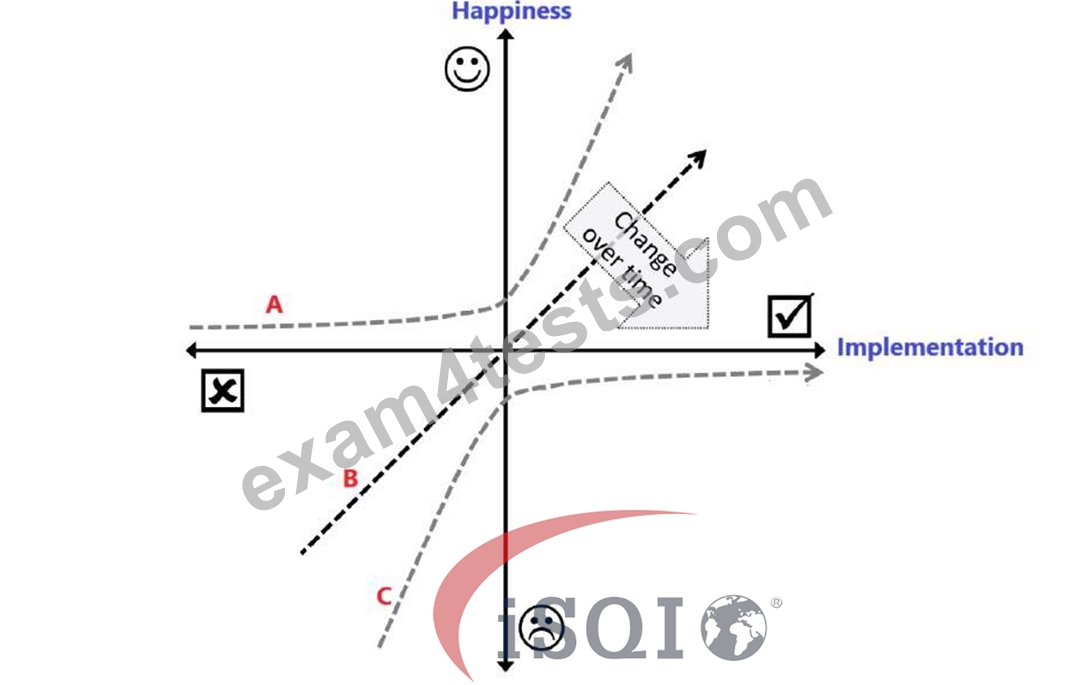
Which requirement categories do these curves represent?
- A. A - Satisfiers; B - Dissatisfiers; C - Delighters
- B. A - Delighters; B - Dissatisfiers; C - Satisfiers
- C. A - Delighters; B - Satisfiers; C - Dissatisfiers
- D. A - Satisfiers; B - Delighters; C - Dissatisfiers
Answer: C
Explanation:
Comprehensive and Detailed Explanation From Exact Extract:
In the Kano model, the x-axis represents implementation of a requirement and the y-axis customer satisfaction.
Dissatisfiers (basic needs) cause strong dissatisfaction when absent but don't increase satisfaction much when fulfilled; their curve is steep in the negative quadrant, flattening as implementation increases- this matches curve C.
Satisfiers have roughly linear behaviour: the more fully implemented, the more satisfied customers are-curve B.
Delighters have little effect when absent but produce high satisfaction when present; their curve is flat near the origin and rises sharply at higher implementation-curve A. Hence mapping A- Delighters, B-Satisfiers, C-Dissatisfiers is correct.
NEW QUESTION # 34
Which of the following best fits the phrase template of a user story?
- A. The system shall process up to 1,000 transactions per minute without performance degradation.
- B. As a system, I shall respond to user inputs within 2 seconds.
- C. The system shall support data exchange with external databases via a RESTful API.
- D. As a user, I want to reset my password so that I can regain access to my account if I forget it.
Answer: D
Explanation:
Comprehensive and Detailed Explanation From Exact Extract:
User stories in agile follow the canonical template: "As a <role>, I want <capability> so that <benefit>".
Option A matches this exactly: role ("user"), capability ("reset my password") and benefit ("regain access if I forget it"). Options B and C are classic system requirements expressed with "shall", not user stories. Option D misuses the template by treating "system" as the role and mixing story language with "shall", which is reserved for formal system requirements. Hence A is the correct user-story example.
NEW QUESTION # 35
In regard to tool support for Requirements Engineering, which statement is correct?
- A. "Management of requirements" tools are used to manage the RE workflow.
- B. "Management of RE process" tools are used to track and trace requirements.
- C. "Documentation of knowledge about the requirements" tools are used for sharing requirements.
- D. Office tools are ideal for managing requirements.
Answer: C
Explanation:
Comprehensive and Detailed Explanation From Exact Extract:
The syllabus distinguishes categories of RE tools: office tools (general purpose), documentation of knowledge about requirements (e.g., wikis, requirements repositories), management of requirements (for traceability, attributes, baselines), management of RE process (workflow and task support) and others. Office tools can be used but have significant limitations-especially for traceability-so A is overstated. Requirements- management tools deal with requirements objects and links, not workflow (C). Process-management tools handle workflow (B). Documentation tools, such as wikis or collaborative repositories, support sharing and collaboratively editing requirements knowledge, which makes D correct.
NEW QUESTION # 36
......
ISQI CPRE-FL_Syll_3.0 (IREB Certified Professional for Requirements Engineering. Foundation Level) Exam is a globally recognized certification that validates an individual's knowledge and skills in requirements engineering. It is designed for professionals who want to enhance their career opportunities in the field of requirements engineering and gain a comprehensive understanding of the essential concepts and techniques involved in this discipline.
Pass Guaranteed Quiz 2025 Realistic Verified Free ISQI: https://www.exam4tests.com/CPRE-FL_Syll_3.0-valid-braindumps.html
Free ISQI Certification CPRE-FL_Syll_3.0 Ultimate Study Guide: https://drive.google.com/open?id=1n97HBrG61pDekx-b_xnHNcFRAyxfvLvK