

Get Latest [Aug-2022] Conduct effective penetration tests using Exam4Tests MS-500
Penetration testers simulate MS-500 exam PDF
NEW QUESTION 152
Please wait while the virtual machine loads. Once loaded, you may proceed to the lab section. This may take a few minutes, and the wait time will not be deducted from your overall test time.
When the Next button is available, click it to access the lab section. In this section, you will perform a set of tasks in a live environment. While most functionality will be available to you as it would be in a live environment, some functionality (e.g., copy and paste, ability to navigate to external websites) will not be possible by design.
Scoring is based on the outcome of performing the tasks stated in the lab. In other words, it doesn't matter how you accomplish the task, if you successfully perform it, you will earn credit for that task.
Labs are not timed separately, and this exam may more than one lab that you must complete. You can use as much time as you would like to complete each lab. But, you should manage your time appropriately to ensure that you are able to complete the lab(s) and all other sections of the exam in the time provided.
Please note that once you submit your work by clicking the Next button within a lab, you will NOT be able to return to the lab.
Username and password
Use the following login credentials as needed:
To enter your username, place your cursor in the Sign in box and click on the username below.
To enter your password, place your cursor in the Enter password box and click on the password below.
Microsoft 365 Username:
admin@[email protected]
Microsoft 365 Password: &=Q8v@2qGzYz
If the Microsoft 365 portal does not load successfully in the browser, press CTRL-K to reload the portal in a new browser tab.
The following information is for technical support only:
Lab instance: 11032396
You need to ensure that a user named Alex Wilber can register for multifactor authentication (MFA).
To complete this task, sign in to the Microsoft Office 365 admin center.
Answer:
Explanation:
See explanation below.
Explanation
Enable Modern authentication for your organization
1. To enable modern authentication, from the admin center, select Settings and then in the Services tab, choose Modern authentication
2. Check the Enable modern authentication Modern authentication panel.
Enable multi-factor authentication for your organization
1. In the admin center, select Users and Active Users.
2. In the Active Users section, Click on multi-factor authentication.
3. On the Multi-factor authentication page, select user if you are enabling this for one user or select Bulk Update to enable multiple users.
4. Click on Enable under Quick Steps.
5. In the Pop-up window, Click on Enable Multi-Factor Authentication.
After you set up multi-factor authentication for your organization, your users will be required to set up two-step verification on their devices.
Reference:
https://docs.microsoft.com/en-us/microsoft-365/admin/security-and-compliance/set-up-multi-factor-authenticatio
NEW QUESTION 153
You have a Microsoft 365 E5 subscription.
Users and device objects are added and removed daily. Users in the sales department frequently change their device.
You need to create three following groups:
The solution must minimize administrative effort.
What is the minimum number of groups you should create for each type of membership? To answer, select the appropriate options in the answer area.
NOTE: Each correct selection is worth one point.
Answer:
Explanation:
Explanation
References:
https://github.com/MicrosoftDocs/azure-docs/blob/master/articles/active-directory/users-groups-roles/groups-dyn
NEW QUESTION 154
Please wait while the virtual machine loads. Once loaded, you may proceed to the lab section. This may take a few minutes, and the wait time will not be deducted from your overall test time.
When the Next button is available, click it to access the lab section. In this section, you will perform a set of tasks in a live environment. While most functionality will be available to you as it would be in a live environment, some functionality (e.g., copy and paste, ability to navigate to external websites) will not be possible by design.
Scoring is based on the outcome of performing the tasks stated in the lab. In other words, it doesn't matter how you accomplish the task, if you successfully perform it, you will earn credit for that task.
Labs are not timed separately, and this exam may more than one lab that you must complete. You can use as much time as you would like to complete each lab. But, you should manage your time appropriately to ensure that you are able to complete the lab(s) and all other sections of the exam in the time provided.
Please note that once you submit your work by clicking the Next button within a lab, you will NOT be able to return to the lab.
Username and password
Use the following login credentials as needed:
To enter your username, place your cursor in the Sign in box and click on the username below.
To enter your password, place your cursor in the Enter password box and click on the password below.
Microsoft 365 Username:
admin@[email protected]
Microsoft 365 Password: &=Q8v@2qGzYz
If the Microsoft 365 portal does not load successfully in the browser, press CTRL-K to reload the portal in a new browser tab.
The following information is for technical support only:
Lab instance: 11032396
You need to ensure that email messages in Exchange Online and documents in SharePoint Online are retained for eight years.
To complete this task, sign in to the Microsoft Office 365 admin center.
Answer:
Explanation:
NB: For our purposes, the retention period will be 8 years.
For retaining email messages in Exchange Online:
Step 1: Create a retention tag
1. Navigate to the Exchange Admin Center
2. Navigate to Compliance management > Retention tags, and then click Add +
3. Select one of the following options:
Applied automatically to entire mailbox (default): Select this option to create a default policy tag (DPT). You can use DPTs to create a default deletion policy and a default archive policy, which applies to all items in the mailbox.
Applied automatically to a specific folder: Select this option to create a retention policy tag (RPT) for a default folder such as Inbox or Deleted Items.
Applied by users to items and folders (Personal): Select this option to create personal tags. These tags allow Outlook and Outlook on the web (formerly known as Outlook Web App) users to apply archive or deletion settings to a message or folders that are different from the settings applied to the parent folder or the entire mailbox.
4. The New retention tag page title and options will vary depending on the type of tag you selected. Complete the following fields:
Name: Enter a name for the retention tag. The tag name is for display purposes and doesn't have any impact on the folder or item a tag is applied to. Consider that the personal tags you provision for users are available in Outlook and Outlook on the web.
Apply this tag to the following default folder: This option is available only if you selected Applied automatically to a specific folder.
Retention action: Select one of the following actions to be taken after the item reaches its retention period:
Delete and Allow Recovery: Select this action to delete items but allow users to recover them using the Recover Deleted Items option in Outlook or Outlook on the web. Items are retained until the deleted item retention period configured for the mailbox database or the mailbox user is reached.
Permanently Delete: Select this option to permanently delete the item from the mailbox database.
Move to Archive: This action is available only if you're creating a DPT or a personal tag. Select this action to move items to the user's In-Place Archive.
Retention period: Select one of the following options:
Never: Select this option to specify that items should never be deleted or moved to the archive.
When the item reaches the following age (in days): Select this option and specify the number of days to retain items before they're moved or deleted. The retention age for all supported items except Calendar and Tasks is calculated from the date an item is received or created. Retention age for Calendar and Tasks items is calculated from the end date.
Comment: User this optional field to enter any administrative notes or comments. The field isn't displayed to users.
Step 2: Create a retention policy
1. Navigate to Compliance management > Retention policies, and then click Add +
2. In New Retention Policy, complete the following fields:
Name: Enter a name for the retention policy.
Retention tags: Click Add + to select the tags you want to add to this retention policy.
A retention policy can contain the following tags:
One DPT with the Move to Archive action.
One DPT with the Delete and Allow Recovery or Permanently Delete actions.
One DPT for voice mail messages with the Delete and Allow Recovery or Permanently Delete actions.
One RPT per default folder such as Inbox to delete items.
Any number of personal tags.
Step 3: Apply a retention policy to mailbox users
After you create a retention policy, you must apply it to mailbox users. You can apply different retention policies to different set of users.
Navigate to Recipients > Mailboxes.
In the list view, use the Shift or Ctrl keys to select multiple mailboxes.
In the details pane, click More options.
Under Retention Policy, click Update.
In Bulk Assign Retention Policy, select the retention policy you want to apply to the mailboxes, and then click Save.
For retaining documents in SharePoint Online
Access Security & Compliance Admin Center
1. Navigate to the Office 365 Admin Centers
2. From the list of available Admin Centers, click on Security & Compliance
How to create and publish a Retention Policy on a SharePoint site
Now that we are in the Security & Compliance Admin Center, we are ready to create and publish a Retention Policy on a SharePoint site. Under Data Governance, click Retention
1. Hit Create button to create new Retention Policy
2. Give your policy a name and description. Hit Next
3. On the next screen is where you set up the logic. You can configure how many days, months, or years to retain the content for, specify whether you want the math (retention period) to be calculated from the Created Date or Last Modified Date. Lastly, you can also specify whether you want to keep or delete content after the Retention period expires. Hit Next
4. On the next screen, you get to choose where to apply the policy. You can apply it to email (Exchange), SharePoint sites, OneDrive accounts as well as Office 365 Groups.
5. In my case, I applied a policy to a single Office 365 Group Site
6. On a final screen, you need to review and confirm the settings and click Create this policy button. It is imperative to note the message you get to see at the bottom. It warns you that content might be deleted as soon as the policy takes effect according to the logic you set up in previous steps.
Reference:
https://docs.microsoft.com/en-us/exchange/security-and-compliance/messaging-records-management/create-a-retention-policy#step-2-create-a-retention-policy
https://docs.microsoft.com/en-us/exchange/security-and-compliance/messaging-records-management/apply-retention-policy#use-the-eac-to-apply-a-retention-policy-to-multiple-mailboxes
https://sharepointmaven.com/how-to-set-a-retention-policy-on-a-sharepoint-site/
NEW QUESTION 155
You have a Microsoft 365 E5 subscription that contains an Azure Active Directory (Azure AD) tenant named contoso.com.
Azure AD Identity Protection alerts for contoso.com are configured as shown in the following exhibit.
A user named User1 is configured to receive alerts from Azure AD Identity Protection.
You create users in contoso.com as shown in the following table.
The users perform the sign-ins shown in the following table.
For each of the following statements, select Yes if the statement is true. Otherwise, select No.
NOTE: Each correct selection is worth one point.
Answer:
Explanation:
Reference:
https://docs.microsoft.com/en-us/azure/active-directory/identity-protection/overview-identity-protection
https://docs.microsoft.com/en-us/azure/active-directory/identity-protection/howto-identity-protection-configure-risk-policies
NEW QUESTION 156
Your company has a Microsoft 365 subscription.
The company forbids users to enroll personal devices in mobile device management (MDM).
Users in the sales department have personal iOS devices.
You need to ensure that the sales department users can use the Microsoft Power BI app from iOS devices
to access the Power BI data in your tenant.
The users must be prevented from backing up the app's data to iCloud.
What should you create?
- A. an app protection policy in Microsoft Intune
- B. a conditional access policy in Microsoft Azure Active Directory (Azure AD) that has a device state
condition - C. a conditional access policy in Microsoft Azure Active Directory (Azure AD) that has a client apps
condition - D. a device compliance policy in Microsoft Intune
Answer: A
Explanation:
Explanation/Reference:
Testlet 1
Overview
Fabrikam, Inc. is manufacturing company that sells products through partner retail stores. Fabrikam has
5,000 employees located in offices throughout Europe.
Existing Environment
Network Infrastructure
The network contains an Active Directory forest named fabrikam.com. Fabrikam has a hybrid Microsoft
Azure Active Directory (Azure AD) environment.
The company maintains some on-premises servers for specific applications, but most end-user
applications are provided by a Microsoft 365 E5 subscription.
Problem Statements
Fabrikam identifies the following issues:
Since last Friday, the IT team has been receiving automated email messages that contain "Unhealthy
Identity Synchronization Notification" in the subject line.
Several users recently opened email attachments that contained malware. The process to remove the
malware was time consuming.
Requirements
Planned Changes
Fabrikam plans to implement the following changes:
Fabrikam plans to monitor and investigate suspicious sign-ins to Active Directory
Fabrikam plans to provide partners with access to some of the data stored in Microsoft 365
Application Administration
Fabrikam identifies the following application requirements for managing workload applications:
User administrators will work from different countries
User administrators will use the Azure Active Directory admin center
Two new administrators named Admin1 and Admin2 will be responsible for managing Microsoft
Exchange Online only
Security Requirements
Fabrikam identifies the following security requirements:
Access to the Azure Active Directory admin center by the user administrators must be reviewed every
seven days. If an administrator fails to respond to an access request within three days, access must be
removed
Users who manage Microsoft 365 workloads must only be allowed to perform administrative tasks for
up to three hours at a time. Global administrators must be exempt from this requirement
Users must be prevented from inviting external users to view company data. Only global administrators
and a user named User1 must be able to send invitations
Azure Advanced Threat Protection (ATP) must capture security group modifications for sensitive
groups, such as Domain Admins in Active Directory
Workload administrators must use multi-factor authentication (MFA) when signing in from an
anonymous or an unfamiliar location
The location of the user administrators must be audited when the administrators authenticate to Azure
AD
Email messages that include attachments containing malware must be delivered without the
attachment
The principle of least privilege must be used whenever possible
Testlet 2
Overview
Litware, Inc. is a financial company that has 1,000 users in its main office in Chicago and 100 users in a
branch office in San Francisco.
Existing Environment
Internal Network Infrastructure
The network contains a single domain forest. The forest functional level is Windows Server 2016.
Users are subject to sign-in hour restrictions as defined in Active Directory.
The network has the IP address range shown in the following table.
The offices connect by using Multiprotocol Label Switching (MPLS).
The following operating systems are used on the network:
Windows Server 2016
Windows 10 Enterprise
Windows 8.1 Enterprise
The internal network contains the systems shown in the following table.
Litware uses a third-party email system.
Cloud Infrastructure
Litware recently purchased Microsoft 365 subscription licenses for all users.
Microsoft Azure Active Directory (Azure AD) Connect is installed and uses the default authentication
settings. User accounts are not yet synced to Azure AD.
You have the Microsoft 365 users and groups shown in the following table.
Planned Changes
Litware plans to implement the following changes:
Migrate the email system to Microsoft Exchange Online
Implement Azure AD Privileged Identity Management
Security Requirements
Litware identities the following security requirements:
Create a group named Group2 that will include all the Azure AD user accounts. Group2 will be used to
provide limited access to Windows Analytics
Create a group named Group3 that will be used to apply Azure Information Protection policies to pilot
users. Group3 must only contain user accounts
Use Azure Advanced Threat Protection (ATP) to detect any security threats that target the forest
Prevent users locked out of Active Directory from signing in to Azure AD and Active Directory
Implement a permanent eligible assignment of the Compliance administrator role for User1
Integrate Windows Defender and Windows Defender ATP on domain-joined servers
Prevent access to Azure resources for the guest user accounts by default
Ensure that all domain-joined computers are registered to Azure AD
Multi-factor authentication (MFA) Requirements
Security features of Microsoft Office 365 and Azure will be tested by using pilot Azure user accounts.
You identify the following requirements for testing MFA.
Pilot users must use MFA unless they are signing in from the internal network of the Chicago office.
MFA must NOT be used on the Chicago office internal network.
If an authentication attempt is suspicious, MFA must be used, regardless of the user location
Any disruption of legitimate authentication attempts must be minimized
General Requirements
Litware want to minimize the deployment of additional servers and services in the Active Directory forest.
NEW QUESTION 157
You need to resolve the issue that targets the automated email messages to the IT team.
Which tool should you run first?
- A. Synchronization Service Manager
- B. Synchronization Rules Editor
- C. Azure AD Connect wizard
- D. IdFix
Answer: C
Explanation:
Reference:
https://docs.microsoft.com/en-us/office365/enterprise/fix-problems-with-directory-synchronization
Overview Litware, Inc. is a financial company that has 1,000 users in its main office in Chicago and 100 users in a branch office in San Francisco.
Topic 1, Fabrikam inc.Overview
Existing Environment
Network Infrastructure
The network contains an Active Directory forest named fabrikam.com. Fabrikam has a hybrid Microsoft Azure Active Directory (Azure AD) environment.
The company maintains some on-premises servers for specific applications, but most end-user applications are provided by a Microsoft 365 E5 subscription.
Problem Statements
Fabrikam identifies the following issues:
Since last Friday, the IT team has been receiving automated email messages that contain "Unhealthy Identity Synchronization Notification" in the subject line.
Several users recently opened email attachments that contained malware. The process to remove the malware was time consuming.
Requirements
Planned Changes
Fabrikam plans to implement the following changes:
Fabrikam plans to monitor and investigate suspicious sign-ins to Active Directory Fabrikam plans to provide partners with access to some of the data stored in Microsoft 365 Application Administration Fabrikam identifies the following application requirements for managing workload applications:
User administrators will work from different countries
User administrators will use the Azure Active Directory admin center
Two new administrators named Admin1 and Admin2 will be responsible for managing Microsoft Exchange Online only Security Requirements Fabrikam identifies the following security requirements:
Access to the Azure Active Directory admin center by the user administrators must be reviewed every seven days. If an administrator fails to respond to an access request within three days, access must be removed Users who manage Microsoft 365 workloads must only be allowed to perform administrative tasks for up to three hours at a time. Global administrators must be exempt from this requirement Users must be prevented from inviting external users to view company data. Only global administrators and a user named User1 must be able to send invitations Azure Advanced Threat Protection (ATP) must capture security group modifications for sensitive groups, such as Domain Admins in Active Directory Workload administrators must use multi-factor authentication (MFA) when signing in from an anonymous or an unfamiliar location The location of the user administrators must be audited when the administrators authenticate to Azure AD Email messages that include attachments containing malware must be delivered without the attachment The principle of least privilege must be used whenever possible
NEW QUESTION 158
Please wait while the virtual machine loads. Once loaded, you may proceed to the lab section. This may take a few minutes, and the wait time will not be deducted from your overall test time.
When the Next button is available, click it to access the lab section. In this section, you will perform a set of tasks in a live environment. While most functionality will be available to you as it would be in a live environment, some functionality (e.g., copy and paste, ability to navigate to external websites) will not be possible by design.
Scoring is based on the outcome of performing the tasks stated in the lab. In other words, it doesn't matter how you accomplish the task, if you successfully perform it, you will earn credit for that task.
Labs are not timed separately, and this exam may more than one lab that you must complete. You can use as much time as you would like to complete each lab. But, you should manage your time appropriately to ensure that you are able to complete the lab(s) and all other sections of the exam in the time provided.
Please note that once you submit your work by clicking the Next button within a lab, you will NOT be able to return to the lab.
Username and password
Use the following login credentials as needed:
To enter your username, place your cursor in the Sign in box and click on the username below.
To enter your password, place your cursor in the Enter password box and click on the password below.
Microsoft 365 Username:
admin@[email protected]
Microsoft 365 Password: #HSP.ug?$p6un
If the Microsoft 365 portal does not load successfully in the browser, press CTRL-K to reload the portal in a new browser tab.
The following information is for technical support only:
Lab instance: 11122308


You need to create an Azure Information Protection label to meet the following requirements:
* Content must expire after 21 days.
* Offline access must be allowed for 21 days only.
* Documents must be protected by using a cloud key.
* Authenticated users must be able to view content only.
To complete this task, sign in to the Microsoft 365 admin center.
Answer:
Explanation:
See explanation below.
Explanation
1. If you haven't already done so, open a new browser window and sign in to the Azure portal. Then navigate to the Azure Information Protection pane.
For example, in the search box for resources, services, and docs: Start typing Information and select Azure Information Protection.
2. From the Classifications > Labels menu option: On the Azure Information Protection - Labels pane, select the label you want to change.
On the Label pane, locate Set permissions for documents and emails containing this label, and select Protect.
3. Select Protection.
4. On the Protection pane, select Azure (cloud key).
5. Select Set permissions to define new protection settings in this portal.
6. If you selected Set permissions for Azure (cloud key), this option lets you select users and usage rights.
To specify the users that you want to be able to open protected documents and emails, select Add permissions.
Then on the Add permissions pane, select the first set of users and groups who will have rights to use the content that will be protected by the selected label:
* Choose Select from the list where you can then add all users from your organization by selecting Add
<organization name> - All members. This setting excludes guest accounts. Or, you can select Add any authenticated users, or browse the directory.
When you choose all members or browse the directory, the users or groups must have an email address. In a production environment, users and groups nearly always have an email address, but in a simple testing environment, you might need to add email addresses to user accounts or groups.
* Change the File Content Expiration setting to 21 days.
* Change the Allow offline access setting to 21 days.
When you have finished configuring the permissions and settings, click OK.
This grouping of settings creates a custom template for the Azure Rights Management service. These templates can be used with applications and services that integrate with Azure Rights Management.
7. Click OK to close the Protection pane and see your choice of User defined or your chosen template display for the Protection option in the Label pane.
8. On the Label pane, click Save.
9. On the Azure Information Protection pane, use the PROTECTION column to confirm that your label now displays the protection setting that you want:
* A check mark if you have configured protection.
* An x mark to denote cancellation if you have configured a label to remove protection.
* A blank field when protection is not set.
When you clicked Save, your changes are automatically available to users and services. There's no longer a separate publish option.
Reference:
https://docs.microsoft.com/en-us/azure/information-protection/configure-policy-protection
NEW QUESTION 159
You have a Microsoft 365 tenant.
You need to retain Azure Active Directory (Azure AD) audit logs for two years. Administrators must be able to query the audit log information by using the Azure Active Directory admin center.
What should you do? To answer, select the appropriate options in the answer area.
NOTE: Each correct selection is worth one point.
Answer:
Explanation:
Reference:
https://docs.microsoft.com/en-gb/azure/active-directory/reports-monitoring/howto-analyze-activity-logs-log-analytics
NEW QUESTION 160
You need to enable and configure Microsoft Defender for Endpoint to meet the security requirements. What should you do?
- A. Configure port mirroring
- B. Download and install the Microsoft Monitoring Agent
- C. Create the ForceDefenderPassiveMode registry setting
- D. Run WindowsDefenderATPOnboardingScripc.cmd
Answer: B
Explanation:
Overview
Contoso, Ltd. is a consulting company that has a main office in Montreal and three branch offices in Seattle, and New York.
The company has the offices shown in the following table.
Contoso has IT, human resources (HR), legal, marketing, and finance departments. Contoso uses Microsoft 365.
NEW QUESTION 161
Please wait while the virtual machine loads. Once loaded, you may proceed to the lab section. This may take a few minutes, and the wait time will not be deducted from your overall test time.
When the Next button is available, click it to access the lab section. In this section, you will perform a set of tasks in a live environment. While most functionality will be available to you as it would be in a live environment, some functionality (e.g., copy and paste, ability to navigate to external websites) will not be possible by design.
Scoring is based on the outcome of performing the tasks stated in the lab. In other words, it doesn't matter how you accomplish the task, if you successfully perform it, you will earn credit for that task.
Labs are not timed separately, and this exam may more than one lab that you must complete. You can use as much time as you would like to complete each lab. But, you should manage your time appropriately to ensure that you are able to complete the lab(s) and all other sections of the exam in the time provided.
Answer:
Explanation:
Please note that once you submit your work by clicking the Next button within a lab, you will NOT be able to return to the lab.
Username and password
Use the following login credentials as needed:
To enter your username, place your cursor in the Sign in box and click on the username below.
To enter your password, place your cursor in the Enter password box and click on the password below.
Microsoft 365 Username:
admin@[email protected]
Microsoft 365 Password: #HSP.ug?$p6un
If the Microsoft 365 portal does not load successfully in the browser, press CTRL-K to reload the portal in a new browser tab.
The following information is for technical support only:
Lab instance: 11122308


You need to prevent any email messages that contain data covered by the U.K. Data Protection Act from being sent to recipients outside of your organization, unless the messages are sent to an external domain named adatum.com.
To complete this task, sign in to the Microsoft 365 admin center.
U. K. National Insurance Number (NINO
U. S. / U.K. Passport Number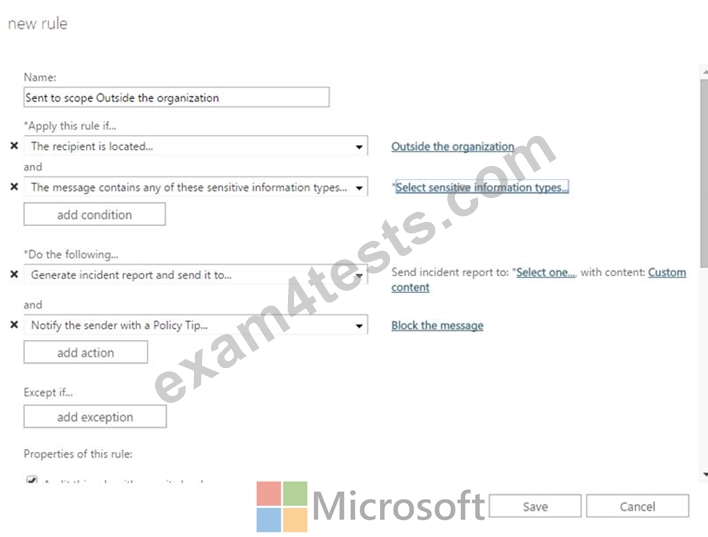
9. Click on "Select Sensitive information Types" to specify the sensitive information details.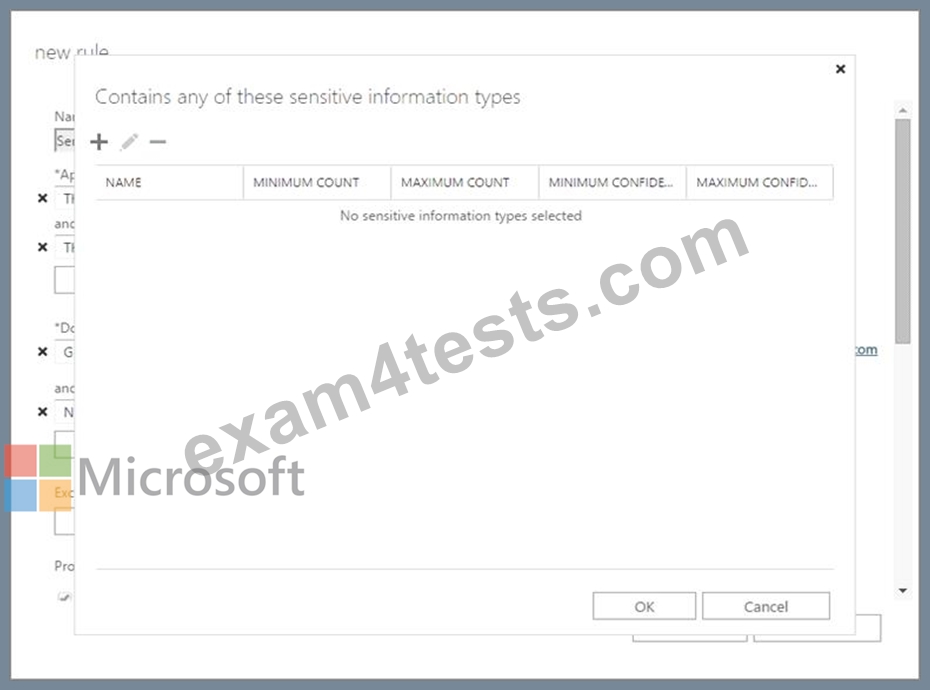
10. Click on (+) plus button and add the following Sensitive information Types:
Reference:
https://events.collab365.community/configure-data-loss-prevention-policies-in-exchange-online-in-office-365/
NEW QUESTION 162
You have a Microsoft 365 subscription that contains 1,000 user mailboxes.
An administrator named Admin1 must be able to search for the name of a competing company in the mailbox of a user named User5.
You need to ensure that Admin1 can search the mailbox of User5 successfully. The solution must prevent Admin1 from sending User5.
Solution: You modify the privacy profile, and then create a Data Subject Request (DSR) case Does this meet the goal?
- A. No
- B. Yes
Answer: B
NEW QUESTION 163
You have a Microsoft 365 subscription that uses a default domain name of contoso.com.
The multi-factor authentication (MFA) service settings are configured as shown in the exhibit. (Clock the Exhibit tab.)
In contoso.com, you create the users shown in the following table.
What is the effect of the configuration? To answer, select the appropriate options in the answer area.
NOTE: Each correct selection is worth one point.
Answer:
Explanation:
NEW QUESTION 164
You configure several Advanced Threat Protection (ATP) policies in a Microsoft 365 subscription.
You need to allow a user named User1 to view ATP reports in the Threat management dashboard.
Which role provides User1 with the required role permissions?
- A. Reports reader
- B. Security reader
- C. Information Protection administrator
- D. Exchange administrator
Answer: B
Explanation:
Explanation/Reference:
https://docs.microsoft.com/en-us/microsoft-365/security/office-365-security/view-reports-for-atp?view=o365- worldwide#what-permissions-are-needed-to-view-the-atp-reports
NEW QUESTION 165
You have a Microsoft 365 subscription. All users use Microsoft Exchange Online.
Microsoft 365 is configured to use the default policy settings without any custom rules.
You manage message hygiene.
Where are suspicious email messages placed by default? To answer, drag the appropriate location to the correct message types. Each location may be used once, more than once, or not at all. You may need to drag the split bar between panes or scroll to view content.
Answer:
Explanation:
NEW QUESTION 166
You have a Microsoft 365 subscription.
A customer requests that you provide her with all documents that reference her by name.
You need to provide the customer with a copy of the content.
Which four actions should you perform in sequence? To answer, move the appropriate actions from the list of actions to the answer area and arrange them in the correct order.
Answer:
Explanation:
Reference:
https://docs.microsoft.com/en-us/microsoft-365/compliance/gdpr-dsr-office365
NEW QUESTION 167
You have a Microsoft 365 subscription.
Some users access Microsoft SharePoint Online from unmanaged devices.
You need to prevent the users from downloading, printing, and syncing files.
What should you do?
- A. From the SharePoint admin center, configure the secure control settings.
- B. From the Microsoft Azure portal, create an Azure AD Identity Protection user risk policy.
- C. From the Microsoft Azure portal, create an Azure Active Directory (Azure AD) Identity Protection sign-in risk policy.
- D. Run the Set-SPOTenantcmdlet and specify the -ConditionalAccessPolicyparameter.
Answer: D
Explanation:
Explanation/Reference:
https://docs.microsoft.com/en-us/powershell/module/sharepoint-online/set-spotenant?view=sharepoint-ps
https://docs.microsoft.com/en-us/sharepoint/control-access-from-unmanaged-devices Manage governance and compliance features in Microsoft 365 Testlet 1 This is a case study. Case studies are not timed separately. You can use as much exam time as you would like to complete each case. However, there may be additional case studies and sections on this exam. You must manage your time to ensure that you are able to complete all questions included on this exam in the time provided.
To answer the questions included in a case study, you will need to reference information that is provided in the case study. Case studies might contain exhibits and other resources that provide more information about the scenario that is described in the case study. Each question is independent of the other questions in this case study.
At the end of this case study, a review screen will appear. This screen allows you to review your answers and to make changes before you move to the next section of the exam. After you begin a new section, you cannot return to this section.
To start the case study
To display the first question in this case study, click the Next button. Use the buttons in the left pane to explore the content of the case study before you answer the questions. Clicking these buttons displays information such as business requirements, existing environment, and problem statements. If the case study has an All Information tab, note that the information displayed is identical to the information displayed on the subsequent tabs. When you are ready to answer a question, click the Question button to return to the question.
Overview
Contoso, Ltd. is a consulting company that has a main office in Montreal and two branch offices in Seattle and New York.
The company has the offices shown in the following table.
Contoso has IT, human resources (HR), legal, marketing, and finance departments. Contoso uses Microsoft
365.
Existing Environment
Infrastructure
The network contains an Active Directory domain named contoso.com that is synced to a Microsoft Azure Active Directory (Azure AD) tenant. Password writeback is enabled.
The domain contains servers that run Windows Server 2016. The domain contains laptops and desktop computers that run Windows 10 Enterprise.
Each client computer has a single volume.
Each office connects to the Internet by using a NAT device. The offices have the IP addresses shown in the following table.
Named locations are defined in Azure AD as shown in the following table.
From the Multi-Factor Authentication page, an address space of 198.35.3.0/24 is defined in the trusted IPs list.
Azure Multi-Factor Authentication (MFA) is enabled for the users in the finance department.
The tenant contains the users shown in the following table.
The tenant contains the groups shown in the following table.
Customer Lockbox is enabled in Microsoft 365.
Microsoft Endpoint Manager Configuration
The devices enrolled in Microsoft Endpoint Manager are configured as shown in the following table.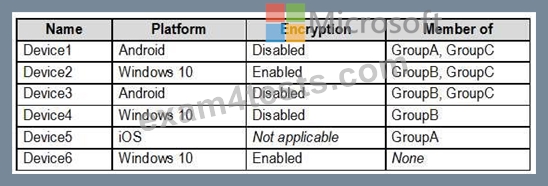
The device compliance policies in Microsoft Endpoint Manager are configured as shown in the following table.
The device compliance policies have the assignments shown in the following table.
The Mark devices with no compliance policy assigned as setting is set to Compliant.
Requirements
Technical Requirements
Contoso identifies the following technical requirements:
* Use the principle of least privilege
* Enable User1 to assign the Reports reader role to users
* Ensure that User6 approves Customer Lockbox requests as quickly as possible
* Ensure that User9 can enable and configure Azure AD Privileged Identity Management
NEW QUESTION 168
You are evaluating which devices are compliant in Intune.
For each of the following statements, select Yes if the statement is true. Otherwise, select No.
NOTE: Each correct selection is worth one point.
Answer:
Explanation:
NEW QUESTION 169
You have a Microsoft 365 subscription that contains 100 users and a Microsoft 365 group named Group1.
All users have Windows 10 devices and use Microsoft SharePoint Online and Exchange Online.
A sensitivity label named Label1 is published as the default label for Group1.
You add two sublabels named Sublabel1 and Sublabel2 to Label1.
You need to ensure that the settings in Sublabel1 are applied by default to Group1.
What should you do?
- A. Modify the policy of Label 1.
- B. Duplicate all the settings from Sublabel1 to Label 1.
- C. Delete the policy of Label! and publish Sublabel1.
- D. Change the order of Sublabel1.
Answer: A
Explanation:
Reference:
https://docs.microsoft.com/en-us/microsoft-365/compliance/sensitivity-labels?view=o365-worldwide
NEW QUESTION 170
You have a Microsoft 365 E5 subscription.
All computers run Windows 10 and are onboarded to Windows Defender Advanced Threat Protection (Windows Defender ATP).
You create a Windows Defender machine group named MachineGroup1.
You need to enable delegation for the security settings of the computers in MachineGroup1.
Which three actions should you perform in sequence? To answer, move the appropriate actions from the list of actions to the answer area and arrange them in the correct order.
Answer:
Explanation:
1 - From the Microsoft Azure portal, create an Azure Active Directory (Azure AD) group.
2 - From Windows Defender Security Center, create a role.
3 - From Windows Defender Security Center, configure the permissions for MachineGroup1.
NEW QUESTION 171
......
Tested Material Used To MS-500 Test Engine: https://www.exam4tests.com/MS-500-valid-braindumps.html
Steps Necessary To Pass The MS-500 Exam: https://drive.google.com/open?id=1FtJsfX1QDjv14jbJq0Q4IOraBIPD0Luo