

Get Ready with FCSS_SASE_AD-25 Exam Dumps (2026)
Realistic FCSS_SASE_AD-25 Dumps are Available for Instant Access
Fortinet FCSS_SASE_AD-25 Exam Syllabus Topics:
| Topic | Details |
|---|---|
| Topic 1 |
|
| Topic 2 |
|
| Topic 3 |
|
| Topic 4 |
|
NEW QUESTION # 33
Which secure internet access (SIA) use case minimizes individual endpoint configuration?
- A. SIA for FortiClient agent remote users
- B. Site-based remote user internet access
- C. Agentless remote user internet access
- D. SIA using ZTNA
Answer: B
Explanation:
Site-based remote user internet access minimizes individual endpoint configuration by routing user traffic through a centralized FortiSASE connection point (such as a FortiAP or FortiGate), rather than requiring each device to be individually configured with the FortiClient agent.
NEW QUESTION # 34
Your FortiSASE customer has a small branch office in which ten users will be using their personal laptops and mobile devices to access the internet.
Which deployment should they use to secure their internet access with minimal configuration?
- A. Deploy FortiClient endpoint agent to secure internet access.
- B. Deploy FortiAP to secure internet access.
- C. Deploy FortiGate as a LAN extension to secure internet access.
- D. Deploy SD-WAN on-ramp to secure internet access.
Answer: B
Explanation:
Deploying FortiAP enables secure internet access for unmanaged personal devices in small branch offices with minimal configuration by automatically directing traffic through FortiSASE, eliminating the need for endpoint installation or complex setup.
NEW QUESTION # 35
Refer to the exhibits.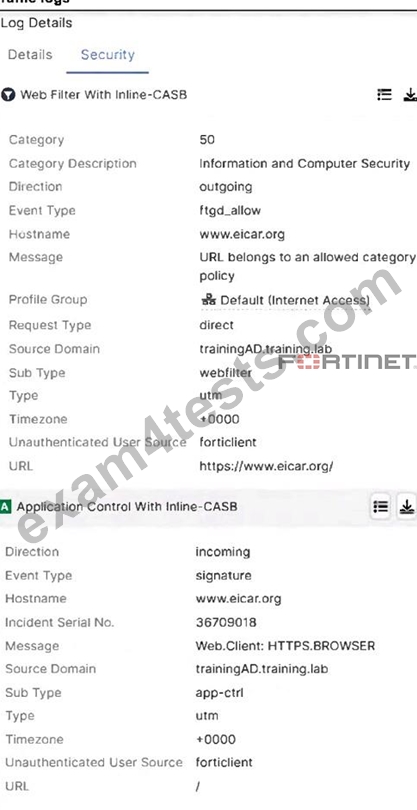
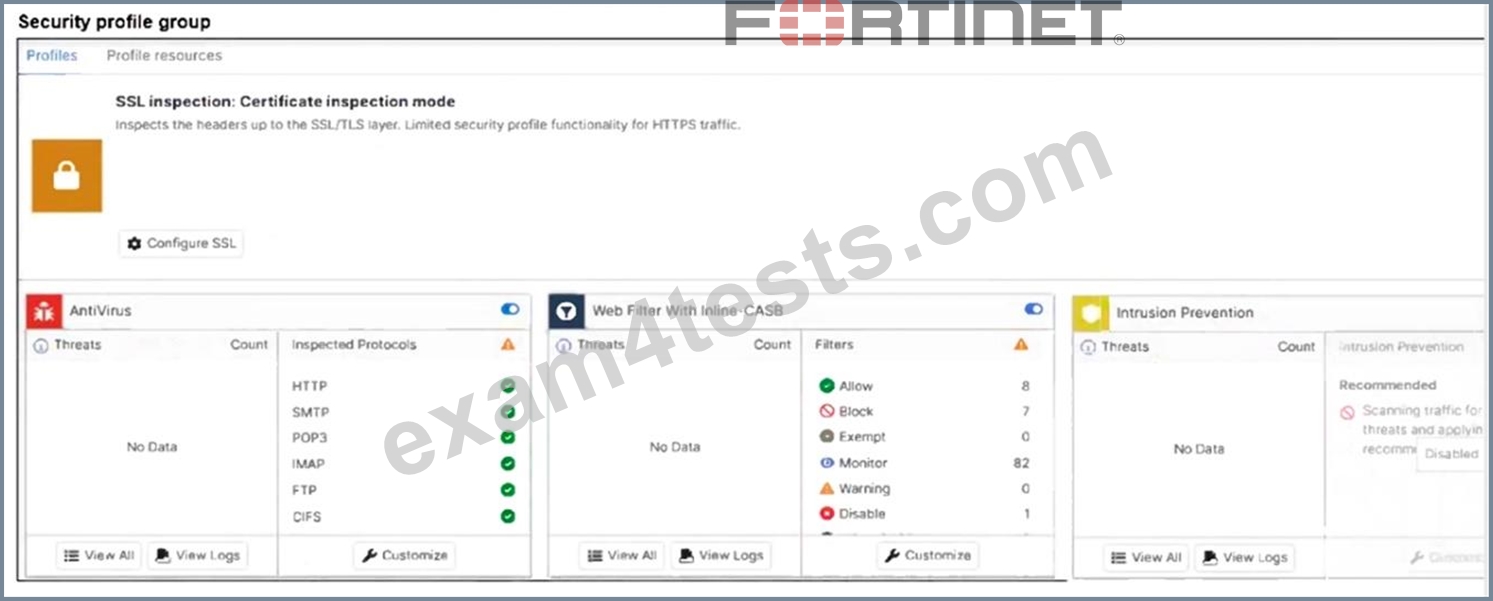
A FortiSASE administrator has configured an antivirus profile in the security profile group and applied it to the internet access policy. Remote users are still able to download the eicar.com-zip file from https://eicar.org.
Which configuration on FortiSASE is allowing users to perform the download?
- A. Web filter is allowing the URL.
- B. Intrusion prevention is disabled.
- C. Application control is exempting all the browser traffic.
- D. Deep inspection is not enabled.
Answer: D
Explanation:
The SSL inspection mode is set to certificate inspection, which only inspects SSL/TLS headers and does not allow full scanning of encrypted content. Without full (deep) inspection, the antivirus profile cannot scan or block malicious files (like eicar.com-zip) delivered over HTTPS, allowing the download to proceed.
NEW QUESTION # 36
Refer to the exhibit.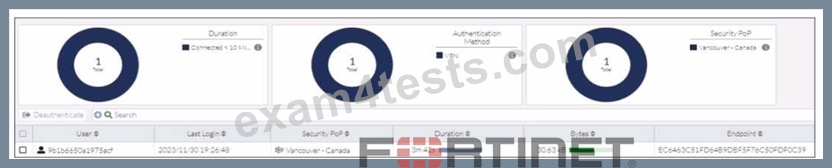
In the user connection monitor, the FortiSASE administrator notices the user name is showing random characters. Which configuration change must the administrator make to get proper user information?
- A. Turn off log anonymization on FortiSASE.
- B. Change the deployment type from SWG to VPN.
- C. Add more endpoint licenses on FortiSASE.
- D. Configure the username using FortiSASE naming convention.
Answer: A
Explanation:
In the user connection monitor, the random characters shown for the username indicate that log anonymization is enabled. Log anonymization is a feature that hides the actual user information in the logs for privacy and security reasons. To display proper user information, you need to disable log anonymization.
Log Anonymization:
When log anonymization is turned on, the actual usernames are replaced with random characters to protect user privacy.
This feature can be beneficial in certain environments but can cause issues when detailed user monitoring is required.
Disabling Log Anonymization:
Navigate to the FortiSASE settings.
Locate the log settings section.
Disable the log anonymization feature to ensure that actual usernames are displayed in the logs and user connection monitors.
FortiSASE 23.2 Documentation: Provides detailed steps on enabling and disabling log anonymization.
Fortinet Knowledge Base: Explains the impact of log anonymization on user monitoring and logging.
NEW QUESTION # 37
For a SASE deployment, what is a crucial step when configuring security checks for regulatory compliance?
- A. Annual reviews of compliance status
- B. Periodic rollback of security updates
- C. Manual verification by external auditors
- D. Continuous monitoring and automatic updates of compliance rules
Answer: D
NEW QUESTION # 38
What are two requirements to enable the MSSP feature on FortiSASE? (Choose two.)
- A. Assign role-based access control (RBAC) to IAM users using FortiCloud IAM portal.
- B. Configure MSSP user accounts and permissions on the FortiSASE portal.
- C. Enable multi-tenancy on the FortiSASE portal.
- D. Add FortiCloud premium subscription on the root FortiCloud account.
Answer: A,D
NEW QUESTION # 39
Refer to the exhibits.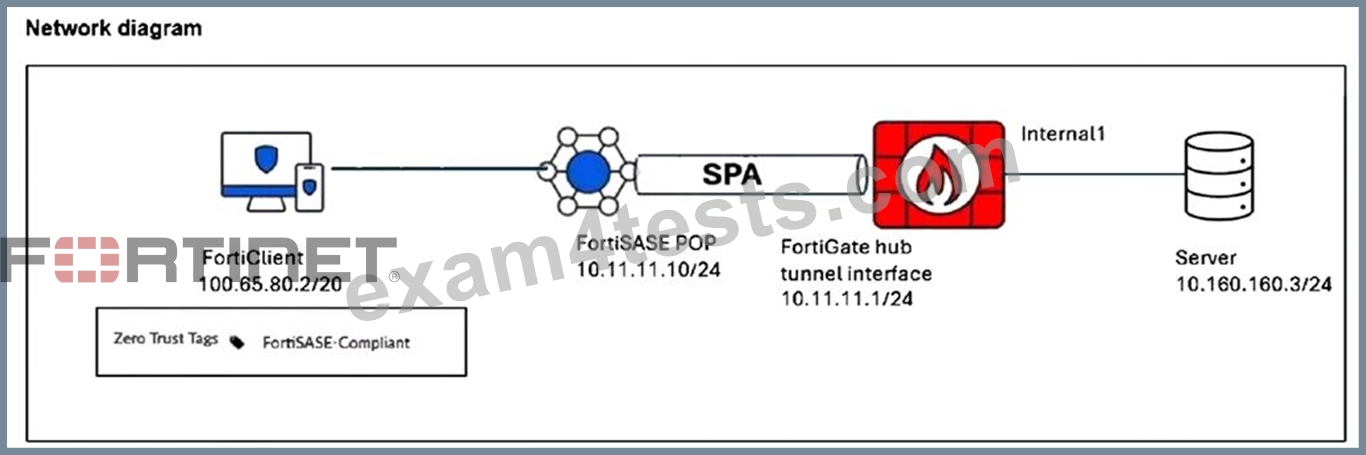
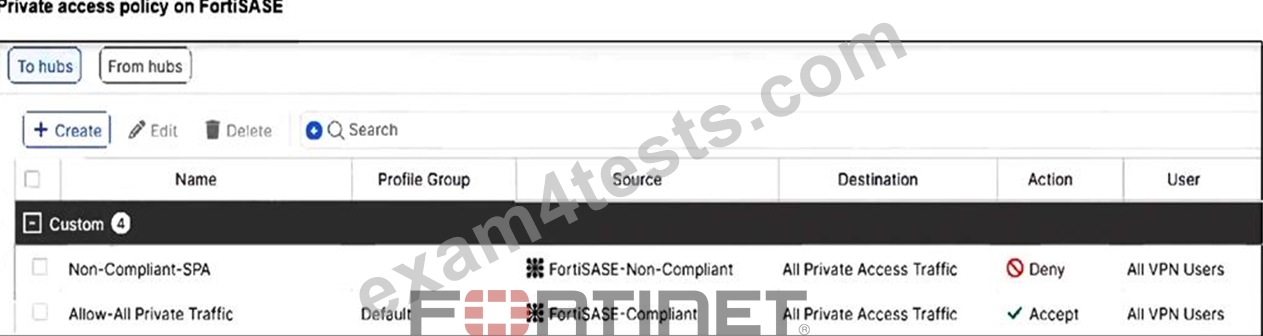
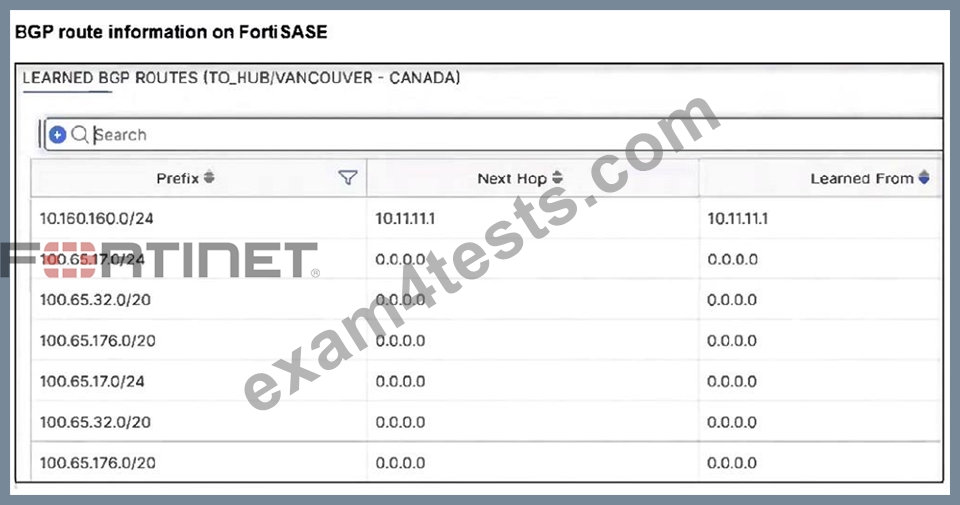
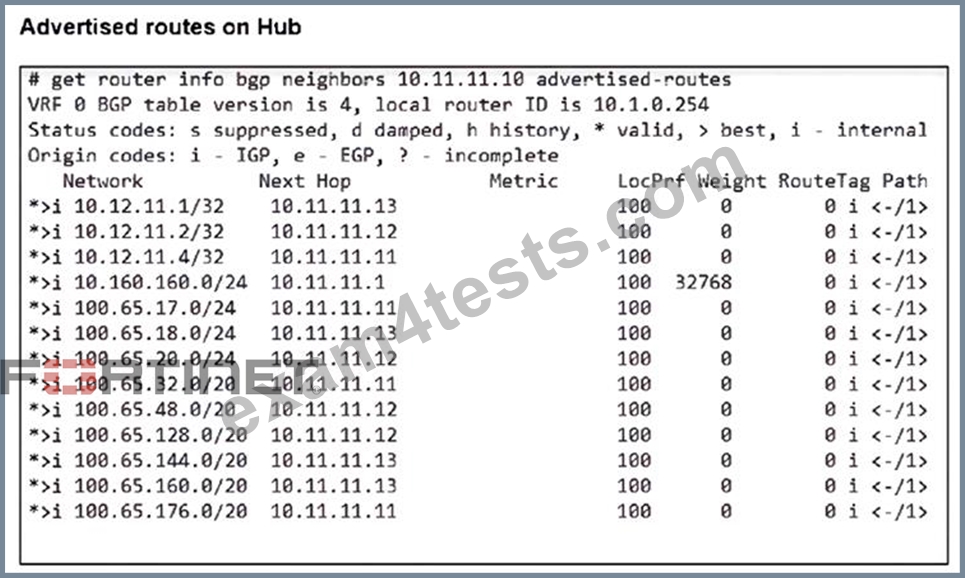
A FortiSASE administrator has configured FortiSASE as a spoke to a FortiGate hub. The tunnel is up to the FortiGate hub. However, the remote FortiClient is not able to access the web server hosted behind the FortiGate hub.
Based on the exhibits, what is the reason for the access failure?
- A. A private access policy has denied the traffic because of failed compliance
- B. The hub firewall policy does not include the FortiClient address range.
- C. The hub is not advertising the required routes.
- D. The server subnet BGP route was not received on FortiSASE.
Answer: B
NEW QUESTION # 40
Refer to the exhibit.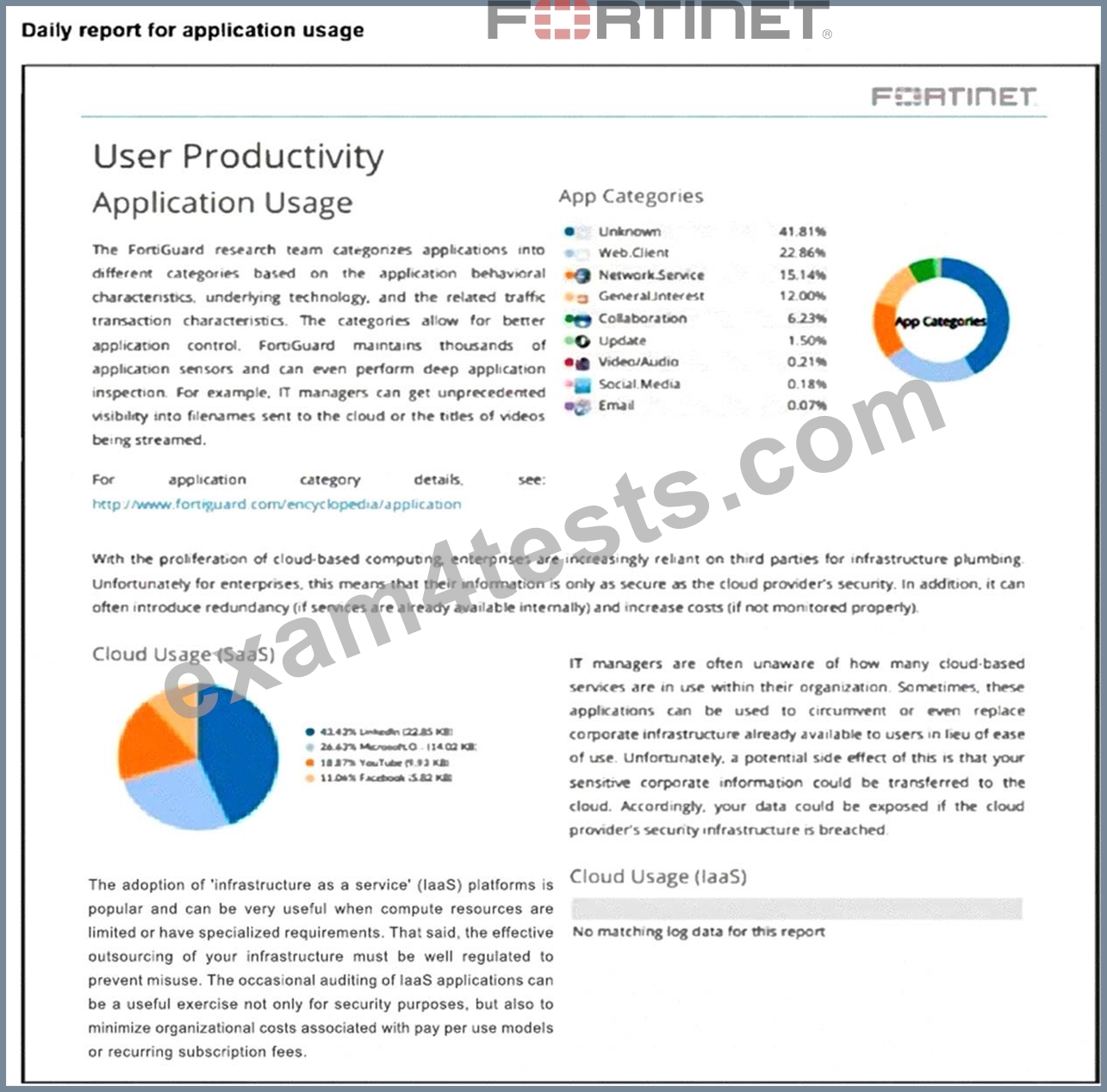
The daily report for application usage for internet traffic shows an unusually high number of unknown applications by category.
What are two possible explanations for this? (Choose two.)
- A. The private access policy must be to set to log Security Events.
- B. Deep inspection is not being used to scan traffic.
- C. The inline-CASB application control profile does not have application categories set to Monitor.
- D. Certificate inspection is not being used to scan application traffic.
Answer: B,D
NEW QUESTION # 41
For monitoring potentially unwanted applications on endpoints, which information is available on the FortiSASE software installations page?
- A. the usage frequency of the software
- B. the vendor of the software
- C. the license status of the software
- D. the endpoint the software is installed on
Answer: D
Explanation:
The FortiSASE software installations page shows which endpoints have specific software installed, allowing administrators to monitor potentially unwanted applications across the network.
NEW QUESTION # 42
A customer wants to upgrade their legacy on-premises proxy to a could-based proxy for a hybrid network. Which FortiSASE features would help the customer to achieve this outcome?
- A. SD-WAN and NGFW
- B. secure web gateway (SWG) and inline-CASB
- C. zero trust network access (ZTNA) and next generation firewall (NGFW)
- D. SD-WAN and inline-CASB
Answer: B
Explanation:
For a customer looking to upgrade their legacy on-premises proxy to a cloud-based proxy for a hybrid network, the combination of Secure Web Gateway (SWG) and Inline Cloud Access Security Broker (CASB) features in FortiSASE will provide the necessary capabilities.
Secure Web Gateway (SWG):
SWG provides comprehensive web security by inspecting and filtering web traffic to protect against web-based threats.
It ensures that all web traffic, whether originating from on-premises or remote locations, is inspected and secured by the cloud-based proxy.
Inline Cloud Access Security Broker (CASB):
CASB enhances security by providing visibility and control over cloud applications and services.
Inline CASB integrates with SWG to enforce security policies for cloud application usage, preventing unauthorized access and data leakage.
FortiOS 7.2 Administration Guide: Details on SWG and CASB features.
FortiSASE 23.2 Documentation: Explains how SWG and inline-CASB are used in cloud-based proxy solutions.
NEW QUESTION # 43
Refer to the exhibits.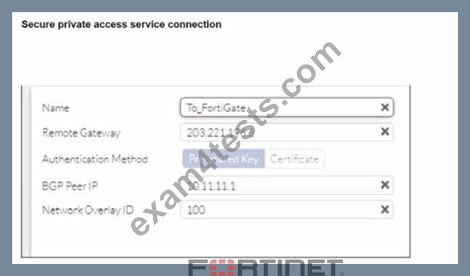
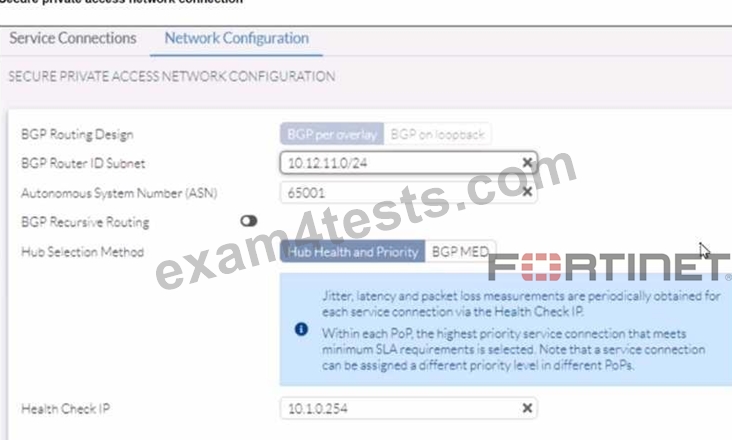
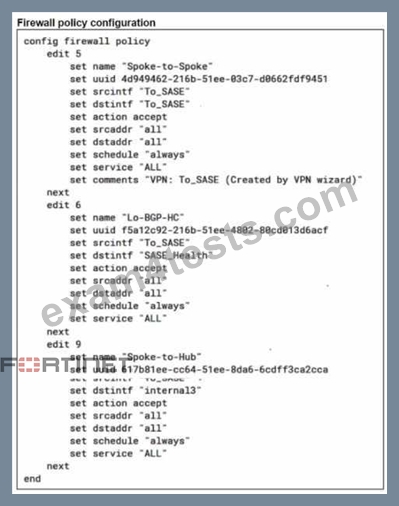
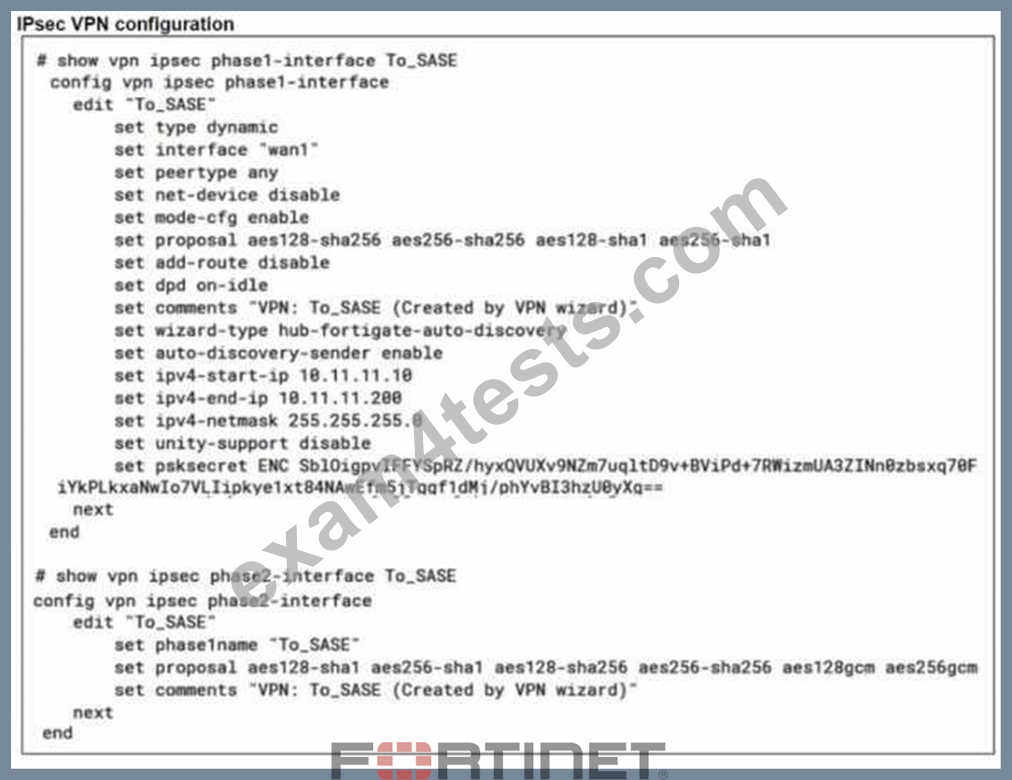
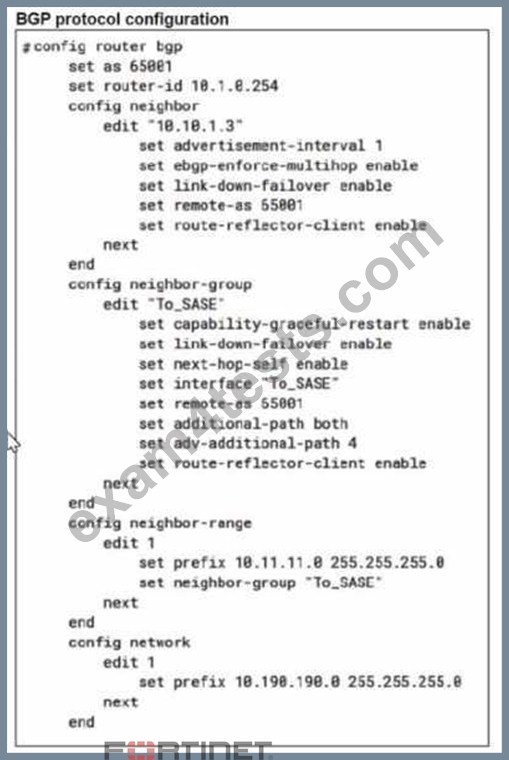
A FortiSASE administrator is trying to configure FortiSASE as a spoke to a FortiGate hub. The VPN tunnel does not establish Based on the provided configuration, what configuration needs to be modified to bring the tunnel up?
- A. The BGP router ID needs to match on the hub and FortiSASE.
- B. NAT needs to be enabled in the Spoke-to-Hub firewall policy.
- C. The hub needs IKEv2 enabled in the IPsec phase 1 settings.
- D. FortiSASE spoke devices do not support mode config.
Answer: C
NEW QUESTION # 44
What is the benefit of SD-WAN on-ramp deployment with FortiSASE?
- A. To secure internet traffic for branch users
- B. To manage branch location endpoints
- C. To provide access to private applications using the bookmark portal
- D. To provide device compliance checks using ZTNA tags
Answer: A
Explanation:
SD-WAN on-ramp with FortiSASE directs branch user internet traffic to the FortiSASE cloud for consistent security enforcement and protection, regardless of the branch location.
NEW QUESTION # 45
What are two benefits of deploying secure private access with SD-WAN? (Choose two.)
- A. inline security inspection by FortiSASE
- B. a direct access proxy tunnel from FortiClient to the on-premises FortiGate
- C. ZTNA posture check performed by the hub FortiGate
- D. support of both TCP and UDP applications
Answer: C,D
Explanation:
Deploying secure private access with SD-WAN enables the hub FortiGate to perform ZTNA posture checks, and supports both TCP and UDP applications over the tunnel, allowing for flexible and secure access to internal resources.
NEW QUESTION # 46
What are two advantages of using zero-trust tags? (Choose two.)
- A. Zero-trust tags can be used to create multiple endpoint profiles which can be applied to different endpoints
- B. Zero-trust tags can determine the security posture of an endpoint.
- C. Zero-trust tags can be used to allow secure web gateway (SWG) access
- D. Zero-trust tags can be used to allow or deny access to network resources
Answer: B,D
Explanation:
Zero-trust tags are critical in implementing zero-trust network access (ZTNA) policies. Here are the two key advantages of using zero-trust tags:
Access Control (Allow or Deny):
Zero-trust tags can be used to define policies that either allow or deny access to specific network resources based on the tag associated with the user or device.
This granular control ensures that only authorized users or devices with the appropriate tags can access sensitive resources, thereby enhancing security.
Determining Security Posture:
Zero-trust tags can be utilized to assess and determine the security posture of an endpoint.
Based on the assigned tags, FortiSASE can evaluate the device's compliance with security policies, such as antivirus status, patch levels, and configuration settings.
Devices that do not meet the required security posture can be restricted from accessing the network or given limited access.
FortiOS 7.2 Administration Guide: Provides detailed information on configuring and using zero-trust tags for access control and security posture assessment.
FortiSASE 23.2 Documentation: Explains how zero-trust tags are implemented and used within the FortiSASE environment for enhancing security and compliance.
NEW QUESTION # 47
How does FortiSASE hide user information when viewing and analyzing logs?
- A. By hashing data using Blowfish
- B. By encrypting data using advanced encryption standard (AES)
- C. By encrypting data using Secure Hash Algorithm 256-bit (SHA-256)
- D. By hashing data using salt
Answer: D
Explanation:
FortiSASE hides user information when viewing and analyzing logs by hashing data using salt. This approach ensures that sensitive user information is obfuscated, enhancing privacy and security.
Hashing Data with Salt:
Hashing data involves converting it into a fixed-size string of characters, which is typically a hash value.
Salting adds random data to the input of the hash function, ensuring that even identical inputs produce different hash values.
This method provides enhanced security by making it more difficult to reverse-engineer the original data from the hash value.
Security and Privacy:
Using salted hashes ensures that user information remains secure and private when stored or analyzed in logs.
This technique is widely used in security systems to protect sensitive data from unauthorized access.
FortiOS 7.2 Administration Guide: Provides information on log management and data protection techniques.
FortiSASE 23.2 Documentation: Details on how FortiSASE implements data hashing and salting to secure user information in logs.
NEW QUESTION # 48
Which FortiSASE feature ensures least-privileged user access to all applications?
- A. thin branch SASE extension
- B. zero trust network access (ZTNA)
- C. secure web gateway (SWG)
- D. SD-WAN
Answer: B
Explanation:
Zero Trust Network Access (ZTNA) is the FortiSASE feature that ensures least-privileged user access to all applications. ZTNA operates on the principle of "never trust, always verify," providing secure access based on the identity of users and devices, regardless of their location.
Zero Trust Network Access (ZTNA):
ZTNA ensures that only authenticated and authorized users and devices can access applications.
It applies the principle of least privilege by granting access only to the resources required by the user, minimizing the potential for unauthorized access.
Implementation:
ZTNA continuously verifies user and device trustworthiness and enforces granular access control policies.
This approach enhances security by reducing the attack surface and limiting lateral movement within the network.
FortiOS 7.2 Administration Guide: Provides detailed information on ZTNA and its role in ensuring least-privileged access.
FortiSASE 23.2 Documentation: Explains the implementation and benefits of ZTNA within the FortiSASE environment.
NEW QUESTION # 49
Refer to the exhibits.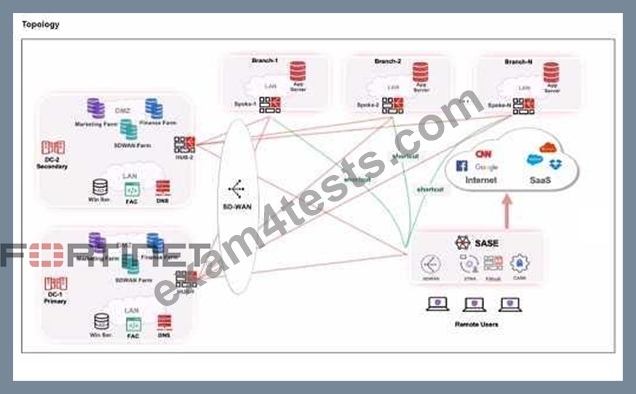
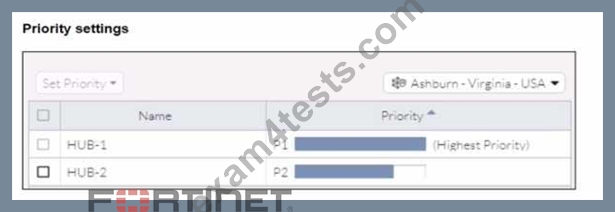
When remote users connected to FortiSASE require access to internal resources on Branch-2. how will traffic be routed?
- A. FortiSASE will use the AD VPN protocol and determine that traffic will be directed to Branch-2 directly, using a dynamic route
- B. FortiSASE will use the AD VPN protocol and determine that traffic will be directed to Branch-2 directly, using a static route
- C. FortiSASE will use the SD-WAN capability and determine that traffic will be directed to HUB-1, which will then route traffic to Branch-2.
- D. FortiSASE will use the SD-WAN capability and determine that traffic will be directed to HUB-2. which will then route traffic to Branch-2.
Answer: A
NEW QUESTION # 50
Which two purposes is the dedicated IP address used for in a FortiSASE deployment? (Choose two.)
- A. For allocation and assignment of unique IP addresses to remote users
- B. For isolation and identification
- C. For user access control to FortiSASE
- D. For regulatory compliance
Answer: B,D
NEW QUESTION # 51
Which two advantages does FortiSASE bring to businesses with multiple branch offices? (Choose two.)
- A. It eliminates the need to have an on-premises firewall for each branch.
- B. it offers customizable dashboard views for each branch location
- C. It enables seamless integration with third-party firewalls.
- D. It offers centralized management for simplified administration.
Answer: A,D
Explanation:
FortiSASE brings the following advantages to businesses with multiple branch offices:
Centralized Management for Simplified Administration:
FortiSASE provides a centralized management platform that allows administrators to manage security policies, configurations, and monitoring from a single interface.
This simplifies the administration and reduces the complexity of managing multiple branch offices.
Eliminates the Need for On-Premises Firewalls:
FortiSASE enables secure access to the internet and cloud applications without requiring dedicated on-premises firewalls at each branch office.
This reduces hardware costs and simplifies network architecture, as security functions are handled by the cloud-based FortiSASE solution.
FortiOS 7.2 Administration Guide: Provides information on the benefits of centralized management and cloud-based security solutions.
FortiSASE 23.2 Documentation: Explains the advantages of using FortiSASE for businesses with multiple branch offices, including reduced need for on-premises firewalls.
NEW QUESTION # 52
......
Download Exam FCSS_SASE_AD-25 Practice Test Questions with 100% Verified Answers: https://www.exam4tests.com/FCSS_SASE_AD-25-valid-braindumps.html
Share Latest FCSS_SASE_AD-25Test Practice Test Questions, Exam Dumps: https://drive.google.com/open?id=1g6d6YJnCpQLH_vxD3RdzFZhebEeQdUD5