

[Nov-2021] Use Real DP-100 Dumps Free Sample Questions and Practice Test Engine
Pass Microsoft DP-100 exam - questions - convert Tets Engine to PDF
Testing Process Details of Microsoft DP-100
As for the exam format, there are usually about 40-60 multiple-choice, active screen, best answer, hot area, build lists, labs, mark review and other question styles. You are expected to complete them in 3 hours. The passing score is 700 out of 1000 maximum possible points. The test is available in the following languages: English, Japanese, Korean, and Chinese (Simplified). To schedule your test, you should first pay the registration fee of $165 and go to the Pearson VUE platform to create an account. Once you log in, choose the “Proctored Exams” section and enter ‘DP-100' as the exam code. Follow the prompts to complete registration. At this stage, you can choose to take your test offline or online. Notice, though, that if you don't succeed on the first try, you'll be required to pay the enrollment fee for the next attempt as well.
NEW QUESTION 113
You are working on a classification task. You have a dataset indicating whether a student would like to play soccer and associated attributes. The dataset includes the following columns:
You need to classify variables by type.
Which variable should you add to each category? To answer, select the appropriate options in the answer area.
NOTE: Each correct selection is worth one point.
Answer:
Explanation:
Explanation
References:
https://www.edureka.co/blog/classification-algorithms/
NEW QUESTION 114
You plan to run a script as an experiment using a Script Run Configuration. The script uses modules from the scipy library as well as several Python packages that are not typically installed in a default conda environment You plan to run the experiment on your local workstation for small datasets and scale out the experiment by running it on more powerful remote compute clusters for larger datasets.
You need to ensure that the experiment runs successfully on local and remote compute with the least administrative effort.
What should you do?
- A. Create and register an Environment that includes the required packages. Use this Environment for all experiment runs.
- B. Do not specify an environment in the run configuration for the experiment. Run the experiment by using the default environment.
- C. Always run the experiment with an Estimator by using the default packages.
- D. Create a virtual machine (VM) with the required Python configuration and attach the VM as a compute target. Use this compute target for all experiment runs.
- E. Create a config.yaml file defining the conda packages that are required and save the file in the experiment folder.
Answer: A
Explanation:
Explanation
If you have an existing Conda environment on your local computer, then you can use the service to create an environment object. By using this strategy, you can reuse your local interactive environment on remote runs.
Reference:
https://docs.microsoft.com/en-us/azure/machine-learning/how-to-use-environments
NEW QUESTION 115
You deploy a model as an Azure Machine Learning real-time web service using the following code.
The deployment fails.
You need to troubleshoot the deployment failure by determining the actions that were performed during deployment and identifying the specific action that failed.
Which code segment should you run?
- A. service.serialize()
- B. service.state
- C. service.get_logs()
- D. service.update_deployment_state()
Answer: C
Explanation:
You can print out detailed Docker engine log messages from the service object. You can view the log for ACI, AKS, and Local deployments. The following example demonstrates how to print the logs.
# if you already have the service object handy
print(service.get_logs())
# if you only know the name of the service (note there might be multiple services with the same name but different version number) print(ws.webservices['mysvc'].get_logs()) Reference:
https://docs.microsoft.com/en-us/azure/machine-learning/how-to-troubleshoot-deployment
NEW QUESTION 116
You need to configure the Feature Based Feature Selection module based on the experiment requirements and datasets.
How should you configure the module properties? To answer, select the appropriate options in the dialog box in the answer area.
NOTE: Each correct selection is worth one point.
Answer:
Explanation:
Explanation:
Box 1: Mutual Information.
The mutual information score is particularly useful in feature selection because it maximizes the mutual information between the joint distribution and target variables in datasets with many dimensions.
Box 2: MedianValue
MedianValue is the feature column, , it is the predictor of the dataset.
Scenario: The MedianValue and AvgRoomsinHouse columns both hold data in numeric format. You need to select a feature selection algorithm to analyze the relationship between the two columns in more detail.
References:
https://docs.microsoft.com/en-us/azure/machine-learning/studio-module-reference/filter-based-feature-selection
NEW QUESTION 117
You are conducting feature engineering to prepuce data for further analysis.
The data includes seasonal patterns on inventory requirements.
You need to select the appropriate method to conduct feature engineering on the data.
Which method should you use?
- A. One Class Support Vector Machine module
- B. Time Series Anomaly Detection module
- C. Exponential Smoothing (ETS) function.
- D. Finite Impulse Response (FIR) Filter module.
Answer: D
NEW QUESTION 118
You are creating a new experiment in Azure Machine Learning Studio.
You have a small dataset that has missing values in many columns.
The data does not require the application of predictors for each column.
You plan to use the Clean Missing Data module to handle the missing data.
You need to select a data cleaning method.
Which method should you use?
- A. Replace using MICE
- B. Replace using; Probabilistic PCA
- C. Normalization
- D. Synthetic Minority Oversampling Technique (SMOTE)
Answer: D
NEW QUESTION 119
You configure a Deep Learning Virtual Machine for Windows.
You need to recommend tools and frameworks to perform the following:
Build deep rwur.il network (DNN) models.
Perform interactive data exploration and visualization.
Which tools and frameworks should you recommend? To answer, drag the appropriate tools to the correct tasks. Each tool may be used once, more than once, or not at all. You may need to drag the split bar between panes or scroll to view content.
NOTE: Each correct selection is worth one point.
Answer:
Explanation:
NEW QUESTION 120
You are a lead data scientist for a project that tracks the health and migration of birds. You create a multi-image classification deep learning model that uses a set of labeled bird photos collected by experts. You plan to use the model to develop a cross-platform mobile app that predicts the species of bird captured by app users.
You must test and deploy the trained model as a web service. The deployed model must meet the following requirements:
An authenticated connection must not be required for testing.
The deployed model must perform with low latency during inferencing.
The REST endpoints must be scalable and should have a capacity to handle large number of requests when multiple end users are using the mobile application.
You need to verify that the web service returns predictions in the expected JSON format when a valid REST request is submitted.
Which compute resources should you use? To answer, select the appropriate options in the answer area.
NOTE: Each correct selection is worth one point.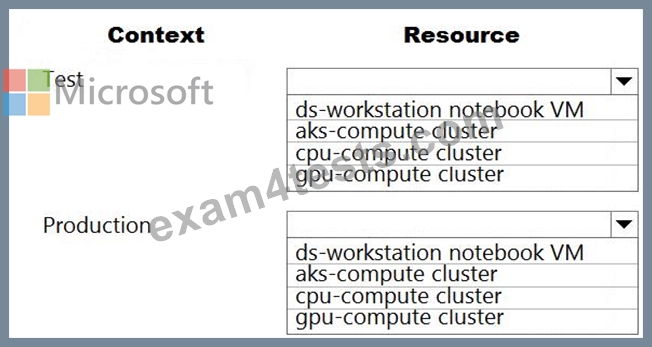
Answer:
Explanation:
Explanation:
Box 1: ds-workstation notebook VM
An authenticated connection must not be required for testing.
On a Microsoft Azure virtual machine (VM), including a Data Science Virtual Machine (DSVM), you create local user accounts while provisioning the VM. Users then authenticate to the VM by using these credentials.
Box 2: gpu-compute cluster
Image classification is well suited for GPU compute clusters
Reference:
https://docs.microsoft.com/en-us/azure/machine-learning/data-science-virtual-machine/dsvm-common-identity
https://docs.microsoft.com/en-us/azure/architecture/reference-architectures/ai/training-deep-learning
NEW QUESTION 121
You arc I mating a deep learning model to identify cats and dogs. You have 25,000 color images.
You must meet the following requirements:
* Reduce the number of training epochs.
* Reduce the size of the neural network.
* Reduce over-fitting of the neural network.
You need to select the image modification values.
Which value should you use? To answer, select the appropriate Options in the answer area.
NOTE: Each correct selection is worth one point.
Answer:
Explanation:
NEW QUESTION 122
Note: This question is part of a series of questions that present the same scenario. Each question in the series contains a unique solution that might meet the stated goals. Some question sets might have more than one correct solution, while others might not have a correct solution.
After you answer a question in this section, you will NOT be able to return to it. As a result, these questions will not appear in the review screen.
You are using Azure Machine Learning Studio to perform feature engineering on a dataset.
You need to normalize values to produce a feature column grouped into bins.
Solution: Apply an Entropy Minimum Description Length (MDL) binning mode.
Does the solution meet the goal?
- A. No
- B. Yes
Answer: B
Explanation:
Entropy MDL binning mode: This method requires that you select the column you want to predict and the column or columns that you want to group into bins. It then makes a pass over the data and attempts to determine the number of bins that minimizes the entropy. In other words, it chooses a number of bins that allows the data column to best predict the target column. It then returns the bin number associated with each row of your data in a column named <colname>quantized.
References:
https://docs.microsoft.com/en-us/azure/machine-learning/studio-module-reference/group-data-into-bins
NEW QUESTION 123
You need to build a feature extraction strategy for the local models.
How should you complete the code segment? To answer, select the appropriate options in the answer area.
NOTE: Each correct selection is worth one point.
Answer:
Explanation:
NEW QUESTION 124
You are developing a hands-on workshop to introduce Docker for Windows to attendees.
You need to ensure that workshop attendees can install Docker on their devices.
Which two prerequisite components should attendees install on the devices? Each correct answer presents part of the solution.
NOTE: Each correct selection is worth one point.
- A. Kitematic
- B. Windows 10 64-bit Professional
- C. VirtualBox
- D. BIOS-enabled virtualization
- E. Microsoft Hardware-Assisted Virtualization Detection Tool
Answer: B,D
Explanation:
C: Make sure your Windows system supports Hardware Virtualization Technology and that virtualization is enabled.
Ensure that hardware virtualization support is turned on in the BIOS settings. For example:
E: To run Docker, your machine must have a 64-bit operating system running Windows 7 or higher.
References:
https://docs.docker.com/toolbox/toolbox_install_windows/
https://blogs.technet.microsoft.com/canitpro/2015/09/08/step-by-step-enabling-hyper-v-for-use-on-windows-10/
NEW QUESTION 125
You create a multi-class image classification deep learning model that uses a set of labeled images. You create a script file named train.py that uses the PyTorch 1.3 framework to train the model.
You must run the script by using an estimator. The code must not require any additional Python libraries to be installed in the environment for the estimator. The time required for model training must be minimized.
You need to define the estimator that will be used to run the script.
Which estimator type should you use?
- A. SKLearn
- B. Estimator
- C. TensorFlow
- D. PyTorch
Answer: D
Explanation:
Explanation
For PyTorch, TensorFlow and Chainer tasks, Azure Machine Learning provides respective PyTorch, TensorFlow, and Chainer estimators to simplify using these frameworks.
Reference:
https://docs.microsoft.com/en-us/azure/machine-learning/how-to-train-ml-models
NEW QUESTION 126
You plan to preprocess text from CSV files. You load the Azure Machine Learning Studio default stop words list.
You need to configure the Preprocess Text module to meet the following requirements:
* Ensure that multiple related words from a single canonical form.
* Remove pipe characters from text.
* Remove words to optimize information retrieval.
Which three options should you select? To answer, select the appropriate options in the answer area.
NOTE: Each correct selection is worth one point.
Answer:
Explanation:
Explanation:
Box 1: Remove stop words
Remove words to optimize information retrieval.
Remove stop words: Select this option if you want to apply a predefined stopword list to the text column. Stop word removal is performed before any other processes.
Box 2: Lemmatization
Ensure that multiple related words from a single canonical form.
Lemmatization converts multiple related words to a single canonical form Box 3: Remove special characters Remove special characters: Use this option to replace any non-alphanumeric special characters with the pipe | character.
References:
https://docs.microsoft.com/en-us/azure/machine-learning/studio-module-reference/preprocess-text
NEW QUESTION 127
You are retrieving data from a large datastore by using Azure Machine Learning Studio.
You must create a subset of the data for testing purposes using a random sampling seed based on the system clock.
You add the Partition and Sample module to your experiment.
You need to select the properties for the module.
Which values should you select? To answer, select the appropriate options in the answer area.
NOTE: Each correct selection is worth one point.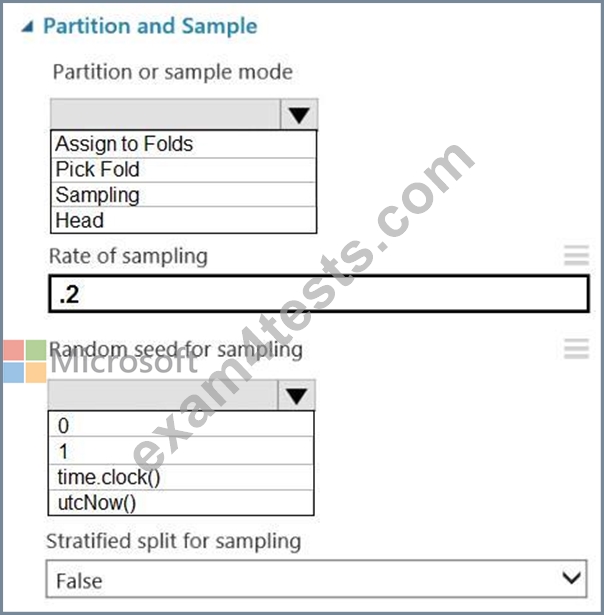
Answer:
Explanation:
Box 1: Sampling
Create a sample of data
This option supports simple random sampling or stratified random sampling. This is useful if you want to create a smaller representative sample dataset for testing.
1. Add the Partition and Sample module to your experiment in Studio, and connect the dataset.
2. Partition or sample mode: Set this to Sampling.
3. Rate of sampling. See box 2 below.
Box 2: 0
3. Rate of sampling. Random seed for sampling: Optionally, type an integer to use as a seed value.
This option is important if you want the rows to be divided the same way every time. The default value is 0, meaning that a starting seed is generated based on the system clock. This can lead to slightly different results each time you run the experiment.
References:
https://docs.microsoft.com/en-us/azure/machine-learning/studio-module-reference/partition-and-sample
NEW QUESTION 128
You are using the Azure Machine Learning Service to automate hyperparameter exploration of your neural network classification model.
You must define the hyperparameter space to automatically tune hyperparameters using random sampling according to following requirements:
* The learning rate must be selected from a normal distribution with a mean value of 10 and a standard deviation of 3.
* Batch size must be 16, 32 and 64.
* Keep probability must be a value selected from a uniform distribution between the range of 0.05 and 0.1.
You need to use the param_sampling method of the Python API for the Azure Machine Learning Service.
How should you complete the code segment? To answer, select the appropriate options in the answer area.
NOTE: Each correct selection is worth one point.
Answer:
Explanation:
Explanation:
In random sampling, hyperparameter values are randomly selected from the defined search space. Random sampling allows the search space to include both discrete and continuous hyperparameters.
Example:
from azureml.train.hyperdrive import RandomParameterSampling
param_sampling = RandomParameterSampling( {
"learning_rate": normal(10, 3),
"keep_probability": uniform(0.05, 0.1),
"batch_size": choice(16, 32, 64)
}
Reference:
https://docs.microsoft.com/en-us/azure/machine-learning/service/how-to-tune-hyperparameters
NEW QUESTION 129
You are preparing to use the Azure ML SDK to run an experiment and need to create compute. You run the following code:
For each of the following statements, select Yes if the statement is true. Otherwise, select No.
NOTE: Each correct selection is worth one point.
Answer:
Explanation:
Explanation:
Box 1: No
If a training cluster already exists it will be used.
Box 2: Yes
The wait_for_completion method waits for the current provisioning operation to finish on the cluster.
Box 3: Yes
Low Priority VMs use Azure's excess capacity and are thus cheaper but risk your run being pre-empted.
Box 4: No
Need to use training_compute.delete() to deprovision and delete the AmlCompute target.
Reference:
https://notebooks.azure.com/azureml/projects/azureml-getting-started/html/how-to-use-azureml/training/train-on-amlcompute/train-on-amlcompute.ipynb
https://docs.microsoft.com/en-us/python/api/azureml-core/azureml.core.compute.computetarget
NEW QUESTION 130
You plan to run a script as an experiment using a Script Run Configuration. The script uses modules from the scipy library as well as several Python packages that are not typically installed in a default conda environment.
You plan to run the experiment on your local workstation for small datasets and scale out the experiment by running it on more powerful remote compute clusters for larger datasets.
You need to ensure that the experiment runs successfully on local and remote compute with the least administrative effort.
What should you do?
- A. Create and register an Environment that includes the required packages. Use this Environment for all experiment runs.
- B. Do not specify an environment in the run configuration for the experiment. Run the experiment by using the default environment.
- C. Always run the experiment with an Estimator by using the default packages.
- D. Create a virtual machine (VM) with the required Python configuration and attach the VM as a compute target. Use this compute target for all experiment runs.
- E. Create a config.yaml file defining the conda packages that are required and save the file in the experiment folder.
Answer: A
Explanation:
If you have an existing Conda environment on your local computer, then you can use the service to create an environment object. By using this strategy, you can reuse your local interactive environment on remote runs.
Reference:
https://docs.microsoft.com/en-us/azure/machine-learning/how-to-use-environments
NEW QUESTION 131
......
Pass Your DP-100 Exam Easily - Real DP-100 Practice Dump Updated Nov 22, 2021: https://www.exam4tests.com/DP-100-valid-braindumps.html
2021 Realistic Verified Free Microsoft DP-100 Exam Questions : https://drive.google.com/open?id=13QiA1y8bOF0rToRblC3U5m63VaRg5uun