

Pass Your Microsoft Exam with AZ-220 Exam Dumps (Updated 128 Questions)
AZ-220 Exam Dumps - Microsoft Practice Test Questions
AZ-220:Microsoft Azure IoT Developer Certification Path
AZ-220:Microsoft Azure IoT Developer Exam is foundation level Certification. It is strongly recommended that aspirants for this exam have good command on at least one Azure-supported language, including C#, Node, C, or Python. Anyone who is having keen interest and familiar with general Microsoft Azure IoT developer concepts and the technologies. More than 85% of IoT development role require a good foundation of Microsoft Azure IoT developer concepts.
NEW QUESTION 75
You have an Azure IoT hub that is being taken from prototype to production.
You plan to connect IoT devices to the IoT hub. The devices have hardware security modules (HSMs).
You need to use the most secure authentication method between the devices and the IoT hub. Company policy prohibits the use of internally generated certificates.
Which authentication method should you use?
- A. a certificate thumbprint
- B. An X.509 certificate signed by a root certification authority (CA).
- C. an X.509 self-signed certificate
- D. a symmetric key
Answer: B
Explanation:
Purchase X.509 certificates from a root certificate authority (CA). This method is recommended for production environments.
The hardware security module, or HSM, is used for secure, hardware-based storage of device secrets, and is the most secure form of secret storage. Both X.509 certificates and SAS tokens can be stored in the HSM Reference:
https://docs.microsoft.com/en-us/azure/iot-dps/concepts-security
NEW QUESTION 76
You need to install the Azure IoT Edge runtime on a new device that runs Windows 10 IoT Enterprise.
Which four actions should you perform in sequence? To answer, move the appropriate actions from the list of actions to the answer area and arrange them in the correct order.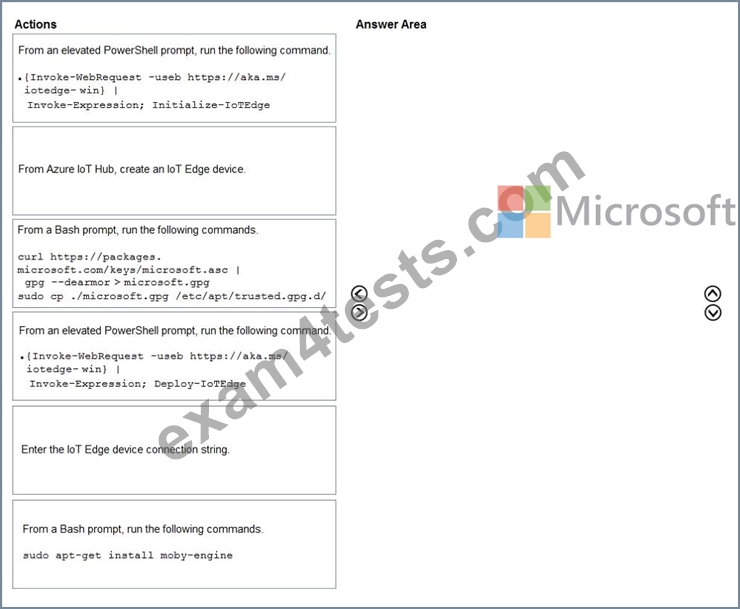
Answer:
Explanation: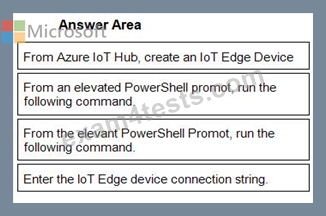
1 - From Azure IoT Hub, create an IoT Edge Device
2 - From an elevated PowerShell promot, run the following command.
3 - From the elevant PowerShell Promot, run the following command.
4 - Enter the loT Edge device connection string.
Reference:
https://docs.microsoft.com/en-us/azure/iot-edge/module-composition
NEW QUESTION 77
You have an Azure IoT solution that includes an Azure IoT hub.
You receive a root certification authority (CA) certificate from the security department at your company.
You need to configure the IoT hub to use the root CA certificate.
Which four actions should you perform in sequence? To answer, move the appropriate actions from the list of actions to the answer area and arrange them in the correct order.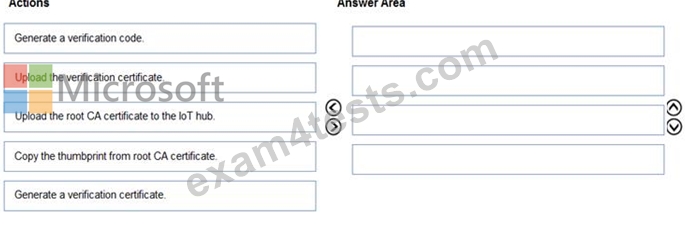
Answer:
Explanation: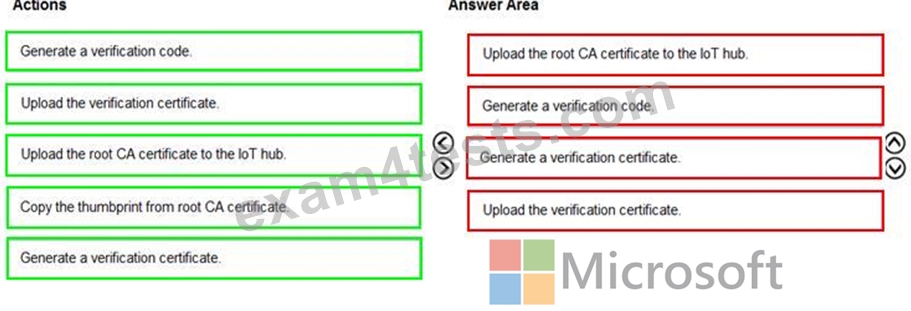
Reference:
https://docs.microsoft.com/bs-latn-ba/azure/iot-hub/iot-hub-security-x509-get-started
NEW QUESTION 78
You have an Azure IoT Edge device named Edge1.
You need to configure the module container to link the module storage to the host storage.
How should you configure the deployment manifest? To answer, drag the appropriate keys to the correct targets. Each key may be used once, more than once, or not at all. You may need to drag the split bar between panes or scroll to view content.
NOTE: Each correct selection is worth one point.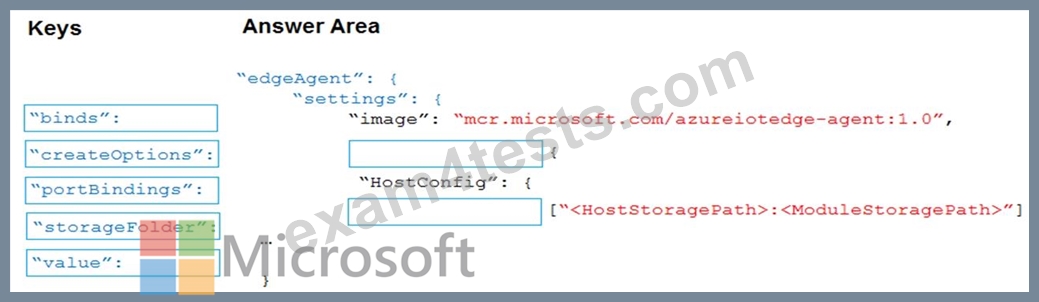
Answer:
Explanation: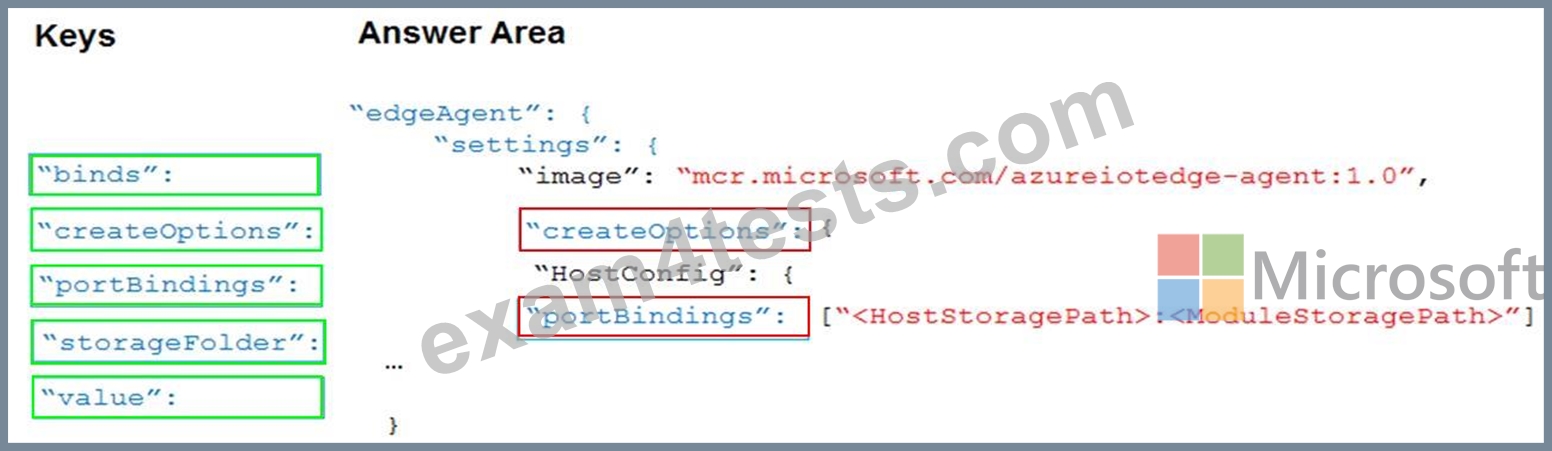
Reference:
https://docs.microsoft.com/en-us/azure/iot-edge/how-to-use-create-options
NEW QUESTION 79
You plan to deploy Azure Time Series Insights.
What should you create on iothub1 before you deploy Time Series Insights?
- A. a new consumer group
- B. a new message route
- C. an IP filter rule
- D. a new shared access policy
Answer: A
Explanation:
Create a dedicated consumer group in the IoT hub for the Time Series Insights environment to consume from.
Each Time Series Insights event source must have its own dedicated consumer group that isn't shared with any other consumer. If multiple readers consume events from the same consumer group, all readers are likely to exhibit failures.
Reference:
https://docs.microsoft.com/en-us/azure/time-series-insights/time-series-insights-how-to-add-an-event-source- iothub
NEW QUESTION 80
Your company develops a custom module and exports the module as a Linux Dockerfile.
You need to deploy the module to an Azure IoT Edge device that runs Ubuntu Server 18.04.
Which three actions should you perform in sequence? To answer, move the appropriate actions from the list of actions to the answer area and arrange them in the correct order.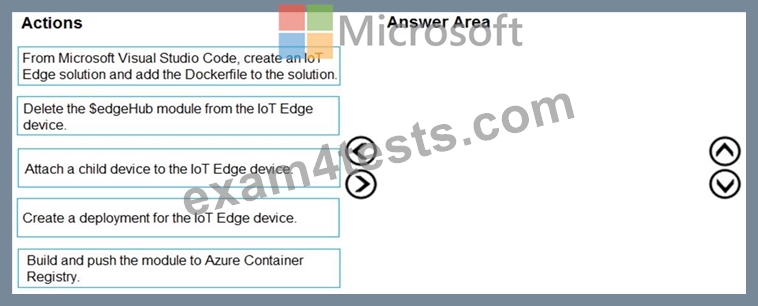
Answer:
Explanation: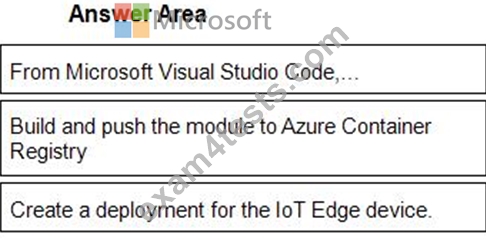
1 - From Microsoft Visual Studio Code,...
2 - Build and push the module to Azure Container Registry
3 - Create a deployment for the IoT Edge device.
Reference:
https://docs.microsoft.com/en-us/azure/iot-edge/tutorial-develop-for-linux?view=iotedge-2020-11
NEW QUESTION 81
You have an Azure IoT Central application that includes a Device Provisioning Service instance.
You need to connect IoT devices to the application without first registering the devices.
In which order should you perform the actions? To answer, move all actions from the list of actions to the answer area and arrange them in the correct order.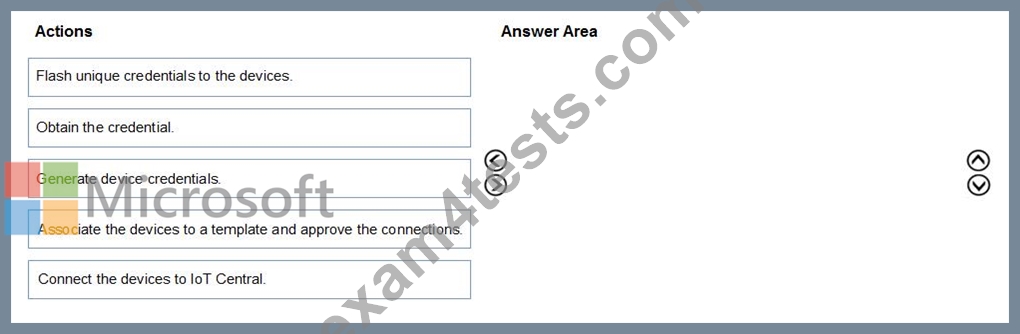
Answer:
Explanation: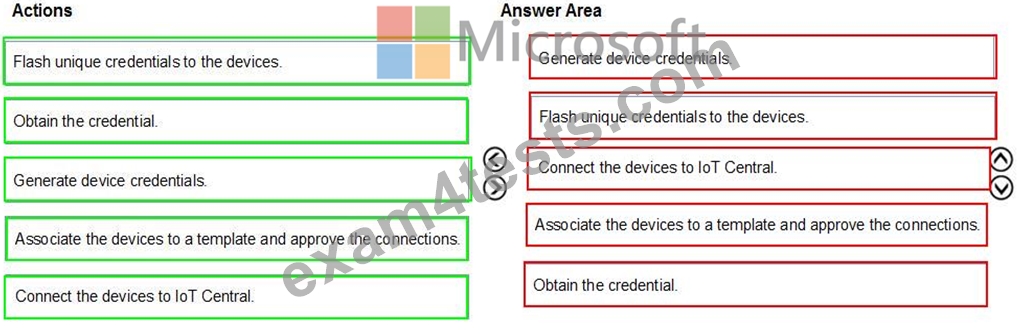
Explanation:
Step: With DPS (Device Provisioning Service) you can generate device credentials and configure the devices offline without registering the devices through IoT Central UI.
Connect devices that use SAS tokens without registering
1. Copy the IoT Central application's group primary key
2. Use the dps-keygen tool to generate the device SAS keys. Use the group primary key from the previous step. The device IDs must be lower-case:
dps-keygen -mk:<group primary key> -di:<device ID>
3. The OEM flashes each device with a device ID, a generated device SAS key, and the application ID scope value.
4. When you switch on a device, it first connects to DPS to retrieve its IoT Central registration information.
The device initially has a device status Unassociated on the Devices page and isn't assigned to a device template. On the Devices page, Migrate the device to the appropriate device template. Device provisioning is now complete, the device status is now Provisioned, and the device can start sending data.
On the Administration > Device connection page, the Auto approve option controls whether you need to manually approve the device before it can start sending data.
Reference:
https://docs.microsoft.com/en-us/azure/iot-central/core/concepts-get-connected
NEW QUESTION 82
You plan to deploy a standard tier Azure IoT hub.
You need to perform an over-the-air (OTA) update on devices that will connect to the IoT hub by using scheduled jobs.
What should you use?
- A. the device twin reported properties
- B. a device-to-cloud message
- C. a cloud-to-device message
- D. a direct method
Answer: D
Explanation:
Releases via the REST API.
All of the operations that can be performed from the Console can also be automated using the REST API. You might do this to automate your build and release process, for example.
You can build firmware using the Particle CLI or directly using the compile source code API.
Note: Over-the-air (OTA) firmware updates are a vital component of any IoT system. Over-the-air firmware updates refers to the practice of remotely updating the code on an embedded device.
Reference:
https://docs.particle.io/tutorials/device-cloud/ota-updates/
NEW QUESTION 83
You use Azure Security Center in an Azure IoT solution.
You need to exclude some security events. The solution must minimize development effort.
What should you do?
- A. Add configuration details to the device twin object.
- B. Create an Azure function to filter security messages.
- C. Add a configuration to the code of the physical IoT device.
- D. Create an azureiotsecurity module twin and add configuration details to the module twin object.
Answer: D
Explanation:
Properties related to every Azure Security Center for IoT security agent are located in the agent configuration object, within the desired properties section, of the azureiotsecurity module.
To modify the configuration, create and modify this object inside the azureiotsecurity module twin identity.
Note: Azure Security Center for IoT's security agent twin configuration object is a JSON format object. The configuration object is a set of controllable properties that you can define to control the behavior of the agent.
These configurations help you customize the agent for each scenario required. For example, automatically excluding some events, or keeping power consumption to a minimal level are possible by configuring these properties.
Reference:
https://docs.microsoft.com/en-us/azure/asc-for-iot/how-to-agent-configuration
NEW QUESTION 84
Note: This question is part of a series of questions that present the same scenario. Each question in the series contains a unique solution that might meet the stated goals. Some question sets might have more than one correct solution, while others might not have a correct solution.
After you answer a question in this section, you will NOT be able to return to it. As a result, these questions will not appear in the review screen.
You have an Azure Stream Analytics job that receives input from an Azure IoT hub and sends the outputs to Azure Blob storage. The job has compatibility level 1.1 and six streaming units.
You have the following query for the job.
You plan to increase the streaming unit count to 12.
You need to optimize the job to take advantage of the additional streaming units and increase the throughput.
Solution: You change the query to the following.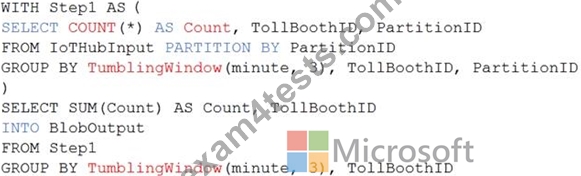
Does this meet the goal?
- A. No
- B. Yes
Answer: B
Explanation:
Max number of Streaming Units with one step and with no partitions is 6.
Reference:
https://docs.microsoft.com/en-us/azure/stream-analytics/stream-analytics-parallelization
NEW QUESTION 85
You need to add Time Series Insights to the solution to meet the pilot requirements.
Which three actions should you perform in sequence? To answer, move the appropriate actions from the list of actions to the answer area and arrange them in the correct order.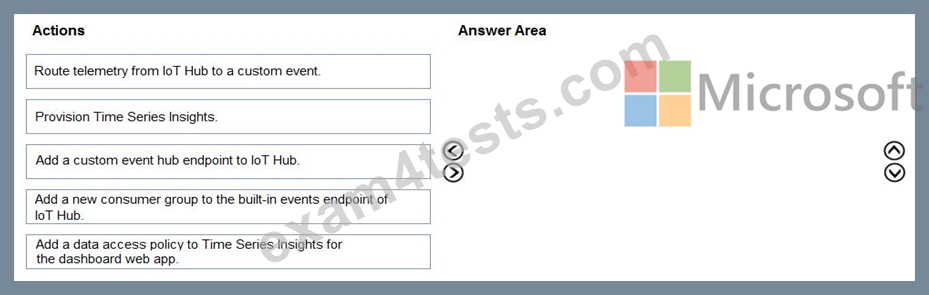
Answer:
Explanation: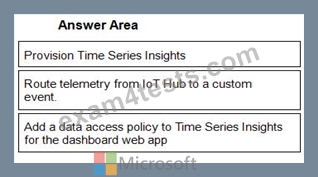
1 - Provision Time Series Insights
2 - Route telemetry from IoT Hub to a custom event.
3 - Add a data access policy to Time Series Insights for the dashboard web app Reference:
https://docs.microsoft.com/en-us/azure/time-series-insights/time-series-insights-update-create-environment
NEW QUESTION 86
You have an Azure IoT Central application that has a custom device template.
You need to configure the device template to support the following activities:
* Return the reported power consumption.
* Configure the desired fan speed.
* Run the device reset routine.
* Read the fan serial number.
Which option should you use for each activity? Each correct answer presents part of the solution.
NOTE: Each correct selection is worth one point.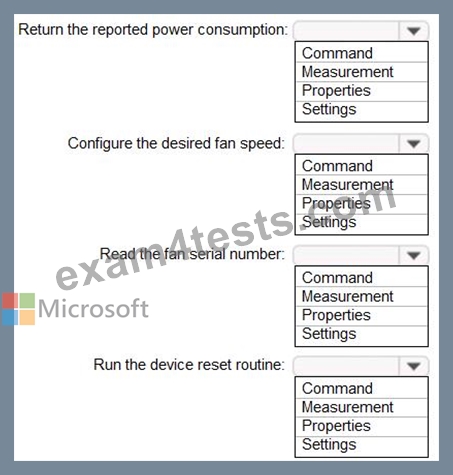
Answer:
Explanation: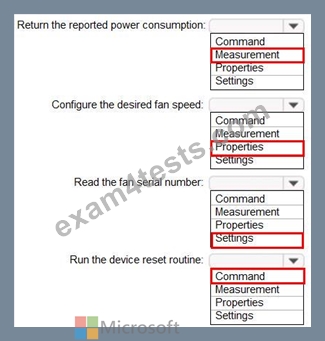
Explanation:
Box 1: Measurement
Telemetry/measurement is a stream of values sent from the device, typically from a sensor. For example, a sensor might report the ambient temperature.
Box 2: Property
The template can provide a writeable fan speed property
Properties represent point-in-time values. For example, a device can use a property to report the target temperature it's trying to reach. You can set writeable properties from IoT Central.
Box 3: Settings
Box 4: Command
You can call device commands from IoT Central. Commands optionally pass parameters to the device and receive a response from the device. For example, you can call a command to reboot a device in 10 seconds.
Reference:
https://docs.microsoft.com/en-us/azure/iot-central/core/howto-set-up-template
NEW QUESTION 87
You have an instance of Azure Time Series Insights and an Azure IoT hub that receives streaming telemetry from IoT devices.
You need to configure Time Series Insights to receive telemetry from the devices.
Which three actions should you perform in sequence? To answer, move the appropriate actions from the list of actions to the answer area and arrange them in the correct order.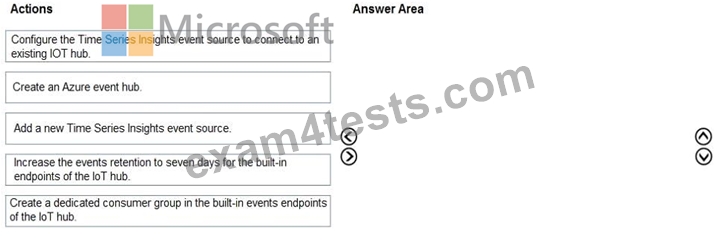
Answer:
Explanation: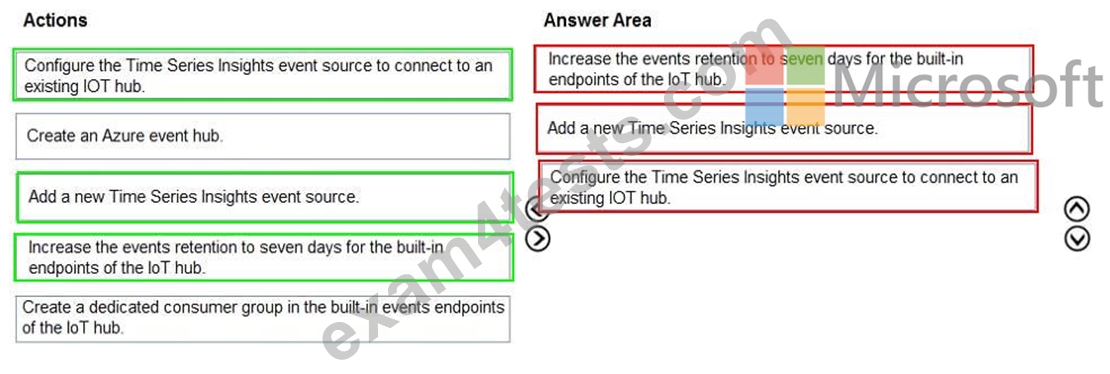
Explanation:
Step 1: Create a dedicated consumer group..
Add a consumer group to your IoT hub.
Applications use consumer groups to pull data from Azure IoT Hub. To reliably read data from your IoT hub, provide a dedicated consumer group that's used only by this Time Series Insights environment.
Step 2: Add a new Time Series Insights event source.
Add a new event source
Sign in to the Azure portal.
In the left menu, select All resources. Select your Time Series Insights environment.
Under Settings, select Event Sources, and then select Add.
In the New event source pane, for Event source name, enter a name that's unique to this Time Series Insights environment. For example, enter event-stream.
Step 3: Configure the Time Series event source to connect to an existing IOT hub Step 4: For Source, select IoT Hub.
Step 5: Select a value for Import option:
If you already have an IoT hub in one of your subscriptions, select Use IoT Hub from available subscriptions. This option is the easiest approach.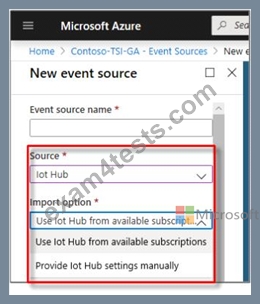
Reference:
https://docs.microsoft.com/en-us/azure/time-series-insights/time-series-insights-how-to-add-an-event-source-iothub
NEW QUESTION 88
You have an Azure IoT hub that uses a Device Provisioning Service instance.
You create a new individual device enrollment that uses symmetric key attestation.
Which detail from the enrollment is required to auto provision the device by using the Device Provisioning Service?
- A. the primary key of the enrollment
- B. the registration ID of the enrollment
- C. the device identity of the IoT hub
- D. the hostname of the IoT hub
Answer: C
Explanation:
An enrollment is the record of devices or groups of devices that may register through auto-provisioning. The enrollment record contains information about the device or group of devices, including:
the attestation mechanism used by the device
the optional initial desired configuration desired IoT hub
the desired device ID
Note: Azure IoT auto-provisioning can be broken into three phases:
1. Service configuration - a one-time configuration of the Azure IoT Hub and IoT Hub Device Provisioning Service instances, establishing them and creating linkage between them.
2. Device enrollment - the process of making the Device Provisioning Service instance aware of the devices that will attempt to register in the future. Enrollment is accomplished by configuring device identity information in the provisioning service, as either an "individual enrollment" for a single device, or a "group enrollment" for multiple devices.
3. Device registration and configuration
Reference:
https://docs.microsoft.com/en-us/azure/iot-dps/concepts-service#enrollment
NEW QUESTION 89
You need to configure Azure IoT Edge module routing to ensure that modules route traffic as shown in the following exhibit.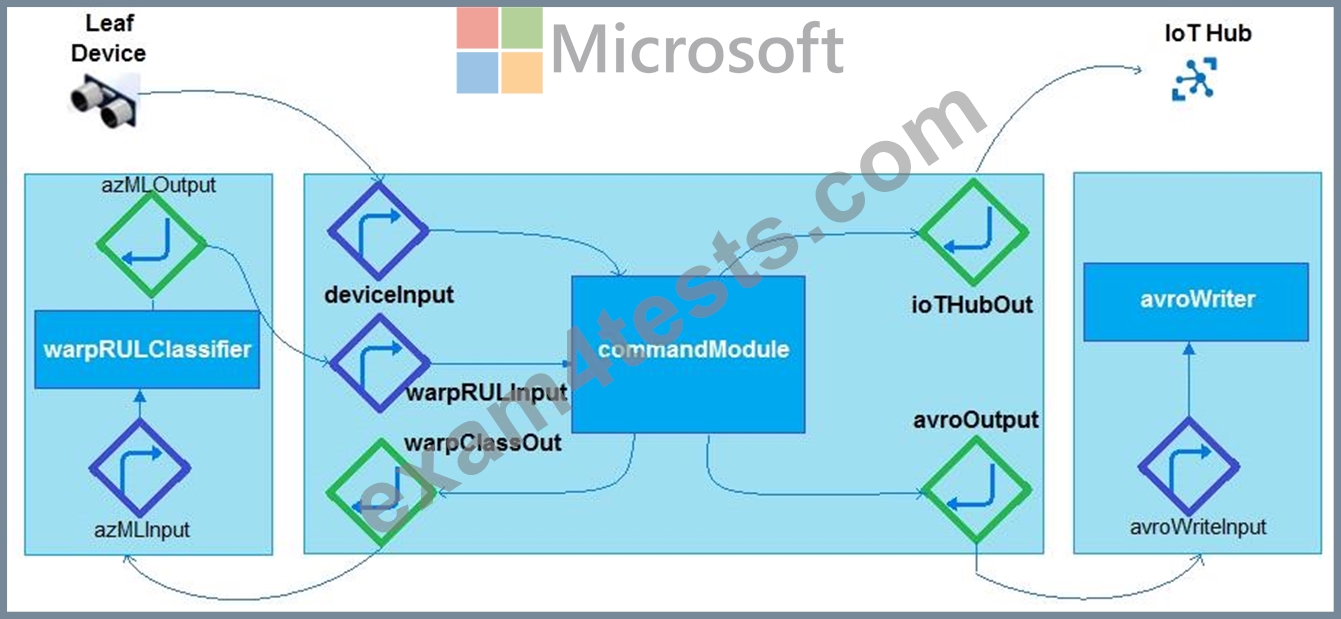
How should you complete the IoT Edge module routes? To answer, select the appropriate options in the answer area.
NOTE: Each correct selection is worth one point.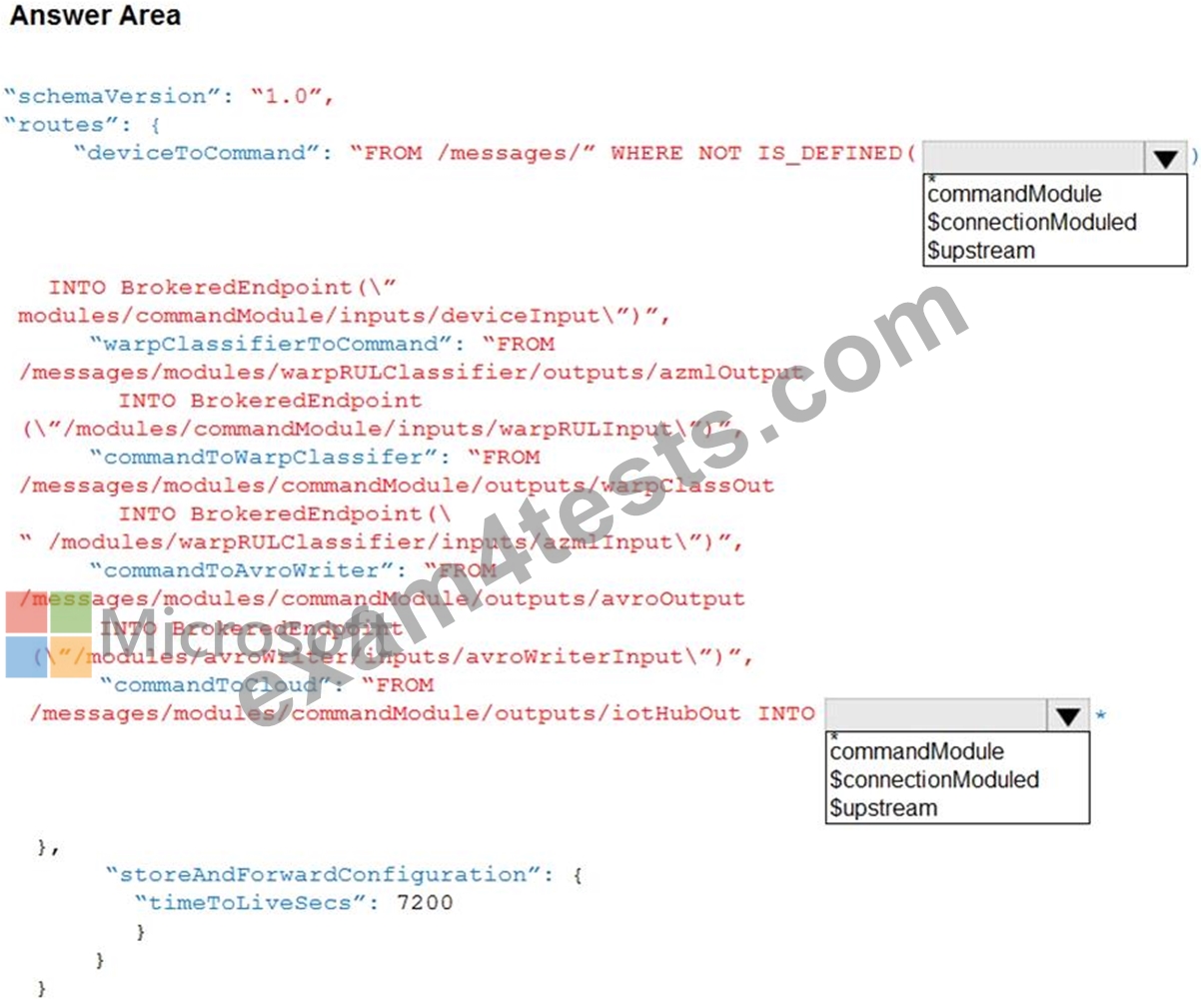
Answer:
Explanation: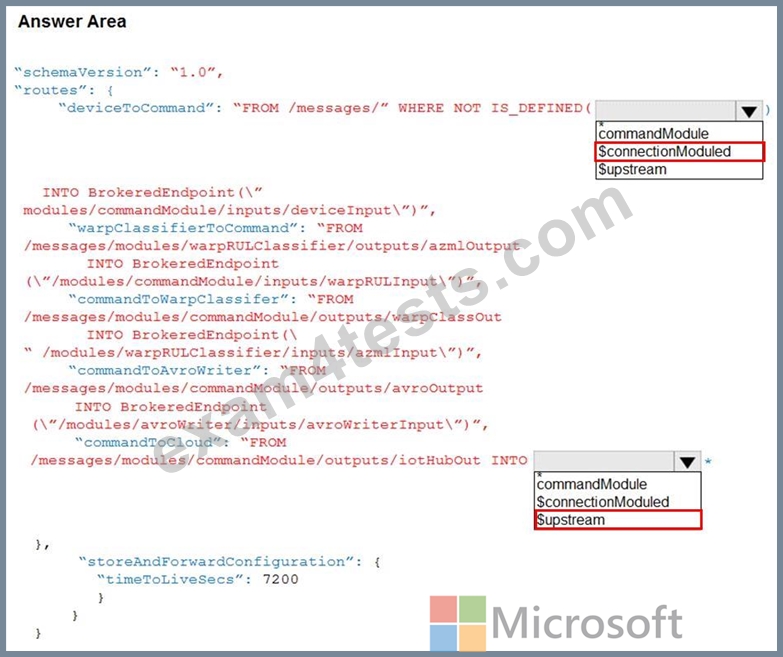
Reference:
https://docs.microsoft.com/en-us/azure/iot-edge/tutorial-machine-learning-edge-06-custom-modules
NEW QUESTION 90
......
New Real AZ-220 Exam Dumps Questions: https://drive.google.com/open?id=1fEezVDfLBQhlQMm_vJZcaCgH1LoFfwXn
Pass Your AZ-220 Exam Easily with Accurate PDF Questions: https://www.exam4tests.com/AZ-220-valid-braindumps.html