

2025 Best Health-Cloud-Accredited-Professional Exam Preparation Material with New Dumps Questions
Free Health-Cloud-Accredited-Professional Exam Files Verified & Correct Answers Downloaded Instantly
Salesforce Health Cloud Accredited Professional Certification Exam covers a wide range of topics related to healthcare operations and patient management, including the use of Salesforce Health Cloud to manage patient data, create and manage care plans, and collaborate with other healthcare professionals. To pass the exam, you must demonstrate a thorough understanding of these topics and be able to apply this knowledge to real-world scenarios.
NEW QUESTION # 30
A Health Cloud administrator would like to setup a new default sub-tab when opening record, where in the setup menu would the administrator go to accomplish this?
- A. Custom Metadata Types
- B. Custom Permissions
- C. Custom Labels
- D. Custom Settings
- E. Custom Object
Answer: D
Explanation:
According to the Health Cloud Implementation Guide, a Health Cloud administrator can change the default sub-tab when opening a record by going to setup, navigating to Custom Settings, and editing the Default Subtab setting. This setting allows you to specify which sub-tab should be displayed by default when opening a record in Health Cloud - Console. The other options are not relevant for changing the default sub-tab.
NEW QUESTION # 31
Which three of the following Health Cloud objects are part of the standard Care Management data Model?
(Choose three)
- A. CarePlanGoal
- B. CareProgramGoal
- C. CarePlan Template Task
- D. TimelineViewConfiguration
- E. CareSpeciality
Answer: A,C,D
NEW QUESTION # 32
A provider's office wants to verify a patient's insurance plan information and coverage when they call into the call center to book an appointment.
Which capability should a consultant leverage to address this requirement?
- A. Benefits Eligibility and Verification
- B. identity Verification
- C. Utilization Management
- D. Intelligent Appointment Management
Answer: A
Explanation:
Benefits Eligibility and Verification is a Health Cloud capability that allows users to verify a patient's insurance plan information and coverage in real time, directly on the patient record1. Users can connect with verification partners easily by integrating with third-party benefits and eligibility services1. Users can also check benefits for medical services, pharmacy, and medical equipment to ensure patients have the required coverage before their visit1.
This capability can help a provider's office to verify a patient's insurance plan information and coverage when they call into the call center to book an appointment. The call center agent can access the patient's account record, click the tab that contains the Benefits Verification component, and see a list of the available health insurance plans for the patient2. The agent can then verify the plan benefits, such as eligibility, coverages, and copayments, by clicking Verify Benefits2. The page then updates with real-time details of the patient's benefits for the selected plan2.
Reference:
1: Get Started with Benefits Verification Unit | Salesforce Trailhead 2: Work with Benefits Verification Unit | Salesforce Trailhead
NEW QUESTION # 33
Bloomington Caregivers has identified the need to encrypt data to comply with the Health Insurance Portability and Accountability Act (HIPAA).
What are three key considerations when complying with HIPAA regulations using Salesforce Shield in conjunction with Bloomington Caregivers' data strategy?
- A. Configuring data retention policies to ensure that records are retained for the appropriate length of time
- B. Implementing audit trails and regularly reviewing them to detect unauthorized access attempts
- C. Providing access to third-party auditors to regularly review Shield implementation settings
- D. Ensuring that sensitive data is encrypted both in transit and at rest
- E. Using third-party data backup solutions to store backups of sensitive data off-site
Answer: A,B,D
Explanation:
The three key considerations when complying with HIPAA regulations using Salesforce Shield in conjunction with Bloomington Caregivers' data strategy are ensuring that sensitive data is encrypted both in transit and at rest, configuring data retention policies to ensure that records are retained for the appropriate length of time, and implementing audit trails and regularly reviewing them to detect unauthorized access attempts. Salesforce Shield provides these features as part of its platform encryption, event monitoring, and field audit trail capabilities.
NEW QUESTION # 34
When setting up Intelligent Sales, which three types of records should an administrator create for a Field Sales Agent before Visit records can be created? (Choose three.)
- A. Assets
- B. Locations
- C. Opportunities
- D. Accounts
- E. Contacts
Answer: B,D,E
NEW QUESTION # 35
Bloomington Caregivers wants to show its end users highlighted information about its providers that work at specific facilities, in one place. This would include provider contact details and the provider's specialty at a given facility. Which Health Cloud feature should a consultant implement to fulfill this requirement?
- A. Facility Relationship Center
- B. Provider Relationship Card
- C. Provider Network Management
- D. HCProvider360 FlexCard
Answer: D
Explanation:
To show end users highlighted information about providers that work at specific facilities, a consultant should implement the Provider Relationship Card feature. This feature allows end users to view information such as provider name, contact details, specialty, role, facility name, and relationship status on a card-like interface on the Facility record page. Provider Network Management, Facility Relationship Center, or HCProvider360 FlexCard are not features that can fulfill this requirement.
NEW QUESTION # 36
An administrator at Bloomington Caregivers has received a change request to alter the appearance of the timeline so that it displays vertically instead of horizontally.
Which step should the administrator take when implementing this change request?
- A. Find the Timeline View Configuration for each relevant timeline in the Health Cloud - Lightning Admin app and change the Orientation to vertical.
- B. Enable Timeline in Salesforce Setup, then set the toggle for vertical orientation to true to set all timeline orientations as vertical.
- C. Enable Timeline in Salesforce Setup. then configure and activate new timeline and add to the relevant Lightning record.
- D. Find the Timeline Orientation setting in Custom Metadata, which controls the orientation of all timelines, and change the value to vertical.
Answer: A
Explanation:
According to the Salesforce documentation1, the Timeline View Configuration is a custom metadata type that defines the appearance and behavior of a timeline in Health Cloud. Each timeline has its own Timeline View Configuration record, which can be accessed and edited from the Health Cloud - Lightning Admin app2. One of the settings that can be changed in the Timeline View Configuration is the Orientation, which controls whether the timeline is displayed horizontally or vertically1. Therefore, to alter the appearance of the timeline so that it displays vertically instead of horizontally, the administrator should find the Timeline View Configuration for each relevant timeline in the Health Cloud - Lightning Admin app and change the Orientation to vertical.
NEW QUESTION # 37
An agent at a MedTech company requires a UI component that displays customer data and contains a link to create a new order. Once clicked, the link starts a process to build a new order and displays the available products for purchase.
Which three OmmStudio capabilities are required to solve this use case?
Choose 3 answers
- A. OmniScript
- B. Document Generation
- C. DataRaptors
- D. FlexCards
- E. Integration Procedures
Answer: A,D,E
Explanation:
To address the use case of creating a UI component for a MedTech company that displays customer data, allows initiating a new order process, and displays available products for purchase, the following OmniStudio capabilities are required:
1. Integration Procedures:
Purpose: Integration Procedures handle server-side logic by connecting with external systems, databases, or Salesforce objects to fetch or update data efficiently.
Role in Use Case: The new order process will likely require data from external systems, such as a product catalog or inventory system. Integration Procedures are ideal for orchestrating these back-end calls and consolidating data to display product availability or order information.
Key Features:
Perform complex, multi-step actions in a single server call.
Fetch data asynchronously, improving UI performance.
Reference:
2. FlexCards:
Purpose: FlexCards are lightweight, reusable UI components that display contextual information on a single screen. They can include links, buttons, and embedded actions.
Role in Use Case: The UI component displaying customer data and providing the link to create a new order is best implemented as a FlexCard.
Key Features:
Can display data fetched via DataRaptors or Integration Procedures.
Easily customizable to match the desired layout and functionality.
3. OmniScript:
Purpose: OmniScripts guide users through multi-step processes with dynamic forms and workflows, integrating seamlessly with FlexCards and Integration Procedures.
Role in Use Case: When the link on the FlexCard is clicked, the OmniScript starts the process to build a new order and display available products. This ensures an intuitive and structured user experience for completing complex processes.
Key Features:
Drag-and-drop UI for creating guided workflows.
Can call Integration Procedures to fetch product details or submit the order.
Capabilities Not Required for This Use Case:
D . DataRaptors: While DataRaptors are crucial for basic data fetch/update operations, the described use case involves orchestrating multiple steps and external system integrations, making Integration Procedures more suitable.
E . Document Generation: This feature is used for generating PDFs or documents, which is not relevant to the process of building a UI component for order creation.
Summary of Implementation:
FlexCards display customer data and include a clickable link to start the new order process.
OmniScript handles the guided workflow to create the order and fetch available products.
Integration Procedures facilitate the server-side logic for fetching products and submitting the order.
OmniStudio Documentation
OmniScript Best Practices
FlexCards for Contextual UI
NEW QUESTION # 38
Which entity in the new data model of Health Cloud can be used to store mappings between different coding systems such ICD and HCC codes?
- A. ContactPoint
- B. Codesets
- C. Identifier
- D. Codeset Bundle
Answer: B
Explanation:
Code Sets are the entity in the new data model of Health Cloud that can be used to store mappings between different coding systems such as ICD and HCC codes. Code Sets are a collection of codes that represent a specific concept or value in a terminology system1.
NEW QUESTION # 39
A pharma company wants the ability to:
* Upload a patient's insurance card, including automatic Member Plan record creation
* Run a benefits verification check
* Schedule on behalf of the patient with a provider
Which set of Health Cloud capabilities should enable the company to build this business process?
- A. Utilization Management, Care Management, Intelligent Document Automation, Intelligent Appointment Management
- B. Virtual Care, Intelligent Appointment Management, Intelligent Document Automation, Intelligent Document Reader
- C. Intelligent Appointment Management, Benefits Verification, Intelligent Document Automation, eFax Integration
- D. Inte,l'9ent Document Automation, Intelligent Appointment Management, Intelligent Document Reader, Benefits Verification
Answer: D
Explanation:
The business process requires a combination of capabilities for handling patient insurance cards, benefits verification, and appointment scheduling. The following Health Cloud capabilities are recommended:
Intelligent Document Automation:
Automates the processing of uploaded documents, such as insurance cards.
Intelligent Document Reader:
Reads data from documents and creates corresponding records (e.g., Member Plan records).
Benefits Verification:
Runs real-time verification checks on insurance plans and coverage.
Intelligent Appointment Management:
Facilitates scheduling appointments on behalf of the patient with the provider.
Why Other Options Are Incorrect:
A & B: These options exclude critical elements like Intelligent Document Reader.
D: Utilization Management and Care Management are unrelated to the stated requirements.
Reference:
Intelligent Document Automation Overview
Intelligent Appointment Management Overview
Benefits Verification Overview
NEW QUESTION # 40
A clinic is looking to manage Its associated physicians within Health Cloud.
Which two objects support Salesforce's recommended approach to model the doctors In the clinic's Health Cloud org?
Choose 2 answers
- A. Healthcare Provider
- B. Person Account
- C. Contact
- D. Healthcare Practitioner
Answer: A,D
Explanation:
To model associated physicians in Health Cloud, Salesforce recommends using a combination of Healthcare Practitioner and Healthcare Provider objects. These objects are tailored to manage data related to healthcare professionals effectively.
Healthcare Practitioner:
Represents individual practitioners like doctors or specialists.
Tracks specific details, such as credentials, specialties, and associated organizations.
Ideal for modeling the clinic's associated physicians.
Healthcare Provider:
Represents the healthcare organizations or facilities with which the practitioners are associated.
Helps establish relationships between practitioners and the broader healthcare ecosystem.
Why Other Options Are Incorrect:
Contact: While Contacts can represent individuals, they lack the specialized fields and relationships provided by Healthcare Practitioner and Provider objects.
Person Account: Primarily used to represent patients, not physicians or healthcare entities.
Reference:
Health Cloud Data Model for Providers
Salesforce Architect: Healthcare Practitioner Object
NEW QUESTION # 41
A customer is looking to implement Discovery Framework to manage their intake and clinical assessments.
Which three capabilities should a consultant configure with Health Cloud out-of-the-box to enhance their assessment functionality?
FHIR Question Bank
- A. Digital Signature Capture
- B. Adding a QR Code
- C. SMS Assessment Completion
- D. Using Previously Submitted Responses
Answer: A,B,D
Explanation:
To enhance their assessment functionality with Discovery Framework, a consultant should configure the following capabilities with Health Cloud out-of-the-box:
Using Previously Submitted Responses: This capability allows users to pre-populate assessment questions with responses from previous assessments, saving time and effort. Users can also edit the responses if needed1.
Digital Signature Capture: This capability allows users to capture electronic signatures from patients or other parties on the assessment form, ensuring consent and compliance. Users can also view and download the signed document as a PDF file2.
Adding a QR Code: This capability allows users to generate a QR code for the assessment form, which can be scanned by patients or other parties to access and complete the assessment on their mobile devices. Users can also track the status of the QR code and send reminders if needed3. FHIR Question Bank or SMS Assessment Completion are not capabilities that are available with Health Cloud out-of-the-box.
NEW QUESTION # 42
How does an administrator display device information on a patient card?
- A. Create a custom field on the FilterCondition_c with a formula that returns the information to display on patient card
- B. Create a custom field on the EHR_Patient object with a formula that returns the information to display on patient card
- C. Create a custom field on the EHR_DeviceRequest with a formula that returns the information to display on patient card
- D. Create an Asset record and create a Care Registered Device record that looks up to the Asset record and then looks up to the Account record for the Patient
- E. Create a custom field on the EHR_MedicalDevices with a formula that returns the nf ormauon to display on patient card
Answer: D
NEW QUESTION # 43
A sales Representative wants to request a Rep-to-Rep Transfer. What two paths are available to request the transfer? (Choose two)
- A. Under visit, choose to navigate to visit Products.
- B. The transfer can be requested while creating an Order Authorization for a Visit.
- C. To Request the transfer, navigate to product, then choose the specific inventory location against which to request the transfer.
- D. During Visit creation you can request the transfer while selecting products required for a visit.
Answer: B,C
Explanation:
According to the Salesforce documentation1, there are two ways to request a rep-to-rep transfer in Health Cloud:
When creating an order authorization for a visit, you can request a transfer from another rep's inventory location by selecting the Transfer option in the Product Selection screen1.
To request a transfer from a specific inventory location, you can navigate to Products, select the product you want to transfer, and then click Request Transfer in the Related list1.
NEW QUESTION # 44
Users need to analyze their patient or member referrals through a prebuilt dashboard that includes reports on important aspects of their referral management.
What should a consultant do in this case?
- A. Upload a Provider Referral Dashboard Template and enable the action bar so that users can generate a Patient referral Management report.
- B. Install the unmanaged extension package that delivers Health Cloud Reports for Patient Referral Management.
- C. Add extra picklist values to Account record type and add fields on the page layout for patient referral data for CRM Analytics to generate a Patient Referral Management report.
- D. Install the add-on package that delivers Health Cloud Reports for Utilization Management and Health Cloud (or Patient Referral Management.
Answer: B
Explanation:
According to the Salesforce documentation1, the Health Cloud Reports for Patient Referral Management is an unmanaged extension package that provides a prebuilt dashboard with reports on important aspects of referral management, such as referral status, referral source, referral age, and referral efficiency. The package also includes custom fields, custom objects, and custom report types to support the dashboard. To use this package, a consultant should install it in their org and assign the appropriate permissions to the users who need to access the dashboard. The package is compatible with Health Cloud and CRM Analytics.
Reference:
1: Provide Referral Management Reports | Health Cloud Administration | Salesforce Developers
NEW QUESTION # 45
When setting up Intelligent Sales, which three types of records should an administrator create for a Field Sales Agent before Visit records can be created? (Choose three.)
- A. Assets
- B. Locations
- C. Opportunities
- D. Accounts
- E. Contacts
Answer: A,B,E
Explanation:
To create Visit records for a Field Sales Agent using Intelligent Sales, the administrator must create Contacts, Locations, and Assets records for the agent. Contacts are the people that the agent visits or interacts with during their sales cycle. Locations are the places where the agent conducts their visits or activities. Assets are the products or devices that the agent sells or services during their visits. Opportunities and Accounts are not required for creating Visit records using Intelligent Sales.
NEW QUESTION # 46
How should a consultant recommend modeling a physician's locations of service, when the physician practices at multiple hospitals and clinics?
- A. Healthcare Provider Relationship
- B. Healthcare Practitioner Facility
- C. Account Contact Relationship
- D. Healthcare Taxonomy
Answer: B
Explanation:
The Healthcare Practitioner Facility object in Salesforce Health Cloud allows modeling of a physician's locations of service. It captures relationships between healthcare practitioners and the facilities (hospitals, clinics, etc.) where they practice.
Key Features of Healthcare Practitioner Facility:
Multiple Locations: Tracks all locations where a physician practices.
Relationships: Links practitioners to facilities, ensuring accurate mapping of service areas.
Operational Benefits: Facilitates scheduling, referrals, and care coordination by providing accurate location data.
Why Other Options Are Incorrect:
Healthcare Taxonomy: Used to classify healthcare providers based on specialties and services, not locations.
Healthcare Provider Relationship: Tracks relationships between healthcare organizations or facilities, not individual physician locations.
Account Contact Relationship: Provides a general relationship mapping but lacks the specificity required for modeling service locations.
Reference:
Health Cloud Data Model for Practitioners and Facilities
NEW QUESTION # 47
Bloomington Caregivers is looking to migrate from Service Cloud to Health Cloud to take advantage of the prebuilt healthcare features and functionality. Which three prerequisites should Bloomington Caregivers' administrators complete to successfully install the Health Cloud managed package in its org?
Choose 3 answers
- A. Enable contacts to relate to multiple accounts.
- B. Log a support case to have person accounts enabled.
- C. Enable data protection details available in records.
- D. Enable Chatter settings from Setup.
- E. Enable person accounts from Setup.
Answer: A,B,D
Explanation:
Migrating from Service Cloud to Health Cloud requires several prerequisites to ensure successful installation and functionality of the Health Cloud managed package:
Key Prerequisites:
Log a Support Case to Enable Person Accounts (Option B):
Health Cloud relies on Person Accounts to manage patients as individuals.
Administrators must contact Salesforce Support to enable Person Accounts in the org since this cannot be activated through Setup.
Enable Contacts to Relate to Multiple Accounts (Option C):
This functionality allows a contact (e.g., a patient) to be associated with multiple accounts, such as primary care providers, specialists, or insurance entities.
Navigate to Setup > Account Settings, and enable Contacts to Multiple Accounts.
Enable Chatter Settings (Option E):
Chatter is used in Health Cloud for collaboration and real-time updates.
Administrators must ensure Chatter is activated to support case discussions, timeline sharing, and other collaborative features.
Other Considerations:
Option A: While enabling data protection is important, it is not a prerequisite for installing Health Cloud.
Option D: Enabling Person Accounts is correct, but it is done via a support case (Option B).
Reference:
Health Cloud Installation Guide
Enabling Person Accounts
Contacts to Multiple Accounts
NEW QUESTION # 48
A provider uses an external appointment management system. The default solution provided by Health Cloud is not viable for the How should a consultant implement a robust system for the provider?
- A. Use an electronic health record (EHR) routing system to book the appointment in Health Cloud.
- B. Create a custom FHIR Adapter to make calls to Health Cloud.
- C. Create an Apex class and leverage Intelligent Appointment Management.
- D. Use a package created by ISV (Independent Software Vendor) for Health Cloud.
Answer: D
Explanation:
To implement a robust appointment management system for a provider that uses an external system, a consultant should use a package created by ISV (Independent Software Vendor) for Health Cloud. This would allow the provider to leverage existing solutions that are integrated with Health Cloud and offer features such as scheduling, reminders, cancellations, rescheduling, and confirmations. Using an EHR routing system, creating a custom FHIR Adapter, or creating an Apex class are not viable options for this requirement3.
NEW QUESTION # 49
A Salesforce Admin wants to create task within a Care plan that ..................................
In the Health cloud console can be used to create tasks ...................................
- A. Timeline Tab
- B. Care Plan Page
- C. Household Tab
- D. Patient List
- E. Care Team
Answer: B,D,E
NEW QUESTION # 50
Where can a Salesforce administrator configuring different levels of access to patients' care plans, configure team members different levels of access to cases to ensure sensitive data is not shared with the wrong groups?
- A. Contact Roles on case
- B. Case Team Roles
- C. Permission Set Groups
- D. Permission Sets
- E. Profiles
Answer: B
Explanation:
Reference and details below.
NEW QUESTION # 51
Which two actions should be completed by health cloud admin in order to leverage the health cloud utilization management capabilities?
- A. Install the healthcloud care request extensions managed package.
- B. Install the health cloud managed package
- C. Assign the health cloud social determinants permission set
- D. Install the heath cloud unmanaged package extension
- E. Assign the health cloud foundation permission set
Answer: A,B
Explanation:
Explanation
Reference and details below.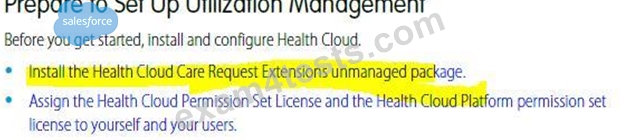
NEW QUESTION # 52
A customer that already has Service Cloud is onboarding a new business unit, which needs to use Health Cloud.
Which three organization-wide default settings should an administrator change to ensure the original business unit that leverages Service Cloud does not have visibility into protected health information (PHI)?
Choose 3 answers
- A. Set related clinical objects to Controlled by Parent or Private.
- B. Set Health Details to Controlled by Parent or Private.
- C. Set Contact to Controlled by Parent.
- D. Set Account and Contract to Private.
- E. Set Person Accounts to Private.
Answer: A,B,E
Explanation:
When onboarding a new business unit to Health Cloud while protecting sensitive data for the existing Service Cloud users, adjusting Organization-Wide Defaults (OWD) is critical.
Recommended Settings:
Health Details to Controlled by Parent or Private:
Ensures that only users with appropriate access to parent records (e.g., Person Accounts or Cases) can view sensitive health-related information.
Person Accounts to Private:
Restricts visibility of patient data at the account level, limiting access to users within the appropriate Health Cloud business unit.
Related Clinical Objects to Controlled by Parent or Private:
Applies restricted access to clinical objects like care plans, conditions, and encounters to ensure that PHI is not accessible to Service Cloud users.
Why Other Options Are Less Suitable:
B . Account and Contract to Private: Relevant for managing non-healthcare data but not directly tied to PHI protection.
D . Contact to Controlled by Parent: While this helps manage access to contact data, it does not address broader clinical objects or PHI.
Reference:
Salesforce Health Cloud Security Best Practices
NEW QUESTION # 53
Which three options are standard objects available for Insurance Management? (choose 3)
- A. Coverage Benefit
- B. PurchaserPlan
- C. MemberPlan
- D. Insurance Benefit
- E. Insurance Coverage
Answer: A,B,C
NEW QUESTION # 54
......
Instant Download Health-Cloud-Accredited-Professional Dumps Q&As Provide PDF&Test Engine: https://www.exam4tests.com/Health-Cloud-Accredited-Professional-valid-braindumps.html
Fast Exam Updates Health-Cloud-Accredited-Professional dumps with PDF Test Engine Practice: https://drive.google.com/open?id=1hSsRfxvFAPfI4Z-IiGE5NaT9FGahmFoF