

2025 Exam4Tests APM APM-PMQ Dumps and Exam Test Engine
APM APM-PMQ DUMPS WITH REAL EXAM QUESTIONS
APM APM-PMQ Exam Syllabus Topics:
| Topic | Details |
|---|---|
| Topic 1 |
|
| Topic 2 |
|
| Topic 3 |
|
| Topic 4 |
|
NEW QUESTION # 18
Which of the below would not usually be recorded within a change request?
- A. Stakeholder opinion.
- B. Cost estimates.
- C. Area(s) of impact.
- D. Benefits.
Answer: A
Explanation:
Detailed Explanation:
* Stakeholder opinion is generally gathered during requirements or stakeholder management but is not a standard part of a formal change request.
NEW QUESTION # 19
You are leading a large-scale information technology project to migrate your company's data to the latest hardware. The delivery is being led by third-party suppliers, who were not involved in the design phase. The supplier has completed their capacity planning and has raised a potential risk that the current data may exceed the storage capacity of the new hardware purchased.
What type of risk response would you choose to mitigate this risk?
- A. Re-forecast the budget to include the likely additional cost.
- B. Transfer the risk to the supplier.
- C. Use the contingency budget to cover the purchase of additional storage.
- D. Tolerate the risk as there may be sufficient storage capacity.
Answer: C
Explanation:
Detailed Explanation:The best approach is to use the contingency budget because:
* Defined Risk Response:Contingency budgets are designed to handle identified risks without impacting the project's main budget.
* Stakeholder Agreement:It avoids escalating disputes with suppliers by addressing the issue proactively.
* Unsuitable Options:
* A: Tolerating the risk is impractical when the risk is confirmed.
* B: Re-forecasting creates unnecessary delays and increases costs.
* D: Transferring risk to the supplier could damage partnerships.
NEW QUESTION # 20
You are the project manager of a project that's currently in the definition phase. After your first meeting, the project sponsor has asked to see the integrated project management plan.
In this scenario, which of the following best describes the importance of an integrated project management plan?
- A. It helps set expectations between the project manager and project sponsor.
- B. It helps new team members understand the project during their onboarding.
- C. It ensures the project's testing strategy will meet the expected level of quality.
- D. It provides a baseline to measure the project's success before the project is closed.
Answer: A
Explanation:
Detailed Explanation:
NEW QUESTION # 21 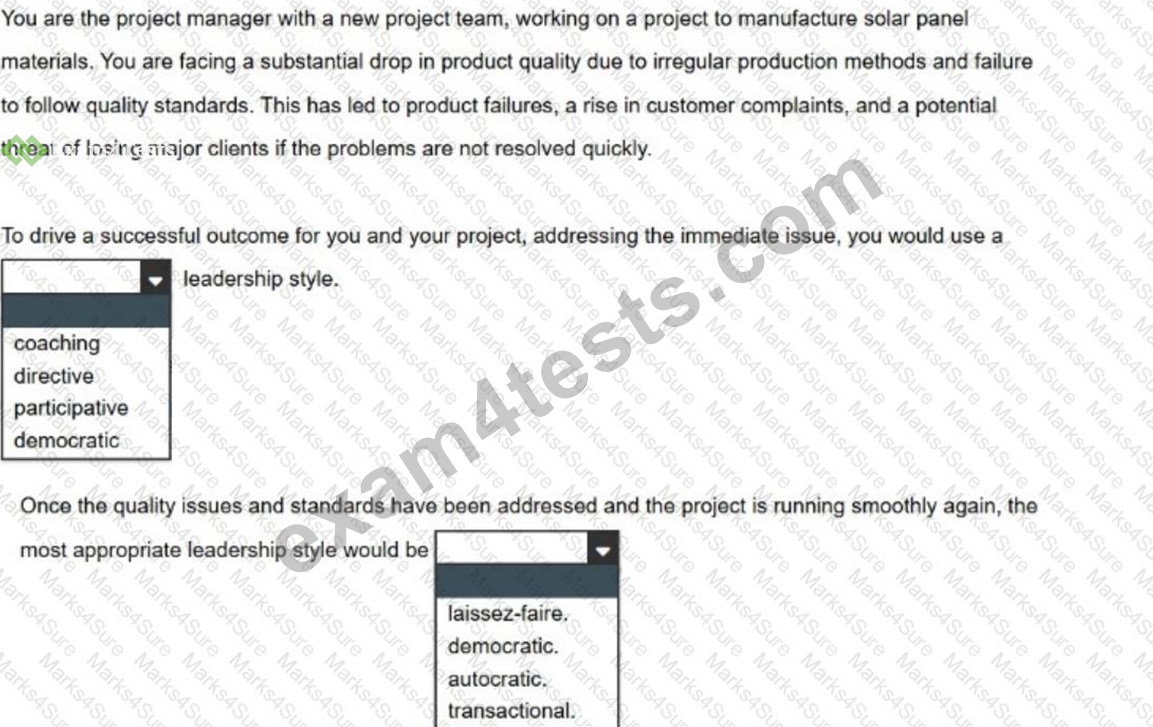
Answer:
Explanation:
Explanation:
Directive
Democratic
Detailed Explanation:
* Directive Leadership:In crises requiring urgent attention, a directive approach ensures quick decision- making and compliance. It allows the leader to control processes to restore stability effectively.
NEW QUESTION # 22
A construction company is planning to build a new office complex. The project manager is considering integrating sustainability principles and priorities into the project management process.
How can integrating sustainability principles and priorities into the management of this project positively impact its long-term success?
* By fostering innovation and creativity, leading to more resilient solutions that adapt to changing environmental and social conditions in the construction of the office complex.
* By requiring additional planning and coordination to integrate sustainability measures seamlessly into existing project timelines and workflows, potentially leading to short-term disruptions in scheduling.
* By enhancing stakeholder trust and reputation, which can attract investors and clients committed to sustainable practices in the development of the office complex.
* By restricting resource consumption and waste generation during the construction process, to guarantee cost savings and improved resource efficiency in this phase of the project.
* By improving worker safety through sustainable construction practices.
* By reducing upfront costs but increasing long-term maintenance expenses due to sustainable building materials.
- A. 1 and 3
- B. 1 and 5
- C. 3 and 6
- D. 2 and 4
Answer: A
Explanation:
Detailed Explanation:Sustainability principles help projects by:
* Fostering Innovation (Option 1):Sustainability encourages long-term adaptability and resilience in designs.
* Enhancing Stakeholder Trust (Option 3):Sustainable practices attract socially responsible investors and build client trust.
* Other Options:While 5 (worker safety) is essential, it's less directly tied to sustainability's core purpose in this context.
NEW QUESTION # 23
You have been appointed as project manager on a transformation project which is looking to improve the recruitment process for a large engineering company. The project has a clearly defined scope, as well as clear milestones and timescales. A hybrid life cycle is being used for this project.
State a total of five features from both linear and iterative life cycles and describe why you recommend incorporating each one in this scenario.
Answer:
Explanation:
See the Explanation for both solutions in detail:
Explanation:
* Linear Features:
* Defined Scope: Ensures clarity and alignment with organizational objectives.
* Milestone Tracking: Tracks progress against fixed timelines.
* Iterative Features:3. Feedback Loops: Allows adjustments based on user feedback.4. Incremental Delivery: Provides early value by delivering in parts.5. Flexibility: Adapts to evolving requirements.
Detailed Explanation:
NEW QUESTION # 24
It is your responsibility as a project professional to promote diversity and inclusion in both your actions and the actions of your team.
Answer:
Explanation:
Explanation:
Attitudes and stereotypes
Adapt your management style
Unconscious Bias:Attitudes and stereotypes influence behavior unconsciously, requiring awareness for effective team management.
Adapt Management Style:Adapting to team member needs ensures equity and optimal performance across diverse teams.
NEW QUESTION # 25
You are a project manager taking over a project that's in the definition phase. The project sponsor asks you to prepare for an upcoming budget review as they have concerns regarding the lack of cost control shown by the project to date.
Which of the following actions would best improve the project sponsor's confidence in how you will control costs?
- A. Create a work breakdown structure.
- B. Create a cost breakdown structure.
- C. Create a financial appraisal.
- D. Create an earned value report.
Answer: B
Explanation:
Detailed Explanation:
* Cost Breakdown Structure:Provides transparency into how the budget is allocated across tasks, improving confidence in cost control.
* Why Other Options Are Incorrect:
* A: Focuses on task definitions, not cost control.
* C: Earned value assesses past performance but doesn't address current concerns.
* D: Financial appraisal doesn't provide actionable insights for cost management.
NEW QUESTION # 26
You start mentoring a junior team member who is new to the project profession. In the first month of mentoring them, you notice their attitude towards stakeholders is poor.
State two impacts this lack of professionalism and knowledge could have on the project's performance.
Answer:
Explanation:
See the Explanation for both solutions in detail:
Explanation:
* Stakeholder disengagement.
* Decreased team morale.
Detailed Explanation:
* Poor stakeholder management leads to reduced buy-in and lack of valuable input, which can derail project objectives.
NEW QUESTION # 27
You are managing a project to transform your organization's ways of working. You are currently in the definition phase, working with team members and stakeholders to establish the project's scope. Because the project impacts the entire organization, it is highly visible. As such, there are many highly invested stakeholders to manage, and the project's budget is under tight scrutiny.
Identify two techniques that can be used to gather requirements from stakeholders with limited time:
Answer:
Explanation:
See the Explanation for both solutions in detail:
Explanation:
Workshops and Focus Groups
Detailed Explanation:
* Workshops:Allows gathering insights efficiently from multiple stakeholders at once.
* Focus Groups:Helps gain deep insights from key stakeholders in a time-constrained setting.
Impacts of Failing to Gather Stakeholder Requirements:
* Project Budget:Scope creep can lead to unplanned costs, exceeding the budget.
* Project Success:Deliverables may fail to meet stakeholder needs, leading to dissatisfaction.
NEW QUESTION # 28
You are managing a construction project aimed at developing a new eco-friendly office building. You are tasked with ensuring that sustainability measures are effectively monitored and reported.
At which point in the project life cycle should you implement sustainability measures?
- A. Sustainability measures should only be reviewed during major project milestones and construction stopped if targets are not being met.
- B. Sustainability measures should be captured at the building's completion and reported in the final project report.
- C. Sustainability measures should be implemented once construction has begun and reported if significant issues arise.
- D. Sustainability measures should be monitored continuously and integrated into project planning, before construction begins.
Answer: D
Explanation:
Detailed Explanation:
NEW QUESTION # 29
According to Herzberg's two-factor theory, which of the following best illustrates a leader who positively impacts team performance and motivation?
- A. A leader who maintains a positive stance on work conditions and refrains from team member engagement to allow productivity.
- B. A leader who monitors every task and provides guidelines for completing them.
- C. A leader who fosters a collaborative work environment and recognizes individual achievements.
- D. A leader who refrains from situational feedback but offers opportunities for career advancement.
Answer: C
Explanation:
Detailed Explanation:
* Herzberg's Two-Factor Theory:Motivational factors such as recognition and teamwork improve employee satisfaction and performance.
* Unsuitable Options:
* B: Lack of engagement hinders motivation.
* C: Micromanagement stifles team autonomy.
* D: Career opportunities are long-term but situational feedback is crucial for day-to-day motivation.
NEW QUESTION # 30
You are managing a project to develop and deploy a new finance management software system for a client.
The project has been deployed and is now in the post-deployment support phase. This phase requires ongoing technical support and maintenance after the software is deployed. The workload can vary significantly over time, is likely to evolve over time, and quick response times are essential.
Question: Based on the features of different contractual relationships and methods of supplier reimbursement, state the most appropriate contract type for the post-deployment phase. (1 mark) Question: Explain four reasons why this would be the most suitable. (4 marks)
Answer:
Explanation:
See the Explanation for both solutions in detail:
Explanation:
Most Appropriate Contract Type:
Time and Materials (T&M) Contract
The Time and Materials (T&M) contract is the most suitable for the post-deployment support phase of this project. This type of contract allows flexibility and is ideal for scenarios where workload can vary significantly, and the scope of work may evolve over time.
Four Reasons Why T&M is the Most Suitable Contract Type:
* Flexibility to Accommodate Changing Workloads:
* The nature of post-deployment support often involves unpredictable workloads that may vary significantly based on client issues, system updates, and evolving requirements. A T&M contract enables scaling of resources (both time and effort) up or down as needed, ensuring the flexibility required for such scenarios.
* Adaptability to Evolving Scope:
* Since post-deployment support tasks often change over time (e.g., addressing newly discovered bugs, implementing requested features, or handling unexpected incidents), a T&M contract is well-suited as it allows for adaptability without the need for renegotiation.
* Cost-Effective for the Client:
* Clients only pay for the actual time and materials used, making it cost-effective. This ensures that no money is wasted on fixed-price contracts where the estimated scope may not align with the actual effort required.
* Enables Quick Response Times:
* Post-deployment support often demands immediate attention to critical issues to maintain the software's reliability and performance. A T&M contract facilitates rapid allocation of resources as needed, ensuring prompt resolution of issues without delays caused by scope or cost discussions.
NEW QUESTION # 31
Why should a project professional complete continuing professional development (CPD)?
- A. To provide continuity between project leads.
- B. To address any identified competency gaps.
- C. To achieve professional targets set by their employer.
- D. To prioritize development of their direct reports.
Answer: B
Explanation:
Detailed Explanation:
NEW QUESTION # 32
Explain how business-as-usual activities can impact the project schedule, considering each of the following elements:
Answer:
Explanation:
See the Explanation for both solutions in detail:
Explanation:
* Cost:Additional operational expenses reduce project funding.
* Quality:Competing priorities can lead to rushed deliverables, affecting quality.
* Scope:Limited resources may result in deprioritizing certain scope items.
* Risk:Overlapping activities introduce unforeseen risks.
* Resource Allocation:Business-as-usual tasks strain shared resources, delaying progress.
Detailed Explanation:
* Cost:Regular operations may consume budgetary reserves, requiring reallocation.
* Quality:Lower prioritization of project tasks can lead to reduced standards.
* Scope:Non-critical deliverables may be delayed or omitted.
* Risk:Uncoordinated overlaps increase vulnerabilities.
* Resource Strain:Teams split between routine and project tasks face inefficiencies.
NEW QUESTION # 33
Which of the following statements does not describe the importance of linking projects to an organisation's objectives?
- A. Projects not aligned with organisational objectives are typically less likely to secure adequate funding.
- B. Linking projects to organisational objectives facilitates better decision-making and prioritisation of initiatives.
- C. Projects unrelated to organisational objectives are typically more successful due to their independence from organisational constraints.
- D. Aligning projects with organisational objectives ensures that resources are allocated efficiently and effectively.
Answer: C
Explanation:
Detailed Explanation:
NEW QUESTION # 34
You are overseeing a construction project for a new retail center. Midway through the project, the design team proposes a significant change to the building's layout, which they argue will improve overall functionality and therefore present better value for money. However, this change would require demolishing and rebuilding a section of the structure.
Given the proposed changes, outline five actions you would take to evaluate the change request to provide an appropriate recommendation.
Answer:
Explanation:
See the Explanation for both solutions in detail:
Explanation:
* Conduct a cost-benefit analysis.
* Review the project scope and objectives.
* Assess risks associated with the change.
* Engage stakeholders for input and alignment.
* Develop a recommendation document.
Detailed Explanation:
NEW QUESTION # 35
......
2025 New Exam4Tests APM-PMQ PDF Recently Updated Questions: https://www.exam4tests.com/APM-PMQ-valid-braindumps.html
APM-PMQ Exam with Guarantee Updated 42 Questions: https://drive.google.com/open?id=1XUk8aoagSJaJCrLl5lbGntCs8ZRIRgzh