

[Oct 09, 2024] DP-203 Test Prep Training Practice Exam Questions Practice Tests
Exam Questions Answers Braindumps DP-203 Exam Dumps PDF Questions
NEW QUESTION # 55
You are designing an Azure Data Lake Storage Gen2 container to store data for the human resources (HR) department and the operations department at your company. You have the following data access requirements:
* After initial processing, the HR department data will be retained for seven years.
* The operations department data will be accessed frequently for the first six months, and then accessed once per month.
You need to design a data retention solution to meet the access requirements. The solution must minimize storage costs.
Answer:
Explanation:
See the answer in explanation.
Explanation
answer is below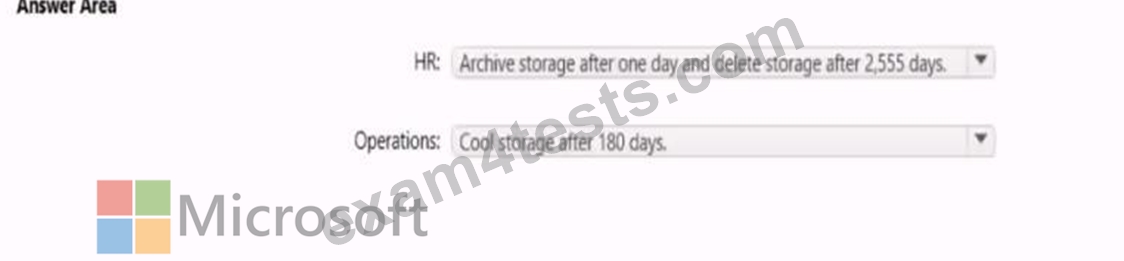
NEW QUESTION # 56
Note: This question is part of a series of questions that present the same scenario. Each question in the series contains a unique solution that might meet the stated goals. Some question sets might have more than one correct solution, while others might not have a correct solution.
After you answer a question in this section, you will NOT be able to return to it. As a result, these questions will not appear in the review screen.
You are designing an Azure Stream Analytics solution that will analyze Twitter data.
You need to count the tweets in each 10-second window. The solution must ensure that each tweet is counted only once.
Solution: You use a tumbling window, and you set the window size to 10 seconds.
Does this meet the goal?
- A. Yes
- B. No
Answer: A
Explanation:
Explanation
Tumbling windows are a series of fixed-sized, non-overlapping and contiguous time intervals. The following diagram illustrates a stream with a series of events and how they are mapped into 10-second tumbling windows.
Reference:
https://docs.microsoft.com/en-us/stream-analytics-query/tumbling-window-azure-stream-analytics
NEW QUESTION # 57
You plan to create a real-time monitoring app that alerts users when a device travels more than 200 meters away from a designated location.
You need to design an Azure Stream Analytics job to process the data for the planned app. The solution must minimize the amount of code developed and the number of technologies used.
What should you include in the Stream Analytics job? To answer, select the appropriate options in the answer area.
NOTE: Each correct selection is worth one point.
Answer:
Explanation:
Reference:
https://docs.microsoft.com/en-us/azure/stream-analytics/stream-analytics-get-started-with-azure-stream-analytics-to-process-data-from-iot-devices
https://docs.microsoft.com/en-us/azure/stream-analytics/geospatial-scenarios
NEW QUESTION # 58
You use Azure Data Factory to prepare data to be queried by Azure Synapse Analytics serverless SQL pools.
Files are initially ingested into an Azure Data Lake Storage Gen2 account as 10 small JSON files. Each file contains the same data attributes and data from a subsidiary of your company.
You need to move the files to a different folder and transform the data to meet the following requirements:
Provide the fastest possible query times.
Automatically infer the schema from the underlying files.
How should you configure the Data Factory copy activity? To answer, select the appropriate options in the answer area.
NOTE: Each correct selection is worth one point.
Answer:
Explanation:
Explanation
Box 1: Preserver herarchy
Compared to the flat namespace on Blob storage, the hierarchical namespace greatly improves the performance of directory management operations, which improves overall job performance.
Box 2: Parquet
Azure Data Factory parquet format is supported for Azure Data Lake Storage Gen2.
Parquet supports the schema property.
Reference:
https://docs.microsoft.com/en-us/azure/storage/blobs/data-lake-storage-introduction
https://docs.microsoft.com/en-us/azure/data-factory/format-parquet
NEW QUESTION # 59
You are designing an application that will store petabytes of medical imaging data When the data is first created, the data will be accessed frequently during the first week. After one month, the data must be accessible within 30 seconds, but files will be accessed infrequently. After one year, the data will be accessed infrequently but must be accessible within five minutes.
You need to select a storage strategy for the dat
a. The solution must minimize costs.
Which storage tier should you use for each time frame? To answer, select the appropriate options in the answer area.
NOTE: Each correct selection is worth one point.
Answer:
Explanation:
References:
https://docs.microsoft.com/en-us/azure/storage/blobs/storage-blob-storage-tiers
NEW QUESTION # 60
You have an Azure subscription that contains an Azure Synapse Analytics dedicated SQL pool. You plan to deploy a solution that will analyze sales data and include the following:
* A table named Country that will contain 195 rows
* A table named Sales that will contain 100 million rows
* A query to identify total sales by country and customer from the past 30 days You need to create the tables. The solution must maximize query performance.
How should you complete the script? To answer, select the appropriate options in the answer area.
NOTE: Each correct selection is worth one point.
Answer:
Explanation:
NEW QUESTION # 61
You have a Microsoft SQL Server database that uses a third normal form schema.
You plan to migrate the data in the database to a star schema in an A?\ire Synapse Analytics dedicated SQI pool.
You need to design the dimension tables. The solution must optimize read operations.
What should you include in the solution? to answer, select the appropriate options in the answer area.
NOTE: Each correct selection is worth one point.
Answer:
Explanation:
NEW QUESTION # 62
You are building an Azure Synapse Analytics dedicated SQL pool that will contain a fact table for transactions from the first half of the year 2020.
You need to ensure that the table meets the following requirements:
* Minimizes the processing time to delete data that is older than 10 years
* Minimizes the I/O for queries that use year-to-date values
How should you complete the Transact-SQL statement? To answer, select the appropriate options in the answer area.
NOTE: Each correct selection is worth one point.
Answer:
Explanation:
Explanation
Table Description automatically generated
Box 1: PARTITION
RANGE RIGHT FOR VALUES is used with PARTITION.
Part 2: [TransactionDateID]
Partition on the date column.
Example: Creating a RANGE RIGHT partition function on a datetime column The following partition function partitions a table or index into 12 partitions, one for each month of a year's worth of values in a datetime column.
CREATE PARTITION FUNCTION [myDateRangePF1] (datetime)
AS RANGE RIGHT FOR VALUES ('20030201', '20030301', '20030401',
'20030501', '20030601', '20030701', '20030801',
'20030901', '20031001', '20031101', '20031201');
Reference:
https://docs.microsoft.com/en-us/sql/t-sql/statements/create-partition-function-transact-sql
NEW QUESTION # 63
You have an Azure subscription that contains an Azure Synapse Analytics dedicated SQL pool. You plan to deploy a solution that will analyze sales data and include the following:
* A table named Country that will contain 195 rows
* A table named Sales that will contain 100 million rows
* A query to identify total sales by country and customer from the past 30 days You need to create the tables. The solution must maximize query performance.
How should you complete the script? To answer, select the appropriate options in the answer area.
NOTE: Each correct selection is worth one point.
Answer:
Explanation:
NEW QUESTION # 64
You are batch loading a table in an Azure Synapse Analytics dedicated SQL pool.
You need to load data from a staging table to the target table. The solution must ensure that if an error occurs while loading the data to the target table, all the inserts in that batch are undone.
How should you complete the Transact-SQL code? To answer, drag the appropriate values to the correct targets. Each value may be used once, more than once, or not at all. You may need to drag the split bar between panes or scroll to view content.
NOTE Each correct selection is worth one point.
Answer:
Explanation: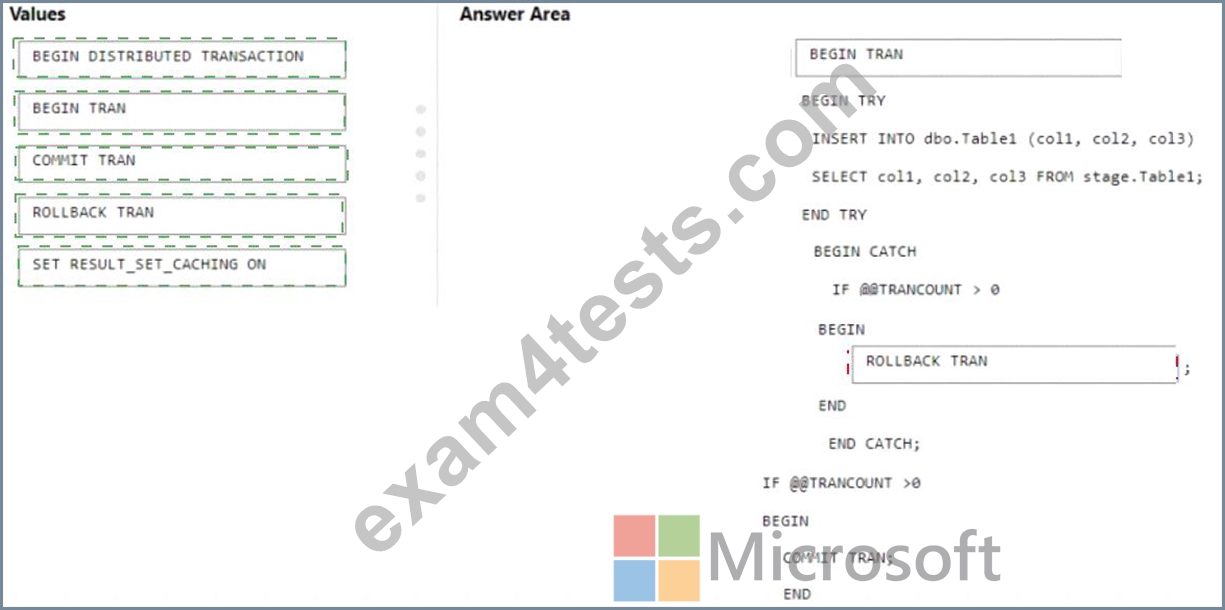
Explanation
D:\mudassar\Untitled.jpg
NEW QUESTION # 65
You have an Azure subscription that contains an Azure Data Lake Storage Gen2 account named storage1.
Storage1 contains a container named container1. Container1 contains a directory named directory1. Directory1 contains a file named file1.
You have an Azure Active Directory (Azure AD) user named User1 that is assigned the Storage Blob Data Reader role for storage1.
You need to ensure that User1 can append data to file1. The solution must use the principle of least privilege.
Which permissions should you grant? To answer, drag the appropriate permissions to the correct resources.
Each permission may be used once, more than once, or not at all. You may need to drag the split bar between panes or scroll to view content.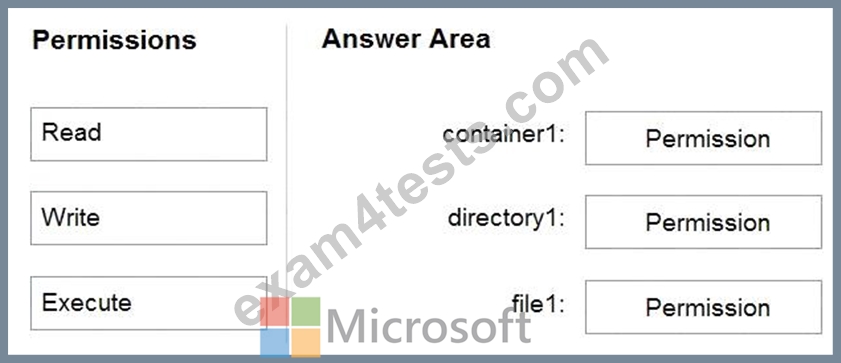
Answer:
Explanation:
Explanation:
Box 1: Execute
If you are granting permissions by using only ACLs (no Azure RBAC), then to grant a security principal read or write access to a file, you'll need to give the security principal Execute permissions to the root folder of the container, and to each folder in the hierarchy of folders that lead to the file.
Box 2: Execute
On Directory: Execute (X): Required to traverse the child items of a directory Box 3: Write On file: Write (W): Can write or append to a file.
Reference:
https://docs.microsoft.com/en-us/azure/storage/blobs/data-lake-storage-access-control
NEW QUESTION # 66
You plan to ingest streaming social media data by using Azure Stream Analytics. The data will be stored in files in Azure Data Lake Storage, and then consumed by using Azure Datiabricks and PolyBase in Azure Synapse Analytics.
You need to recommend a Stream Analytics data output format to ensure that the queries from Databricks and PolyBase against the files encounter the fewest possible errors. The solution must ensure that the tiles can be queried quickly and that the data type information is retained.
What should you recommend?
- A. Avro
- B. Parquet
- C. JSON
- D. CSV
Answer: A
Explanation:
The Avro format is great for data and message preservation. Avro schema with its support for evolution is essential for making the data robust for streaming architectures like Kafka, and with the metadata that schema provides, you can reason on the data. Having a schema provides robustness in providing meta-data about the data stored in Avro records which are self- documenting the data. References: http://cloudurable.com/blog/avro/index.html
NEW QUESTION # 67
You have an Azure Synapse Analytics dedicated SQL pool that contains a table named Table1.
You have files that are ingested and loaded into an Azure Data Lake Storage Gen2 container named container1.
You plan to insert data from the files into Table1 and azure Data Lake Storage Gen2 container named container1.
You plan to insert data from the files into Table1 and transform the dat a. Each row of data in the files will produce one row in the serving layer of Table1.
You need to ensure that when the source data files are loaded to container1, the DateTime is stored as an additional column in Table1.
Solution: In an Azure Synapse Analytics pipeline, you use a Get Metadata activity that retrieves the DateTime of the files.
Does this meet the goal?
- A. Yes
- B. No
Answer: B
Explanation:
Instead use a serverless SQL pool to create an external table with the extra column.
Reference:
https://docs.microsoft.com/en-us/azure/synapse-analytics/sql/create-use-external-tables
NEW QUESTION # 68
You are monitoring an Azure Stream Analytics job.
The Backlogged Input Events count has been 20 for the last hour.
You need to reduce the Backlogged Input Events count.
What should you do?
- A. Add an Azure Storage account to the job.
- B. Increase the streaming units for the job.
- C. Drop late arriving events from the job.
- D. Stop the job.
Answer: B
Explanation:
General symptoms of the job hitting system resource limits include:
* If the backlog event metric keeps increasing, it's an indicator that the system resource is constrained
* (either because of output sink throttling, or high CPU).
Note: Backlogged Input Events: Number of input events that are backlogged. A non-zero value for this metric implies that your job isn't able to keep up with the number of incoming events. If this value is slowly increasing or consistently non-zero, you should scale out your job: adjust Streaming Units.
Reference:
https://docs.microsoft.com/en-us/azure/stream-analytics/stream-analytics-scale-jobs
https://docs.microsoft.com/en-us/azure/stream-analytics/stream-analytics-monitoring
NEW QUESTION # 69
You are batch loading a table in an Azure Synapse Analytics dedicated SQL pool.
You need to load data from a staging table to the target table. The solution must ensure that if an error occurs while loading the data to the target table, all the inserts in that batch are undone.
How should you complete the Transact-SQL code? To answer, drag the appropriate values to the correct targets. Each value may be used once, more than once, or not at all. You may need to drag the split bar between panes or scroll to view content.
NOTE Each correct selection is worth one point.
Answer:
Explanation:
Explanation:
D:\mudassar\Untitled.jpg
NEW QUESTION # 70
You have an Azure Synapse Analytics dedicated SQL pool.
You need to create a table named FactInternetSales that will be a large fact table in a dimensional model.
FactInternetSales will contain 100 million rows and two columns named SalesAmount and OrderQuantity.
Queries executed on FactInternetSales will aggregate the values in SalesAmount and OrderQuantity from the last year for a specific product. The solution must minimize the data size and query execution time.
How should you complete the code? To answer, select the appropriate options in the answer area.
NOTE: Each correct selection is worth one point.
Answer:
Explanation:
Explanation
Box 1: (CLUSTERED COLUMNSTORE INDEX
CLUSTERED COLUMNSTORE INDEX
Columnstore indexes are the standard for storing and querying large data warehousing fact tables. This index uses column-based data storage and query processing to achieve gains up to 10 times the query performance in your data warehouse over traditional row-oriented storage. You can also achieve gains up to 10 times the data compression over the uncompressed data size. Beginning with SQL Server 2016 (13.x) SP1, columnstore indexes enable operational analytics: the ability to run performant real-time analytics on a transactional workload.
Note: Clustered columnstore index
A clustered columnstore index is the physical storage for the entire table.
Diagram Description automatically generated
To reduce fragmentation of the column segments and improve performance, the columnstore index might store some data temporarily into a clustered index called a deltastore and a B-tree list of IDs for deleted rows. The deltastore operations are handled behind the scenes. To return the correct query results, the clustered columnstore index combines query results from both the columnstore and the deltastore.
Box 2: HASH([ProductKey])
A hash distributed table distributes rows based on the value in the distribution column. A hash distributed table is designed to achieve high performance for queries on large tables.
Choose a distribution column with data that distributes evenly
Reference: https://docs.microsoft.com/en-us/sql/relational-databases/indexes/columnstore-indexes-overview
https://docs.microsoft.com/en-us/azure/synapse-analytics/sql-data-warehouse/sql-data-warehouse-tables-overview
https://docs.microsoft.com/en-us/azure/synapse-analytics/sql-data-warehouse/sql-data-warehouse-tables-distribu
NEW QUESTION # 71
......
The DP-203 exam is intended for professionals with a strong foundation in data engineering and experience working with Azure data services. Data Engineering on Microsoft Azure certification is ideal for data engineers, data architects, and database administrators who want to expand their skill set and gain expertise in designing and implementing data solutions on Azure. Data Engineering on Microsoft Azure certification exam covers a wide range of topics, including data integration, data storage, data processing, and data security, and it requires a thorough understanding of Azure services and tools.
Download Free Microsoft DP-203 Real Exam Questions: https://www.exam4tests.com/DP-203-valid-braindumps.html
DP-203 Exam Dumps, DP-203 Practice Test Questions: https://drive.google.com/open?id=1QOLaITe1c95OCshivHbtTI3k0foEejF3