

Regular Free Updates DP-203 Dumps Real Exam Questions Test Engine May 08, 2022
Practice Test Questions Verified Answers As Experienced in the Actual Test!
Exam DP-203: Data Engineering on Microsoft Azure
Candidates for this exam should have subject matter expertise integrating, transforming, and consolidating data from various structured and unstructured data systems into a structure that is suitable for building analytics solutions.
Azure Data Engineers help stakeholders understand the data through exploration, and they build and maintain secure and compliant data processing pipelines by using different tools and techniques. These professionals use various Azure data services and languages to store and produce cleansed and enhanced datasets for analysis.
Azure Data Engineers also help ensure that data pipelines and data stores are high-performing, efficient, organized, and reliable, given a set of business requirements and constraints. They deal with unanticipated issues swiftly, and they minimize data loss. They also design, implement, monitor, and optimize data platforms to meet the data pipelines needs.
A candidate for this exam must have strong knowledge of data processing languages such as SQL, Python, or Scala, and they need to understand parallel processing and data architecture patterns.
Part of the requirements for: Microsoft Certified: Azure Data Engineer Associate
NEW QUESTION 97
You need to schedule an Azure Data Factory pipeline to execute when a new file arrives in an Azure Data Lake Storage Gen2 container.
Which type of trigger should you use?
- A. schedule
- B. on-demand
- C. tumbling window
- D. event
Answer: C
Explanation:
Event-driven architecture (EDA) is a common data integration pattern that involves production, detection, consumption, and reaction to events. Data integration scenarios often require Data Factory customers to trigger pipelines based on events happening in storage account, such as the arrival or deletion of a file in Azure Blob Storage account.
Reference:
https://docs.microsoft.com/en-us/azure/data-factory/how-to-create-event-trigger
NEW QUESTION 98
You need to implement the surrogate key for the retail store table. The solution must meet the sales transaction dataset requirements.
What should you create?
- A. a system-versioned temporal table
- B. a table that has a FOREIGN KEY constraint
- C. a user-defined SEQUENCE object
- D. a table that has an IDENTITY property
Answer: D
Explanation:
Scenario: Implement a surrogate key to account for changes to the retail store addresses.
A surrogate key on a table is a column with a unique identifier for each row. The key is not generated from the table data. Data modelers like to create surrogate keys on their tables when they design data warehouse models. You can use the IDENTITY property to achieve this goal simply and effectively without affecting load performance.
Reference:
https://docs.microsoft.com/en-us/azure/synapse-analytics/sql-data-warehouse/sql-data-warehouse-tables-identity
NEW QUESTION 99
You have an enterprise-wide Azure Data Lake Storage Gen2 account. The data lake is accessible only through an Azure virtual network named VNET1.
You are building a SQL pool in Azure Synapse that will use data from the data lake.
Your company has a sales team. All the members of the sales team are in an Azure Active Directory group named Sales. POSIX controls are used to assign the Sales group access to the files in the data lake.
You plan to load data to the SQL pool every hour.
You need to ensure that the SQL pool can load the sales data from the data lake.
Which three actions should you perform? Each correct answer presents part of the solution.
NOTE: Each area selection is worth one point.
- A. Use the managed identity as the credentials for the data load process.
- B. Add the managed identity to the Sales group.
- C. Use the snared access signature (SAS) as the credentials for the data load process.
- D. Create a managed identity.
- E. Add your Azure Active Directory (Azure AD) account to the Sales group.
- F. Create a shared access signature (SAS).
Answer: B,D,E
Explanation:
The managed identity grants permissions to the dedicated SQL pools in the workspace.
Note: Managed identity for Azure resources is a feature of Azure Active Directory. The feature provides Azure services with an automatically managed identity in Azure AD Reference:
https://docs.microsoft.com/en-us/azure/synapse-analytics/security/synapse-workspace-managed-identity
NEW QUESTION 100
You are creating a new notebook in Azure Databricks that will support R as the primary language but will also support Scale and SOL Which switch should you use to switch between languages?
- A. \\(<Language>)
- B. %<Language>
- C. \\(<Language>)
- D. @<Language>
Answer: B
Explanation:
Explanation
To change the language in Databricks' cells to either Scala, SQL, Python or R, prefix the cell with '%', followed by the language.
%python //or r, scala, sql
Reference:
https://www.theta.co.nz/news-blogs/tech-blog/enhancing-digital-twins-part-3-predictive-maintenance-with-azure
NEW QUESTION 101
You are monitoring an Azure Stream Analytics job.
You discover that the Backlogged Input Events metric is increasing slowly and is consistently non-zero.
You need to ensure that the job can handle all the events.
What should you do?
- A. Create an additional output stream for the existing input stream.
- B. Remove any named consumer groups from the connection and use $default.
- C. Change the compatibility level of the Stream Analytics job.
- D. Increase the number of streaming units (SUs).
Answer: D
Explanation:
Explanation
Backlogged Input Events: Number of input events that are backlogged. A non-zero value for this metric implies that your job isn't able to keep up with the number of incoming events. If this value is slowly increasing or consistently non-zero, you should scale out your job. You should increase the Streaming Units.
Note: Streaming Units (SUs) represents the computing resources that are allocated to execute a Stream Analytics job. The higher the number of SUs, the more CPU and memory resources are allocated for your job.
Reference:
https://docs.microsoft.com/bs-cyrl-ba/azure/stream-analytics/stream-analytics-monitoring
NEW QUESTION 102
You need to collect application metrics, streaming query events, and application log messages for an Azure Databrick cluster.
Which type of library and workspace should you implement? To answer, select the appropriate options in the answer area.
NOTE: Each correct selection is worth one point.
Answer:
Explanation:
Explanation
You can send application logs and metrics from Azure Databricks to a Log Analytics workspace. It uses the Azure Databricks Monitoring Library, which is available on GitHub.
References:
https://docs.microsoft.com/en-us/azure/architecture/databricks-monitoring/application-logs
NEW QUESTION 103
You are building an Azure Stream Analytics job to retrieve game data.
You need to ensure that the job returns the highest scoring record for each five-minute time interval of each game.
How should you complete the Stream Analytics query? To answer, select the appropriate options in the answer are a.
NOTE: Each correct selection is worth one point.
Answer:
Explanation:
Reference:
https://docs.microsoft.com/en-us/stream-analytics-query/topone-azure-stream-analytics
https://docs.microsoft.com/en-us/azure/stream-analytics/stream-analytics-window-functions
NEW QUESTION 104
You have an Azure Storage account and a data warehouse in Azure Synapse Analytics in the UK South region.
You need to copy blob data from the storage account to the data warehouse by using Azure Data Factory. The solution must meet the following requirements:
* Ensure that the data remains in the UK South region at all times.
* Minimize administrative effort.
Which type of integration runtime should you use?
- A. Azure-SSIS integration runtime
- B. Azure integration runtime
- C. Self-hosted integration runtime
Answer: B
Explanation:
Explanation
Reference:
https://docs.microsoft.com/en-us/azure/data-factory/concepts-integration-runtime
NEW QUESTION 105
You plan to implement an Azure Data Lake Gen2 storage account.
You need to ensure that the data lake will remain available if a data center fails in the primary Azure region.
The solution must minimize costs.
Which type of replication should you use for the storage account?
- A. geo-zone-redundant storage (GZRS)
- B. geo-redundant storage (GRS)
- C. zone-redundant storage (ZRS)
- D. locally-redundant storage (LRS)
Answer: D
Explanation:
Explanation
Locally redundant storage (LRS) copies your data synchronously three times within a single physical location in the primary region. LRS is the least expensive replication option Reference:
https://docs.microsoft.com/en-us/azure/storage/common/storage-redundancy
NEW QUESTION 106
Note: This question is part of a series of questions that present the same scenario. Each question in the series contains a unique solution that might meet the stated goals. Some question sets might have more than one correct solution, while others might not have a correct solution.
After you answer a question in this section, you will NOT be able to return to it. As a result, these questions will not appear in the review screen.
You have an Azure Synapse Analytics dedicated SQL pool that contains a table named Table1.
You have files that are ingested and loaded into an Azure Data Lake Storage Gen2 container named container1.
You plan to insert data from the files in container1 into Table1 and transform the dat a. Each row of data in the files will produce one row in the serving layer of Table1.
You need to ensure that when the source data files are loaded to container1, the DateTime is stored as an additional column in Table1.
Solution: You use an Azure Synapse Analytics serverless SQL pool to create an external table that has an additional DateTime column.
Does this meet the goal?
- A. No
- B. Yes
Answer: A
Explanation:
Instead use the derived column transformation to generate new columns in your data flow or to modify existing fields.
Reference:
https://docs.microsoft.com/en-us/azure/data-factory/data-flow-derived-column
NEW QUESTION 107
You have an Azure subscription that contains the following resources:
* An Azure Active Directory (Azure AD) tenant that contains a security group named Group1.
* An Azure Synapse Analytics SQL pool named Pool1.
You need to control the access of Group1 to specific columns and rows in a table in Pool1 Which Transact-SQL commands should you use? To answer, select the appropriate options in the answer area.
NOTE: Each appropriate options in the answer area.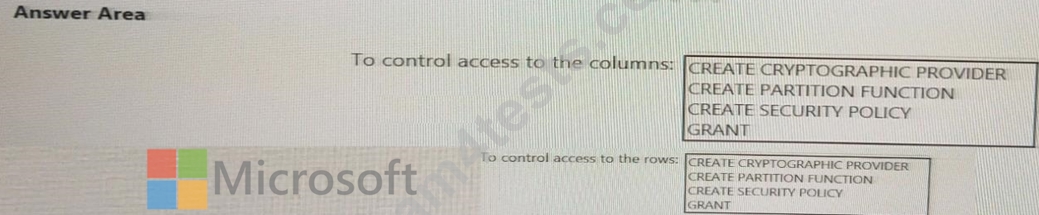
Answer:
Explanation:
NEW QUESTION 108
You have an enterprise data warehouse in Azure Synapse Analytics.
Using PolyBase, you create an external table named [Ext].[Items] to query Parquet files stored in Azure Data Lake Storage Gen2 without importing the data to the data warehouse.
The external table has three columns.
You discover that the Parquet files have a fourth column named ItemID.
Which command should you run to add the ItemID column to the external table?
- A. Option D
- B. Option C
- C. Option B
- D. Option A
Answer: B
Explanation:
https://docs.microsoft.com/en-us/sql/t-sql/statements/create-external-table-transact-sql
NEW QUESTION 109
You use Azure Stream Analytics to receive Twitter data from Azure Event Hubs and to output the data to an Azure Blob storage account.
You need to output the count of tweets during the last five minutes every five minutes. Each tweet must only be counted once.
Which windowing function should you use?
- A. a five-minute Session window
- B. a five-minute Tumbling window
- C. a five-minute Hopping window that has one-minute hop
- D. a five-minute Sliding window
Answer: B
Explanation:
Tumbling window functions are used to segment a data stream into distinct time segments and perform a function against them, such as the example below. The key differentiators of a Tumbling window are that they repeat, do not overlap, and an event cannot belong to more than one tumbling window.
Reference:
https://docs.microsoft.com/en-us/azure/stream-analytics/stream-analytics-window-functions
NEW QUESTION 110
You are designing a monitoring solution for a fleet of 500 vehicles. Each vehicle has a GPS tracking device that sends data to an Azure event hub once per minute.
You have a CSV file in an Azure Data Lake Storage Gen2 container. The file maintains the expected geographical area in which each vehicle should be.
You need to ensure that when a GPS position is outside the expected area, a message is added to another event hub for processing within 30 seconds. The solution must minimize cost.
What should you include in the solution? To answer, select the appropriate options in the answer area.
NOTE: Each correct selection is worth one point.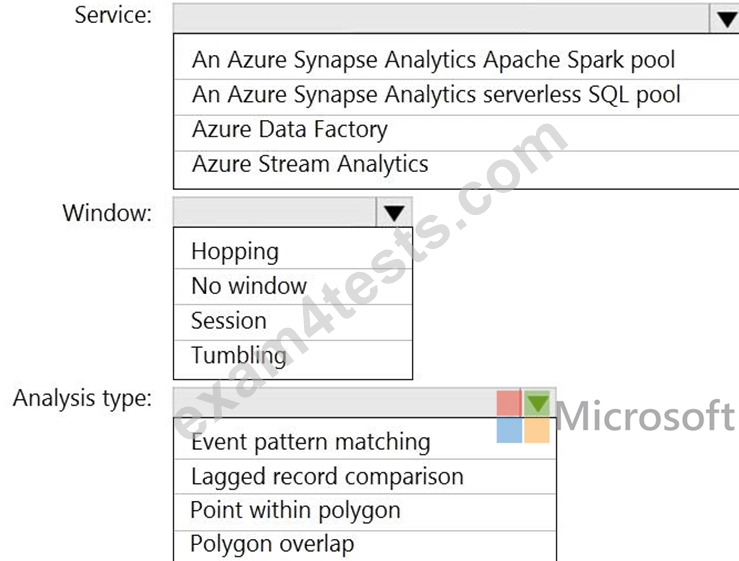
Answer:
Explanation:
Reference:
https://docs.microsoft.com/en-us/azure/stream-analytics/stream-analytics-window-functions
NEW QUESTION 111
You have an Azure Synapse Analytics dedicated SQL pool.
You run PDW_SHOWSPACEUSED(dbo,FactInternetSales'); and get the results shown in the following table.
Which statement accurately describes the dbo,FactInternetSales table?
- A. All distribution contain data.
- B. The table uses round-robin distribution.
- C. The table contains less than 1,000 rows.
- D. The table is skewed.
Answer: D
Explanation:
Explanation
Data skew means the data is not distributed evenly across the distributions.
Reference:
https://docs.microsoft.com/en-us/azure/synapse-analytics/sql-data-warehouse/sql-data-warehouse-tables-distribu
NEW QUESTION 112
You need to implement an Azure Synapse Analytics database object for storing the sales transactions dat a. The solution must meet the sales transaction dataset requirements.
What solution must meet the sales transaction dataset requirements.
What should you do? To answer, select the appropriate options in the answer area.
NOTE: Each correct selection is worth one point.
Answer:
Explanation:
Reference:
https://docs.microsoft.com/en-us/sql/t-sql/statements/create-table-azure-sql-data-warehouse
NEW QUESTION 113
Note: This question is part of a series of questions that present the same scenario. Each question in the series contains a unique solution that might meet the stated goals. Some question sets might have more than one correct solution, while others might not have a correct solution.
After you answer a question in this section, you will NOT be able to return to it. As a result, these questions will not appear in the review screen.
You have an Azure Storage account that contains 100 GB of files. The files contain rows of text and numerical values. 75% of the rows contain description data that has an average length of 1.1 MB.
You plan to copy the data from the storage account to an enterprise data warehouse in Azure Synapse Analytics.
You need to prepare the files to ensure that the data copies quickly.
Solution: You copy the files to a table that has a columnstore index.
Does this meet the goal?
- A. No
- B. Yes
Answer: A
Explanation:
Instead convert the files to compressed delimited text files.
Reference:
https://docs.microsoft.com/en-us/azure/sql-data-warehouse/guidance-for-loading-data
NEW QUESTION 114
You need to collect application metrics, streaming query events, and application log messages for an Azure Databrick cluster.
Which type of library and workspace should you implement? To answer, select the appropriate options in the answer area.
NOTE: Each correct selection is worth one point.
Answer:
Explanation:
Explanation
You can send application logs and metrics from Azure Databricks to a Log Analytics workspace. It uses the Azure Databricks Monitoring Library, which is available on GitHub.
References:
https://docs.microsoft.com/en-us/azure/architecture/databricks-monitoring/application-logs
NEW QUESTION 115
You are performing exploratory analysis of the bus fare data in an Azure Data Lake Storage Gen2 account by using an Azure Synapse Analytics serverless SQL pool.
You execute the Transact-SQL query shown in the following exhibit.
What do the query results include?
- A. Only CSV files in the tripdata_2020 subfolder.
- B. All CSV files that have file names that contain "tripdata_2020".
- C. All files that have file names that beginning with "tripdata_2020".
- D. Only CSV that have file names that beginning with "tripdata_2020".
Answer: D
NEW QUESTION 116
You have two Azure Storage accounts named Storage1 and Storage2. Each account holds one container and has the hierarchical namespace enabled. The system has files that contain data stored in the Apache Parquet format.
You need to copy folders and files from Storage1 to Storage2 by using a Data Factory copy activity. The solution must meet the following requirements:
* No transformations must be performed.
* The original folder structure must be retained.
* Minimize time required to perform the copy activity.
How should you configure the copy activity? To answer, select the appropriate options in the answer area.
NOTE: Each correct selection is worth one point.
Answer:
Explanation:
Explanation
Graphical user interface, text, application, chat or text message Description automatically generated
Box 1: Parquet
For Parquet datasets, the type property of the copy activity source must be set to ParquetSource.
Box 2: PreserveHierarchy
PreserveHierarchy (default): Preserves the file hierarchy in the target folder. The relative path of the source file to the source folder is identical to the relative path of the target file to the target folder.
Reference:
https://docs.microsoft.com/en-us/azure/data-factory/format-parquet
https://docs.microsoft.com/en-us/azure/data-factory/connector-azure-data-lake-storage
NEW QUESTION 117
You have an Azure Databricks workspace named workspace! in the Standard pricing tier. Workspace!
contains an all-purpose cluster named cluster). You need to reduce the time it takes for cluster 1 to start and scale up. The solution must minimize costs. What should you do first?
- A. Upgrade workspace! to the Premium pricing tier.
- B. Create a pool in workspace1.
- C. Configure a global init script for workspace1.
- D. Create a cluster policy in workspace1.
Answer: B
NEW QUESTION 118
......
Pass Microsoft DP-203 Exam in First Attempt Easily: https://www.exam4tests.com/DP-203-valid-braindumps.html
The Most Efficient DP-203 Pdf Dumps For Assured Success : https://drive.google.com/open?id=1QOLaITe1c95OCshivHbtTI3k0foEejF3