

Pass IIBA CCBA Exam Info and Free Practice Test
New 2026 Latest Questions CCBA Dumps - Use Updated IIBA Exam
Achieving the CCBA certification provides numerous benefits for business analysts. It demonstrates to employers and peers that the individual possesses a high level of knowledge and expertise in business analysis, which can lead to increased job opportunities and career advancement. Additionally, it provides access to a community of professionals who hold the same certification, which can lead to networking opportunities and access to valuable resources and information. Overall, the CCBA certification is a valuable investment for business analysts looking to enhance their skills and advance their careers.
The CCBA certification exam is offered by the International Institute of Business Analysis (IIBA), a non-profit professional association that supports and promotes the profession of business analysis. Certification of Capability in Business Analysis (CCBA) certification exam assesses an individual’s knowledge of the BABOK (Business Analysis Body of Knowledge) and their ability to apply it in real-world scenarios.
The benefit in Obtaining the IIBA CCBA Exam Certification
- IIBA CCBA recognition and respect from colleagues and employers.
- IIBA CCBA receives exclusive updates on Amazon's latest products and innovations.
- Resumes with IIBA CCBA certifications get noticed and fast-tracked by hiring managers.
- IIBA CCBA Exam certification is the absolute best way to communicate your proficiency in the Amazon Web Services.
- IIBA CCBA can display Amazon certification logos on their business cards, resumes, and websites to leverage the power of the Amazon brand.
NEW QUESTION # 339
A business analyst (BA) has elicited requirements for a new system. A subset of these requirements refers to judging the performance of the system, such as efficiency, capacity, security, and scalability. What technique is used to examine and group these requirements?
- A. Trace requirements
- B. Functional decomposition
- C. Non-functional requirements analysis
- D. Scope model
Answer: C
Explanation:
Explanation
The most common non-functional requirements categories include availability, compatibility, functionality, maintainability, performance efficiency, portability, reliability, scalability, security, usability, certification, compliance, localization, service-level agreements, and extensibility.
NEW QUESTION # 340
A business analyst (BA) has developed requirements for a project containing sensitive information. The requirements were approved and the solution was implemented. What should the BA do to ensure these requirements are maintained for future reference?
- A. Archive the requirements package in the business analysis portal
- B. Send the requirements package to stakeholder in a password protected email
- C. Store the requirements package on secure shared drive
- D. Print the requirements package and distribute it to stakeholders in person
Answer: C
Explanation:
The BA should store the requirements package on a secure shared drive that has access control and encryption to protect the sensitive information from unauthorized access or modification. This will ensure that the requirements are available for future reference and can be traced to the solution. Printing the requirements package and distributing it to stakeholders in person may compromise the confidentiality and integrity of the information. Archiving the requirements package in the business analysis portal may not provide adequate security measures for sensitive information. Sending the requirements package to stakeholder in a password protected email may expose the information to interception or hacking. Reference: [A Guide to the Business Analysis Body of Knowledge (BABOK Guide)], Chapter 3: Business Analysis Planning and Monitoring, Section 3.6: Plan Requirements Management Process, Task 3.6.2: Define Requirements Change Process, Page 58. [Business Analysis for Practitioners: A Practice Guide], Chapter 3: Requirements Elicitation and Analysis, Section 3.7: Requirements Traceability, Page 66.
NEW QUESTION # 341
A business analyst (BA) has identified the impacts and resolution for a proposed change. Based on the Responsible, Accountable, Consulted, informed (RACI) matrix, who must approve the change before it is implemented?
- A. Subject matter expert
- B. Project manager
- C. System architect
- D. Business sponsor
Answer: D
Explanation: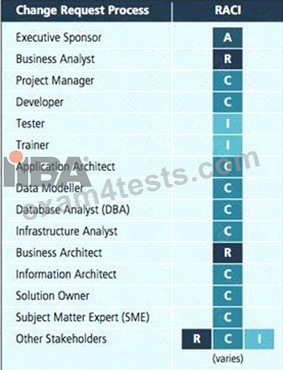
Table Description automatically generated
NEW QUESTION # 342
A business analyst (BA) is given an additional requirement near the end of the development phase that needs to be incorporated into the system as part of the same release. In this situation, the first activity the BA performs to understand the effect of the proposed change is to:
- A. check with the project manager for timeline and budget metrics.
- B. determine whether stakeholders are available for further elicitation.
- C. determine whether the additional requirement is traceable to a need.
- D. consult with the technical team for technical feasibility.
Answer: D
NEW QUESTION # 343
There are three inputs to the business analysis planning approach process. Which one of the following is not one of the three inputs?
- A. Expert judgment
- B. Organizational process assets
- C. Business need
- D. Risk and rewards analysis
Answer: D
Explanation:
Explanation
Risk and rewards analysis is not, of itself, an input to the business analysis planning approach process.
Answer B is incorrect. Business need is an input to the business analysis planning approach process.
Answer D is incorrect. Expert judgment is an input to the business analysis planning approach process.
Answer C is incorrect. Organizational process assets are inputs to the business analysis planning approach
process.
NEW QUESTION # 344
A client wants to rehire a business analysis consulting firm for another project. The assigned business analyst (BA) developed a good rapport with the stakeholders, but delivered documents that contained lots of technical jargon that the client could not fully understand. Based on the feedback, the consulting company should:
- A. identify performance metrics before commencing work.
- B. recommend a new methodology which is the latest trend in the industry.
- C. assign a different BA to the project.
- D. discuss the feedback during the brainstorming sessions after project completion.
Answer: D
NEW QUESTION # 345
A business analyst has determined that there are five possible solutions to a business need. If the business analyst completes the solution assessment on multiple solutions, what is the goal of the assessment?
- A. The business analyst should determine which solution has the greatest business value.
- B. The business analyst should determine the opportunity cost of each assessment.
- C. The business analyst should determine which solution is quickest to implement.
- D. The business analyst should only have one solution, not five.
Answer: A
NEW QUESTION # 346
What business analysis process is needed to define the solution scope and prepare the business plan for the endeavor?
- A. Prioritize requirements.
- B. Define requirements management and communication.
- C. Verify requirements.
- D. Determine solution approach.
Answer: D
Explanation:
The business analysis process of determining the solution approach is the process that's needed in order to define the solution scope and prepare the business plan for the endeavor.
Answer C is incorrect. Prioritization of requirements is needed to rank requirements from the most important to the least important based on the identified needs.
Answer B is incorrect. Defining requirements management and communication is not related to the solution scope.
Answer A is incorrect. Verifying requirements is the verification of the requirements for the stakeholders and completeness of the endeavor.
NEW QUESTION # 347
A business analyst (BA) is working on a set of tasks to establish a governance process for the project. The BA intends to identify who has authority and responsibility to propose changes, who should be involved in the change discussions, and how changes will be documented and communicated. Which of the following are the inputs that would help the BA complete the task?
- A. Governance approach and business analysis approach
- B. Business analysis approach and stakeholder engagement approach
- C. Governance approach and stakeholder engagement approach
- D. Stakeholder engagement approach and information management approach
Answer: B
Explanation:
Reference:
BABOK v.3.0 - IIBA - A Guide to the Business Analysis Body of Knowledge - International Institute of Business Analysis (2015) (Page 47)
NEW QUESTION # 348
Which basis for prioritization allows the project team to work initially with lower-risk requirements first?
- A. Quantitative ranking
- B. Positive risk ranking
- C. Relationship to other requirements
- D. Implementation difficulty
Answer: D
Explanation:
Explanation
This approach prioritizes requirements that are easiest to implement first. This allows the project team to work with the lowest risk requirements first to gain familiarity with the requirements. This is especially useful with a new technology or materials where a learning curve is involved.
Answer A is incorrect. There is not a prioritization basis for quantitative ranking.
Answer B is incorrect. There is not a prioritization basis called positive risk ranking.
Answer C is incorrect. The basis of relationship to other requirements is useful for requirements that need to
be implemented so that other requirements, which are dependent on the initial requirements, can be implemented.
NEW QUESTION # 349
Sam is the project manager of the NHT Project. His project has stakeholders from the end users, server administrators, functional managers, external customers, technicians, and executive managers. In this high- profile project, which group of stakeholders is the most important?
- A. Executive management
- B. External customers
- C. End users
- D. No stakeholders are more important than other stakeholders.
Answer: B
NEW QUESTION # 350
A long-established company selling ice cream is entering its crucial sales period leading up to summer. Based on the company's risk tolerance, a business analyst (BA) has advised against replacing the most popular flavors with new untested flavors. What is the company's attitude toward risk, as assessed by the BA?
- A. Risk-averse
- B. Risk-soaking
- C. Risk-neutral
- D. Risk-optimizing
Answer: A
Explanation:
Risk-averse means having a low tolerance for risk and preferring to avoid uncertainty or potential losses. This describes the company's attitude toward risk, as they do not want to experiment with new flavors that might affect their sales. Risk-neutral means being indifferent to risk and basing decisions on expected outcomes.
Risk-optimizing means having a high tolerance for risk and seeking opportunities for reward. Risk-soaking means being willing to accept losses or negative consequences of risk. References: BABOK Guide v3, page
12; CCBA Mock Test, question 10
NEW QUESTION # 351
Ben is the business analyst for his organization. Ben is currently working on a solution to improve a laser printer. He has taken the laser printer apart, identified each component, and documented each component's purpose. What type of requirements organization is Ben doing in this scenario?
- A. Functional decomposition
- B. Data modeling
- C. Scope modeling
- D. Process modeling
Answer: A
Explanation:
Explanation
Ben is completing the functional decomposition technique for the organize requirements process. Each component in the printer can have its own set of requirements, while the improved printer to be manufactured is the ultimate goal of the requirements.
Answer D is incorrect. Data modeling describes the concepts and relationships relevant to the solution or business domain.
Answer C is incorrect. Scope modeling allows the requirements to be organized by the solution component they're relevant to.
Answer B is incorrect. Process modeling is the activity of representing processes of an enterprise, so that the current process may be analyzed and improved in future. It allows the requirements to be organized around the related processes. Processes are also considered to have sub-processes, inputs, and outputs.
NEW QUESTION # 352
A business analyst (BA) is identifying the functions and features required for a new enterprise software solution. The BA reviews historical documents about the current business processes and then interviews each stakeholder group, individually, asking Questions about current business processes. The BA compares the information obtained during the stakeholder interviews with the information gathered from the historical documents. Which activity is the BA performing with this approach?
- A. Confirmation of elicitation results
- B. Validation of requirements
- C. Capture of elicitation outcomes
- D. Verification of requirements
Answer: A
Explanation:
The business analyst is engaged in the activity of confirming elicitation results. This involves comparing information obtained from different sources to ensure that the requirements and understanding of the business processes are accurate and complete. By reviewing historical documents and interviewing stakeholders, the BA is cross-verifying the information to confirm that the elicitation results align with both the documented history and the stakeholders' current understanding.
NEW QUESTION # 353
During a project to replace an existing system, requirements for new functionality were elicited. Upon further investigation, additional types of requirements related to other features and characteristics were also identified.
What can facilitate effectively understanding the different types of requirements?
- A. Process modelling
- B. Scope modelling
- C. Classification schema
- D. Fishbone diagram
Answer: C
Explanation:
Explanation
A classification schema is a technique that helps to organize and categorize requirements based on common characteristics or attributes. A classification schema can facilitate effectively understanding the different types of requirements by providing a clear and consistent way to communicate, prioritize, analyze, and manage them. A classification schema can also help to identify gaps, overlaps, and dependencies among requirements. References: BABOK® Guide, Version 3, Chapter 10: Techniques, Section 10.6: Classification Schema, Page 387; Chapter 6: Requirements Life Cycle Management, Section 6.2: Prioritize Requirements, Page 146.
NEW QUESTION # 354
By which of the following is the performance of all requirements management and communication activities governed?
- A. Business analyst
- B. Project manager
- C. Project sponsor
- D. Business analysis plans
Answer: D
Explanation:
Explanation
Business analysis plans define how requirements and communication should take place. These plans and directives should be based on the requirements of the organization for all business analysis activities.
Answer B is incorrect. The business analyst carries out the rules and directives of business analysis plans.
Answer D is incorrect. The project sponsor doesn't govern the requirements management and communication needs.
Answer C is incorrect. The project manager doesn't govern any business analysis activities.
NEW QUESTION # 355
As a business analyst, you'll often need to analyze business needs, requirements, and solutions for assumptions and constraints. Which one of the following is a constraint? Choose the best answer.
- A. The solution must cost less than $450,000.
- B. The solution won't need external resources.
- C. The solution must be done by December 31.
- D. The solution should be implemented during the summer months.
Answer: A
Explanation:
A constraint is a restriction or limitation on possible solutions. Constraints can be business or technical in nature and are defined as factors that must be true for the solution to be acceptable1. A constraint can affect the quality and success of the solution, so it should be carefully identified and managed throughout the project lifecycle2. In this question, option A is a constraint because it specifies a fixed budget limit for the solution that cannot be exceeded. The other options are not constraints because:
Option B is an assumption, not a constraint. An assumption is a factor believed to be true, but not confirmed. Assumptions often affect the strategy of the project, as project managers may plan the project based on what they expect to happen. Assumptions can contribute to project risks, as they are not always accurate. Therefore, assumptions should be documented and validated throughout the project lifecycle3. In this question, option B is an assumption because it expresses a preference or expectation for the solution implementation, but it is not a mandatory condition.
Option C is a deadline, not a constraint. A deadline is a specific date or time by which a task, project, or deliverable must be completed or submitted. Deadlines can be imposed by external factors, such as customer requirements, contractual obligations, or regulatory compliance, or by internal factors, such as resource availability, project scope, or quality standards. Deadlines can influence the project schedule, scope, and cost, but they are not constraints in themselves. Deadlines can be changed or negotiated depending on the project circumstances and stakeholder agreement4. In this question, option C is a deadline because it indicates a target date for the solution completion, but it does not specify a fixed limitation on the solution itself.
Option D is a design decision, not a constraint. A design decision is a choice made by the project team or the solution provider about how the solution will be developed, implemented, or operated. Design decisions can be based on various criteria, such as technical feasibility, business value, user experience, or best practices. Design decisions can affect the functionality, performance, usability, and maintainability of the solution, but they are not constraints in themselves. Design decisions can be changed or revised depending on the feedback, testing, or evaluation of the solution5. In this question, option D is a design decision because it indicates a preference or option for the solution development, but it does not impose a fixed limitation on the solution itself.
Reference:
Assumption vs. Constraint: Definitions, Types and Differences, section "What are assumptions and constraints?" Assumptions and Constraints in Project Management - PM Study Circle, section "What is a Constraint?" It's Not "All Requirements" - Assumptions and Constraints Matter Too! (BABOK 6.4), section "What are Assumptions and Constraints?" What is a Deadline? - Definition from Techopedia, first paragraph Design Decisions in Software Engineering, first paragraph Business Analysis Expert Certification, CCBA| IIBA, section "BABOK Guide v3", chapter 6, section 6.1.4.2
NEW QUESTION # 356
According to the business analysis book 'A Guide to the Business Analysis Body of Knowledge', which your exam is largely based on, almost all methodologies fit somewhere along a spectrum between plan-driven and what other methodology?
- A. Cost-driven
- B. Reward-driven
- C. Risk-driven
- D. Change-driven
Answer: D
Explanation:
Explanation
The methodology that defines the business analysis approach is either plan-driven or change-driven.
Answer A is incorrect. Risk-driven is not a valid approach for planning business analysis activities.
Answer B is incorrect. Cost-driven is not a valid approach for planning the business analysis activities.
Answer D is incorrect. Reward-driven is not a valid approach for planning the business analysis activities.
NEW QUESTION # 357
......
Latest CCBA Exam Dumps IIBA Exam: https://www.exam4tests.com/CCBA-valid-braindumps.html
Pass IIBA CCBA PDF Dumps Recently Updated 633 Questions: https://drive.google.com/open?id=1g51Yd4m24UBqbKnAP7A1yXzinrCHr0Qi