

Easily To Pass New NP-Con-101 Premium Exam Updated [Mar 10, 2026]
NP-Con-101 Certification All-in-One Exam Guide Mar-2026
NEW QUESTION # 22
The development director at a nonprofit needs to track grant lifecycles using NPSP, including assigning actions to staff members, tracking applications, reporting deadlines, and summarizing the total amount awarded with payments.
How should the consultant model payments, applications, reporting deadlines, and actions in NPSP for the grant seeking institution?
A)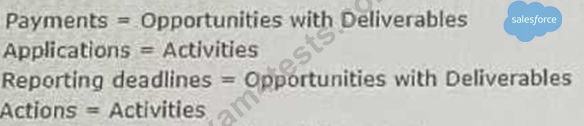
B)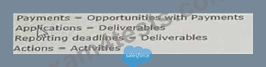
C)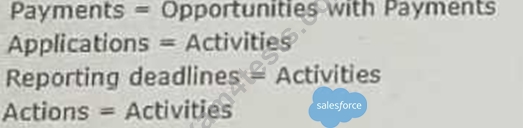
D)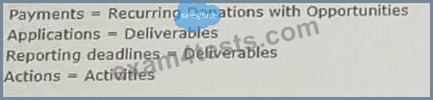
- A. Option C
- B. Option D
- C. Option B
- D. Option A
Answer: C
Explanation:
To track grant lifecycles using the Nonprofit Success Pack (NPSP), including assigning actions to staff members, tracking applications, reporting deadlines, and summarizing the total amount awarded with payments, the consultant should model the components as follows:
Payments = Opportunities with Payments:
Use the Opportunities object in Salesforce to track each grant awarded.
For each Opportunity, create related Payment records to track individual disbursements or installments of the grant amount.
Applications = Deliverables:
Utilize the Deliverables object to track the application process for grants.
Create Deliverable records to capture key details such as submission deadlines, requirements, and statuses.
Reporting Deadlines = Deliverables:
Similar to applications, use the Deliverables object to track reporting deadlines.
Create Deliverable records for each required report, specifying due dates and completion statuses.
Actions = Activities:
Use the Activities object to assign tasks and actions to staff members.
Create Task records for actions related to the grant, such as follow-ups, meetings, and communications.
This configuration ensures that all aspects of the grant lifecycle are tracked effectively within Salesforce, leveraging NPSP's capabilities to manage opportunities, payments, deliverables, and activities.
Salesforce Nonprofit Success Pack Documentation: Detailed instructions on using Opportunities, Payments, Deliverables, and Activities in NPSP.
Salesforce Help Documentation: Opportunities, Activities, Payments, Deliverables.
Top of Form
Bottom of Form
https://www.freecram.com/question/Salesforce.Nonprofit-Cloud-Consultant.v2020-09-19.q37/the-development-director-at-a-nonprofit-needs-to-track-grant-lifecycles-using-the-npsp-including-assignin
NEW QUESTION # 23
A nonprofit is implementing Accounting Subledger and wants to know how the data from Salesforce would be transferred to its accounting system.
Which three methods are possible?
Choose 3 answers
- A. Develop a custom integration solution.
- B. Schedule a Data Export from Salesforce.
- C. Integrate Salesforce with the accounting system using middleware.
- D. Configure Salesforce Connect to integrate with the accounting system.
- E. Export data via Salesforce reports to upload to the accounting system.
Answer: A,C,E
Explanation:
To transfer data from Salesforce to an accounting system using Accounting Subledger, nonprofits can use several methods. Here are three possible methods:
Integrate Salesforce with the Accounting System Using Middleware:
Middleware can act as a bridge between Salesforce and the accounting system, facilitating data transfer.
Tools like MuleSoft, Jitterbit, or Dell Boomi can be used to create integrations that sync data between Salesforce and the accounting system.
This method ensures real-time or near-real-time data synchronization, reducing manual data handling.
Export Data via Salesforce Reports to Upload to the Accounting System:
Salesforce allows the creation of detailed reports which can be exported in various formats (e.g., CSV, Excel).
These reports can be manually uploaded to the accounting system.
This method is suitable for organizations with fewer transactions or where real-time integration is not critical.
Develop a Custom Integration Solution:
For organizations with specific needs that are not met by standard middleware solutions, a custom integration can be developed.
This involves using Salesforce APIs (REST or SOAP) to programmatically extract data from Salesforce and load it into the accounting system.
Custom integrations provide flexibility but require more technical expertise and maintenance.
Salesforce Integration Patterns and Best Practices: Salesforce Integration Guide.
Salesforce Reporting and Exporting: Salesforce Reporting.
NEW QUESTION # 24
A nonprofit needs to clean up large amounts of Contact address data from its street canvassing and telemarketing operations on a monthly basis.
What should the consultant use to standardize addresses in NPSP?
- A. Address Verification
- B. NPSP Data Importer
- C. Seasonal Addresses
- D. Batch Data Import
Answer: A
Explanation:
To standardize addresses in NPSP, especially when dealing with large amounts of Contact address data from street canvassing and telemarketing operations, the consultant should use Address Verification:
Enable Address Verification:
In Salesforce, navigate to the NPSP Settings.
Under "Address Management," enable Address Verification.
Configure the Address Verification settings according to the needs of the nonprofit.
Use Address Verification Service:
Utilize the integrated Address Verification service to standardize and validate addresses.
The service checks addresses against a reliable database, ensuring they are accurate and properly formatted.
Batch Processing:
For large amounts of data, set up batch processing to regularly verify and standardize addresses.
This can be scheduled to run monthly or as needed to keep the address data clean and accurate.
Review and Correct:
After verification, review any addresses flagged as incorrect or incomplete and make necessary corrections.
Using Address Verification helps ensure the nonprofit's address data is accurate and standardized, improving the quality of their data management.
Salesforce Nonprofit Success Pack (NPSP) Documentation: Address Management Salesforce Help: Configuring Address Verification
NEW QUESTION # 25
A nonprofit organization wants to automatically generate an Opportunity whenever a Lead is converted.
What should the consultant do to meet this requirement?
- A. Create a process using Process Builder that will automatically create an Opportunity on Lead Conversion.
- B. Write a trigger that automatically generates an Opportunity on Lead conversion.
- C. Install a third-party app from the AppExchange that converts leads to any other object.
- D. Select the "Create an Opportunity on Lead Convert" checkbox in NPSP Settings.
Answer: D
Explanation:
To automatically generate an Opportunity whenever a Lead is converted in NPSP, the consultant should enable the "Create an Opportunity on Lead Convert" option in the NPSP Settings. This option ensures that an Opportunity is automatically created as part of the lead conversion process.
Navigate to NPSP Settings:
Go to the App Launcher, search for "NPSP Settings", and select it.
Enable Lead Conversion Setting:
In NPSP Settings, expand the "Leads" section.
Find the "Lead Conversion" settings.
Check the box for "Create an Opportunity on Lead Convert".
Save the settings.
This configuration streamlines the process, ensuring that Opportunities are consistently created during lead conversion, without requiring additional custom code or third-party applications.
CertGod Nonprofit Cloud Consultant Guide:
NEW QUESTION # 26
The executive director at a nonprofit organization wants to have a report to see how much each board member has raised by either direct gifts or gifts they helped to influence for this fiscal year. There is a custom checkbox field on the Contact record to indicate board members.
How should the consultant create this report?
- A. Use the Contacts & Accounts report type. Add a field filter for Board Member = TRUE. Include the Total Gifts this Year and Soft Credits this Year fields.
- B. Use the Contacts & Accounts report type. Add a field filter for Board Member = TRUE. Add a cross filter for Opportunities with Soft Credits. Group results by Giving Totals.
- C. Use the Opportunities report type. Add a field filter for Contacts with Board Member = TRUE. Group results by the Total Gifts this Year and Soft Credits this Year fields.
- D. Use the Opportunities report type. Add a cross filter for Contacts with Board Member = TRUE. Summarize the Total Gifts this Year and Soft Credits this Year fields.
Answer: D
Explanation:
To create a report showing how much each board member has raised, you should:
Use the Opportunities report type: This allows you to capture all gift data.
Add a cross filter for Contacts with Board Member = TRUE: This filters the report to include only those contacts who are board members.
Summarize the Total Gifts this Year and Soft Credits this Year fields: This provides the total amounts for direct gifts and influenced gifts.
This method ensures that both direct contributions and soft credits (gifts influenced by board members) are included in the report.
Salesforce Help: Creating and Customizing Reports
Salesforce Trailhead: Reporting for Nonprofits
NEW QUESTION # 27
A consultant is training a system admin to prepare for a new release of a particular open source Nonprofit Cloud product.
Where are two places the system admin should look for release notes on the product?
Choose 2 answers
- A. The Nonprofit Cloud release announcement group in the Trailblazer Community.
- B. The Nonprofit Hub group in the Trailblazer Community.
- C. The product's GitHub repository release page.
- D. The Salesforce Trust website.
Answer: B,C
Explanation:
To prepare for a new release of an open-source Nonprofit Cloud product, the system admin should check the following sources for release notes:
Nonprofit Hub Group in the Trailblazer Community:
The Trailblazer Community is a rich resource for Salesforce users, including non-profits. The Nonprofit Hub group frequently posts updates, discussions, and release notes related to Nonprofit Cloud products.
This group can be accessed by logging into the Trailblazer Community and searching for "Nonprofit Hub." GitHub Repository Release Page:
For open-source products, the official GitHub repository is a primary source for release notes. The release page on GitHub will have detailed notes about new features, bug fixes, and enhancements.
To access, navigate to the product's GitHub repository and click on the "Releases" tab.
Trailblazer Community: Nonprofit Hub Group
GitHub: Product's repository release page
NEW QUESTION # 28
The admin at a nonprofit is implementing Salesforce Shield in its org to enable field platform encryption.
What are three NPSP considerations when implementing Shield Platform Encryption?
Choose 3 answers
- A. The NPSP Data Import object supports encryption of all fields in the import batch.
- B. If the Role Name field is encrypted on the NPSP Partial Soft Credit object, the nightly Soft Credit rollups fail.
- C. Fields on the NPSP Address object can be encrypted, but encryption is unavailable for address fields on the Account and Contact object.
- D. The NPSP MergeContacts list button on Contact list views will fail if the Contact Name is encrypted.
- E. NPSP Data Import is unable to perform Custom Unique Id matching on Accounts and Contacts with an encrypted field.
Answer: B,D,E
Explanation:
When implementing Salesforce Shield Platform Encryption with NPSP, there are several key considerations:
Role Name Field on Partial Soft Credit Object:
If the Role Name field on the NPSP Partial Soft Credit object is encrypted, the nightly Soft Credit rollups will fail. This is because the rollup process relies on accessing this field, and encryption can interfere with its functionality.
MergeContacts List Button:
The NPSP MergeContacts list button on Contact list views will fail if the Contact Name is encrypted. The merging process requires access to the Contact Name to identify and merge records accurately, which encryption can prevent.
Custom Unique Id Matching:
NPSP Data Import cannot perform Custom Unique Id matching on Accounts and Contacts if the field used for matching is encrypted. This limitation arises because the encryption prevents the import process from accurately comparing and matching the encrypted values.
These considerations highlight the impact of encryption on certain NPSP functionalities, and it is important to plan accordingly when implementing Shield Platform Encryption.
Salesforce Shield Platform Encryption Documentation
Nonprofit Success Pack (NPSP) Documentation on Data Import and Soft Credits
NEW QUESTION # 29
A nonprofit wants to use Volunteers for Salesforce for volunteer management. Which action should a consultant take before installing the package?
- A. Check that the nonprofit has the most recent NPSP release.
- B. Apply for license donation for Volunteers for Salesforce.
- C. Ensure the Program Management Module Is already Installed.
- D. Compare usage of roll-up summary fields to limits.
Answer: A,D
Explanation:
Before installing the Volunteers for Salesforce package, a consultant should:
Check that the nonprofit has the most recent NPSP release:
Ensure that the organization is running the latest version of the Nonprofit Success Pack (NPSP). This is crucial because newer releases might contain important updates and fixes that can impact the installation and functionality of Volunteers for Salesforce.
Compare usage of roll-up summary fields to limits:
Volunteers for Salesforce might add additional roll-up summary fields, which can potentially exceed Salesforce limits. It's important to review the current usage of roll-up summary fields and compare them to Salesforce limits to avoid any issues during or after the installation.
NEW QUESTION # 30
A gift officer successfully imported a small list of donors and their donations. The gift officer wants to add these donors to a Campaign from an Opportunities report but the "Add to Campaign" option is not available. The gift officer wants to add donors to a Campaign from a report. What should the consultant recommend?
- A. Create a joined report with Opportunities and Campaigns
- B. Export the Opportunity report results and import the list of donors as Campaign Members using the Data Import Wizard
- C. Go to Setup and add the "Add to Campaign" button to the report type
- D. Create a report type that includes Contacts such as the Opportunities with Contact Roles report type
Answer: D
Explanation:
To add donors to a Campaign from an Opportunities report, the report must include Contact records. The correct approach is to create a report type that includes Contacts, such as the Opportunities with Contact Roles report type.
Creating the Report:
Navigate to the Reports tab and click "New Report."
Select the "Opportunities with Contact Roles" report type. This report type includes both Opportunity and Contact records.
Configuring the Report:
Add the necessary filters to include the desired Opportunities and their related Contacts.
Customize the report to display relevant fields, such as Contact Name and Opportunity Amount.
Adding to Campaign:
Once the report is configured and run, select the Contacts you want to add to the Campaign.
Use the "Add to Campaign" button available in the report to add these Contacts as Campaign Members.
Benefits of This Approach:
Ensures that the Campaign Members are correctly linked to the Opportunity records.
Streamlines the process of managing Campaigns and associated donor information.
Additional Steps:
Ensure that the "Add to Campaign" button is enabled for the report type in Setup if it is not already visible.
CertGod Nonprofit Cloud Consultant study guide: "Create a report type that includes Contacts such as the Opportunities with Contact Roles report type".
NEW QUESTION # 31
A nonprofit receives a check that includes donations from several donors for a specific program the nonprofit runs.
Which two features should a consultant configure to track this gift?
Choose 2 answers
- A. Multiple Payments
- B. Recurring Donations
- C. GAU Allocations
- D. Partial Soft Credits
Answer: C,D
Explanation:
To track a check that includes donations from several donors for a specific program, the consultant should configure GAU Allocations and Partial Soft Credits in NPSP. Here's why:
GAU Allocations:
General Accounting Unit (GAU) Allocations are used to track how donations are allocated across different programs or funds.
This feature allows the nonprofit to specify which portion of the check is designated for the specific program, providing clear tracking and reporting.
Partial Soft Credits:
Partial Soft Credits can be used to attribute portions of a single donation to multiple donors.
This feature allows the nonprofit to recognize each donor for their contribution while keeping the accounting of the total donation intact.
Salesforce NPSP Documentation on GAU Allocations
Salesforce NPSP Documentation on Soft Credits
NEW QUESTION # 32
A large nonprofit is a social enterprise that functions like a for-profit corporation. The funding the nonprofit tracks in Salesforce only comes from corporations. The nonprofit needs to manage Leads and track its Opportunity pipeline.
Which account model should the consultant recommend'
- A. One-to-One Account Model in NPSP
- B. Person Account Model without NPSP
- C. Individual Account Model in N9SP
- D. Standard Account Model without NPSP
Answer: D
Explanation:
For a large nonprofit that functions like a for-profit corporation and tracks funding exclusively from corporations, the Standard Account Model without NPSP is the most suitable choice. This model allows the nonprofit to manage Leads and track its Opportunity pipeline effectively, focusing on corporate accounts.
Benefits of the Standard Account Model:
Simplicity: The Standard Account Model is straightforward and designed for organizations that do not need the additional features provided by NPSP.
Corporate Focus: It is well-suited for managing corporate accounts and opportunities without the additional complexities of individual or household account models.
Steps to Implement:
Set Up Standard Account Model:
Use the default Salesforce setup for Accounts, Contacts, Leads, and Opportunities.
Customize as Needed:
Customize the standard objects and fields to align with the nonprofit's specific requirements for tracking corporate funding.
Salesforce Standard Account Model Documentation
Salesforce Trailhead: Manage Accounts and Opportunities
NEW QUESTION # 33
A consultant has is encountering an issue when configuring Nonprofit Cloud Case Management and wants to know if it is a documented issue.
Where should the consultant look first to confirm if it is a known product issue?
- A. Trailblazer Community
- B. Salesforce Help
- C. Salesforce Trust Site
- D. AppExchange
Answer: B
Explanation:
When encountering an issue while configuring Nonprofit Cloud Case Management, the consultant should first check Salesforce Help to see if it is a documented issue. Salesforce Help provides extensive documentation, release notes, and known issues, making it a reliable source for troubleshooting.
Steps to Check:
Salesforce Help:
Navigate to Salesforce Help & Training.
Search for the specific issue or error message.
Review any available documentation, known issues, and suggested resolutions.
Additional Resources:
If the issue is not documented in Salesforce Help, the consultant can also check the Trailblazer Community for discussions and solutions provided by other users.
Salesforce Help & Training
Salesforce Trailhead: Salesforce Help Resources
NEW QUESTION # 34
A nonprofit provides after-school programs to historically underserved youth. The nonprofit wants to track each program and the status of youth enrolled in the program.
Which set of objects within the Program Management Module should a consultant use to track the programs and enrollments?
- A. Program Engagements and Program Cohorts
- B. Programs and Attendance
- C. Programs and Contacts
- D. Programs and Program Engagements
Answer: D
Explanation:
https://trailhead.salesforce.com/content/learn/modules/program-management-with-nonprofit-cloud/manage-nonprofit-programs-with-salesforce To track each program and the status of youth enrolled in the program using the Program Management Module (PMM) in Salesforce, the consultant should use the "Programs" and "Program Engagements" objects.
Key Features:
Programs: This object represents the various programs offered by the nonprofit. Each program can have multiple engagements and activities associated with it.
Program Engagements: This object tracks the involvement of individuals (youth in this case) in specific programs. It allows the nonprofit to monitor the status and progress of each participant within the program.
Steps to Implement:
Set Up Programs:
Navigate to the Programs tab.
Create records for each after-school program offered by the nonprofit.
Track Engagements:
Navigate to the Program Engagements tab.
Create records for each youth enrolled in the programs, linking them to the appropriate program and tracking their status.
Salesforce Program Management Module Documentation
Salesforce Trailhead: Program Management for Nonprofits
NEW QUESTION # 35
A consultant is importing a number of new individual gifts from a recent fundraising event for a non-profit that is using NPSP. It is very important that donors receive credit for these new donations. Where is the automatic Opportunity Contact Role hard credit value configured for this scenario?
- A. Relationship record
- B. Opportunity Settings
- C. NPSP Settings
- D. Affiliation record
Answer: C
Explanation:
To ensure that donors receive credit for new donations, the automatic Opportunity Contact Role hard credit value should be configured in NPSP Settings. Here's how to do it:
Navigate to NPSP Settings:
Go to the App Launcher and search for "NPSP Settings".
Access Donations Settings:
Under NPSP Settings, select "Donations".
Click on "Opportunity Contact Roles".
Configure Default Contact Role:
Set the default Contact Role for Opportunities to ensure that the primary donor is automatically assigned the correct role.
This role typically is "Primary Donor" or "Donor".
Verify and Save:
Ensure that the configuration is correct and save the changes.
This setup ensures that when new donations are imported or entered, the primary donor receives the appropriate hard credit automatically, maintaining accurate donor credit records.
Salesforce NPSP Documentation: Opportunity Contact Roles
Salesforce Trailhead: Manage Donations in NPSP
NEW QUESTION # 36
A development officer wants to integrate wealth scoring information into Salesforce.
Which solution should the consultant recommend?
- A. A third-party app on the AppExchange
- B. Salesforce Optimizer
- C. Philanthropy Cloud
- D. Pardot
Answer: A
Explanation:
To integrate wealth scoring information into Salesforce, the consultant should recommend using a third-party app from the AppExchange. Here's the process:
Explore AppExchange:
Visit the Salesforce AppExchange.
Search for wealth scoring or donor prospecting applications.
Evaluate Apps:
Review the available apps that offer wealth scoring and donor analytics.
Evaluate the features, customer reviews, and integration capabilities of each app.
Select an App:
Choose an app that best fits the nonprofit's requirements for wealth scoring integration.
Popular options include apps like WealthEngine, DonorSearch, or iWave.
Install and Configure the App:
Install the selected app into the Salesforce org.
Follow the configuration steps provided by the app to integrate wealth scoring data with Salesforce records.
Map Wealth Scores to Salesforce Fields:
Map the wealth scoring data fields to the appropriate fields on Salesforce objects, such as Contacts and Opportunities.
Ensure the data is displayed where it is most useful for development officers and other users.
By using a third-party app from the AppExchange, the nonprofit can seamlessly integrate comprehensive wealth scoring information into Salesforce, enhancing their donor prospecting and engagement strategies.
Salesforce AppExchange: WealthEngine
Salesforce Documentation: Install Apps from AppExchange
NEW QUESTION # 37
A local community center provides health care services to eligible local residents. Staff currently triage patients through of a series of qualifying questions that drive additional qualification questions. The center wants to extend triage capabilities to its volunteers to determine whether residents qualify for services. Service decisions need to be made immediately while the patient is interacting with the staff or volunteer.
Which solution should the consultant recommend?
- A. Use a Workflow Rule with Field Updates and Case Assignment Rules to triage and assign the case to the proper services queue.
- B. Use Case records, Validation Rules and Process Builder to post case details to the central volunteer Chatter Group so all volunteers can collaborate on eligible services.
- C. Create a Flow to guide volunteers on triage screens, capture accurate data and generate a services decision.
- D. Use a Standard Lightning Component to displaying custom fields from several objects and generate a services decision.
Answer: C
Explanation:
Salesforce Flows are ideal for guiding users through step-by-step processes, making them a perfect solution for triaging patients. By creating a flow, the nonprofit can ensure volunteers follow a consistent process, capture accurate data, and make immediate service decisions. Here's how to set this up:
Design the Flow:
Open Flow Builder from Setup.
Create a new Screen Flow.
Add Screens and Inputs:
Add screens with input fields for the qualifying questions.
Use Decision elements to branch the flow based on the answers provided.
Capture Data:
Use Assignment elements to store input data in variables.
Save data to Salesforce records as needed (e.g., Case or Custom Object records).
Generate Decision Outcomes:
Based on the data captured, use Decision elements to determine eligibility.
Display the outcome on a final screen or update a record with the decision.
Test and Deploy:
Test the flow thoroughly in Sandbox.
Deploy the flow to production and embed it in the relevant Lightning pages.
"Create a Simple Flow" from Salesforce Help: Create a Flow
"Guided Processes for Nonprofits" from Salesforce.org: Salesforce Flow for Nonprofits
NEW QUESTION # 38
A large non-profit organization needs to keep track of a vast network of donors in NPSP. The donors have their own complex relationships, where they may be related to many different Accounts. Which Salesforce object does Saleforce.org recommend using to address this complexity?
- A. Relationships
- B. Organization Accounts
- C. Connections
- D. Affiliations
- E. Contact (associated to Multiple Accounts)
Answer: D
Explanation:
Salesforce.org recommends using the Affiliations object to address the complexity of tracking donors who have relationships with many different Accounts. The Affiliations object is designed to manage and represent the various roles and relationships that a Contact can have with multiple Accounts. This is especially useful for non-profit organizations that need to track complex and multifaceted relationships between donors and organizations.
Understanding Affiliations in NPSP:
Affiliations are used to track the various roles a Contact has with different Accounts.
Each Affiliation record links a Contact to an Account, along with a Role and a Status.
This allows organizations to manage and report on the different ways Contacts are connected to multiple Accounts.
Setting Up Affiliations:
In NPSP (Nonprofit Success Pack), navigate to the App Launcher and select "NPSP Settings." Under the Affiliations section, you can configure different settings related to Affiliations, such as default role values and Affiliation mappings.
Creating and Managing Affiliations:
When creating a new Contact or updating an existing one, you can add Affiliation records to link the Contact to various Accounts.
Navigate to the Contact's detail page, and in the Affiliations related list, click "New Affiliation." Fill out the required fields such as Account, Role, and Status, then save the record.
Using Affiliations for Reporting:
Affiliations can be included in reports to analyze the relationships Contacts have with multiple Accounts.
For example, you can create a report to show all Contacts and their respective roles in various organizations, which helps in understanding the network and influence of donors.
Benefits of Using Affiliations:
It provides a structured way to manage complex donor relationships.
Enhances reporting capabilities by allowing detailed analysis of donor connections.
Improves data accuracy by avoiding duplicate records and ensuring each Contact's relationships are properly tracked.
CertGod Nonprofit Cloud Consultant study guide: "Which Salesforce object does Saleforce.org recommend using to address this complexity?" Salesforce Nonprofit Success Pack documentation on Affiliations: "Manage and represent the various roles and relationships that a Contact can have with multiple Accounts."
NEW QUESTION # 39
What does a consultant need to enable and deploy before using Advanced Mapping in NPSP?
- A. Delegated Administration
- B. My Domain
- C. Custom triggers
- D. Customizable Rollups
Answer: B
Explanation:
Before using Advanced Mapping in NPSP, it is necessary to enable and deploy My Domain. My Domain is a prerequisite for using several Salesforce features, including Advanced Mapping, as it allows you to customize your Salesforce org's URL, and it enhances security by creating a unique subdomain for your Salesforce org.
Steps to Enable My Domain:
Navigate to Setup:
Go to Setup -> My Domain.
Register My Domain:
Enter your preferred domain name and check its availability.
Register the domain and wait for the confirmation email.
Deploy My Domain:
After registration, deploy the domain to users and ensure it is active.
Salesforce Nonprofit Success Pack Documentation
Salesforce Help: My Domain
https://www.craftsmantech.com/2019/11/14/npsp-data-import-advanced-mapping/
NEW QUESTION # 40
......
Last NP-Con-101 practice test reviews: Practice Test Salesforce dumps: https://www.exam4tests.com/NP-Con-101-valid-braindumps.html
Get Real NP-Con-101 Exam Dumps [Mar-2026] Practice Tests: https://drive.google.com/open?id=1ZKT9vaZSTKVRha3dqqoqzNqOsZT0PQW1